


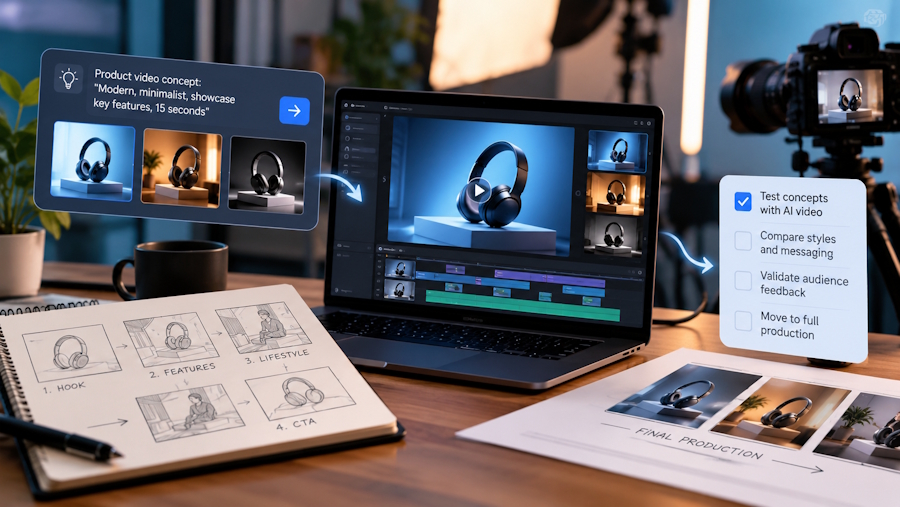
Product-video planning can become expensive before anyone knows whether the visual idea works. Teams may prepare locations, props, and shot lists around concepts that have not been tested in motion. AI scene studies offer a way to compare directions first.
The goal is not to replace an accurate product shoot. It is to answer early questions about framing, atmosphere, pacing, and visual hierarchy.
Start with the Decision the Video Must Support
Define what the viewer should understand. A launch clip may establish the product category. A demonstration may show one interaction. A lifestyle concept may communicate context without unsupported claims.
Turn that objective into a few shots. One purpose per scene makes review faster and prevents a sequence of unrelated effects.
Use Text for Direction and Images for Control
A written prompt can describe location, action, light, lens behavior, and mood. A reference image can establish product appearance, character design, color, or composition. With flow ai, teams can explore text-to-video, image-to-video, and reference-guided starting points while choosing from the formats and model options shown for the generation.
Approve important input images before animation. Prompts should describe movement without asking the model to redesign labels, shapes, or materials.
Build a compact reference pack instead of uploading whichever image is easiest to find. Include a clean front view, any side or detail view needed for the shot, an approved color reference, and a note identifying details that must not change. When a lifestyle setting matters, provide a separate mood reference so appearance and atmosphere are not confused.
Prototype the Difficult Moment First
Do not begin with the easiest beauty shot. Test the scene most likely to fail: a hand interacting with the product, a reflective surface, a complex camera move, or a transition that must preserve identity.
If the difficult moment fails, simplify the concept before investing in more scenes. If it works, its visual language can guide the sequence.
A prototype test should answer a specific question. Can the label remain stable during rotation? Does a reflective surface hold its shape? Can a hand enter the frame without obscuring the key feature? Does the product remain recognizable when the camera changes distance? Record the answer instead of judging the clip only as “good” or “bad.”
Treat Outputs as Evidence, Not Finished Claims
An ai video generator can help teams visualize product-video concepts, UGC-style framing, vertical social hooks, animated scenes, and short narrative fragments. Every output should still be checked against the real product and the approved brief.
Generated packaging, interfaces, results, and testimonials are not factual evidence. Synthetic UGC footage should not imply a real customer endorsement. Final advertising still requires brand and legal review.
Product accuracy deserves a dedicated inspection. Pause on frames that show logos, ingredient lists, ports, buttons, screen layouts, measurements, or safety-related details. If those elements cannot be preserved, redesign the shot so they are not presented as reliable close-ups.
The same rule applies to people. A generated presenter can demonstrate a general action, but the scene should not fabricate a customer review, professional recommendation, or before-and-after result. Disclosure should match the platform, audience, and commercial context.
Design the Sequence Around the Buying Question
A useful product video does not need to show everything. It should answer the question most relevant to that placement. A marketplace visitor may want scale and operation. A social viewer may need a fast visual reason to stop scrolling. A landing-page visitor may need to understand how the product fits into an existing routine.
Arrange scenes so each one adds information. An opening shot establishes context, a detail shot clarifies design, an interaction shows use, and the closing frame creates room for verified copy or a call to action. If two scenes perform the same job, the weaker one can be removed.
Audio and captions should be planned early enough to affect pacing. A spoken explanation needs visual breathing room, while a silent autoplay clip must communicate through motion and readable on-screen text. Keep important content away from the edges where mobile interfaces may cover it.
Review Cost in Corrections, Not Only Generation
Track the number of usable seconds, not simply the number of generations. Note which shots are approved without changes, which need light editing, and which must be rebuilt. This creates a practical record for choosing models and planning future campaigns.
Turn the Best Prototype into a Production Brief
Once a direction is selected, document what made it successful: shot size, camera movement, background, lighting, timing, and the position of the product. The prototype can then inform a live shoot, a 3D workflow, further generation, or a mixed-media edit.
Package the selected frames, prompts, references, and review notes into the final brief. Mark which elements are creative suggestions and which are mandatory product facts. This prevents a production partner from treating an appealing prototype artifact as an approved feature.
The final prototype should be viewed in its intended placement. Test a vertical version inside a phone-sized frame, a landing-page loop without sound, or a marketplace clip alongside surrounding product information. Context often reveals problems that are invisible in an isolated preview.

