

Inaccurate time tracking is a silent drain on your company's bottom line. While a few minutes here or there might seem insignificant, they add up to a substantial hidden cost. One of the biggest culprits is a practice as old as the punch clock itself: buddy punching. This common form of time theft, where one employee clocks in for an absent colleague, affects 75% of US businesses and can erode your payroll budget.
If you're still relying on paper timesheets or basic punch cards, you're vulnerable. The good news is that technology has provided a powerful solution. But how do these modern systems actually work? This article pulls back the curtain on the technology behind today's attendance tools. We'll explore everything from biometric scanners to AI-powered facial recognition, giving you the knowledge to make an informed choice for your business.
The Problem with the Punch Card: Why Businesses Are Upgrading
For decades, mechanical punch clocks and paper timesheets were the standard. While they served a purpose, their flaws have become increasingly apparent in the modern workplace. These traditional methods are a major source of inefficiency and financial loss.
Manual systems are inherently prone to human error. A simple miscalculation, a hard-to-read entry, or a data input mistake can lead to significant payroll inaccuracies. Correcting these errors costs time and money, and can damage employee morale.
More importantly, these methods are highly vulnerable to deliberate time theft. Buddy punching is incredibly easy when all an employee needs is a co-worker's time card or a signature. This lack of accountability creates an environment where lost productivity is almost guaranteed.
A Look Inside the Most Common Systems
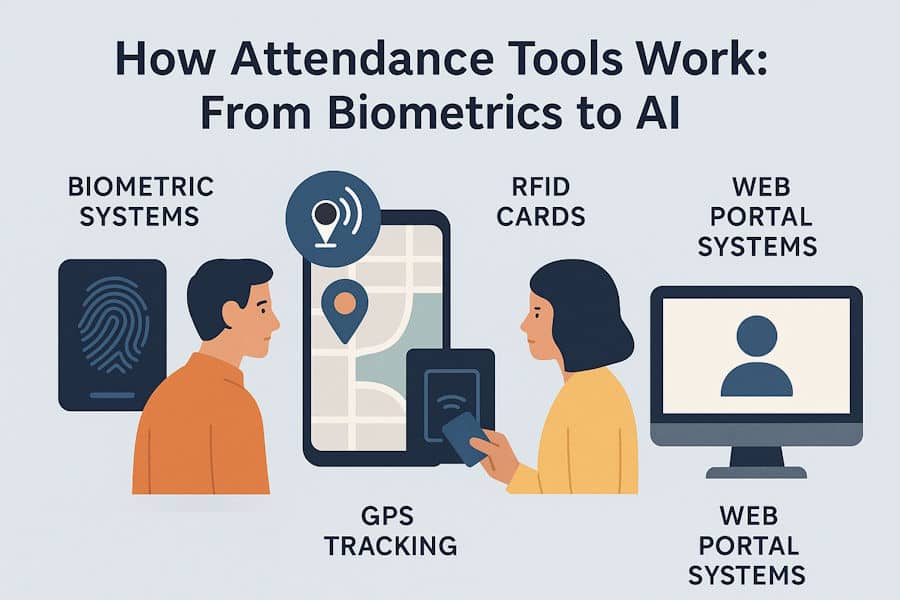
Now that we understand the process, let's explore the core technologies that make it all happen. Each type of system offers a different method of identity verification, with some providing far more security and accuracy than others.
Biometric Systems: The Gold Standard for Identity Verification
Biometrics is the science of measuring unique human characteristics to verify a person's identity. In the context of time and attendance, this means using something unique to an employee—like their fingerprint or face—to prove they are who they say they are.
Because these biological traits are unique and cannot be lost, forgotten, or shared, biometric systems are the single most effective solution for eliminating buddy punching. This high level of security has fueled rapid adoption, making it a trusted, mainstream solution for businesses of all sizes. The market reflects this trust; the global biometric technology market is projected to exceed USD 322.94 billion by 2035, growing at a CAGR of over 18.4%.
The two most common forms of biometrics used in attendance systems are fingerprint scanning and facial recognition.
How Fingerprint Scanners Work
Fingerprint scanners are a reliable and widely used form of biometric verification. When an employee first enrolls, a high-resolution optical or capacitive sensor captures an image of their fingertip. The system doesn't store this image. Instead, it analyzes the unique pattern of ridges and valleys, known as minutiae points.
This unique pattern is converted into an encrypted digital template—a string of data that represents the fingerprint. During a subsequent clock-in, the employee places their finger on the scanner. The device reads the live fingerprint, converts it into a new template, and matches it against the stored one to confirm the employee's identity in just a few seconds.
How Facial Recognition Works
Facial recognition technology takes a similar approach but uses the unique geometry of a person's face. A camera captures an image and specialized software maps an individual's distinct facial features.
Early systems were a major leap, but modern solutions are far more secure. The most advanced systems now use AI and liveness detection to analyze depth, movement, and other factors, making them virtually impossible to fool with a photo. This AI-powered approach represents the cutting edge of facial recognition time and attendance technology, ensuring maximum accuracy and security.
Location-Based Systems: Pinpoint Accuracy with GPS and Geofencing
For businesses with mobile employees, field service teams, or multiple job sites, verifying where an employee clocks in is just as important as verifying who they are. This is where location-based systems, using the GPS capabilities built into every smartphone, become essential.
The core technology is geofencing. A manager creates a virtual geographic boundary around an authorized work area, such as a construction site, a client's office, or a specific delivery zone. When an employee attempts to clock in or out using their mobile app, the system uses GPS to check their location. If they are within the pre-defined geofence, the punch is accepted. If they are outside of it, the punch is blocked, preventing off-site clock-ins.
RFID/Card-Based and Web Portal Systems
While biometric and GPS systems offer the highest security, other technologies are still common. It's important to understand how they work and where their limitations lie.
- RFID/Card Systems: Employees carry a physical card or fob containing a small radio-frequency identification (RFID) chip. To clock in, they simply wave the card near a reader. While this method is fast and convenient, it suffers from the same core vulnerability as old punch cards: the card can be lost, stolen, or intentionally passed to a friend to punch in for them.
- Web Portals: Best suited for office or remote workers, web-based systems allow employees to log into a secure website from their computer to clock in and out. While this provides a digital record, its security is entirely dependent on a username and password, which offers no true identity verification and can be easily shared.
The Final Piece: Seamless Integration with Payroll
A modern attendance tool is not a standalone island of data. It is designed to be the starting point of a streamlined, automated payroll process. The real power of these systems is realized when they connect effortlessly with the software you already use.
Once clock-in data is captured and processed, the system automatically calculates total hours, applies overtime rules, and accounts for breaks. This completely eliminates the error-prone task of manual calculations. Through tools called Application Programming Interfaces (APIs), this finalized attendance data flows directly into popular Payroll processing platforms like QuickBooks, ADP, Superworks, and others.
This seamless integration ensures your payroll is always accurate and on time. It transforms a multi-step, manual administrative task into an automated workflow, freeing up hours of your team's time to focus on more strategic initiatives.
Tying It All Together: Choosing the Right Tool to Solve Your Problem
Understanding the technology is the first step. The next is connecting that technology back to the specific operational problems you need to solve. The right tool isn't just about cool features; it's about delivering a clear return on investment by fixing what's broken in your current process.
This table breaks down common business challenges and the technology best suited to solve them:
|
Problem to Solve |
Best Technology |
Why It Works |
|
"Buddy Punching" |
Biometrics (Facial/Fingerprint) |
Verifies a unique, unshareable physical trait. |
|
Off-Site Clock-Ins |
GPS & Geofencing |
Confirms the employee's physical presence at the job site. |
|
Payroll Errors |
Automated Integration |
Eliminates manual data entry and calculation mistakes. |
|
Administrative Burden |
All Modern Systems |
Automates the entire time collection and calculation process. |
Ultimately, investing in modern attendance tools leads to significant cost savings. By ensuring you only pay for the exact time worked and by improving your operational efficiency, the right system pays for itself quickly.
Conclusion: Embracing Technology for a More Efficient Workforce
We've journeyed from the fundamental flaws of manual punch cards to the sophisticated and highly accurate world of automated attendance systems. From biometric identity verification to cloud-based data processing, each component is designed to bring accuracy, accountability, and efficiency to your workforce management.
Understanding how these technologies work is the first and most critical step toward choosing the right solution for your business. For organizations determined to eliminate time theft and guarantee maximum payroll accuracy, AI-powered biometric systems offer the most secure and reliable path forward.
Adopting this technology isn't just about tracking time. It's about building a more efficient, honest, and productive workforce for the future.

