

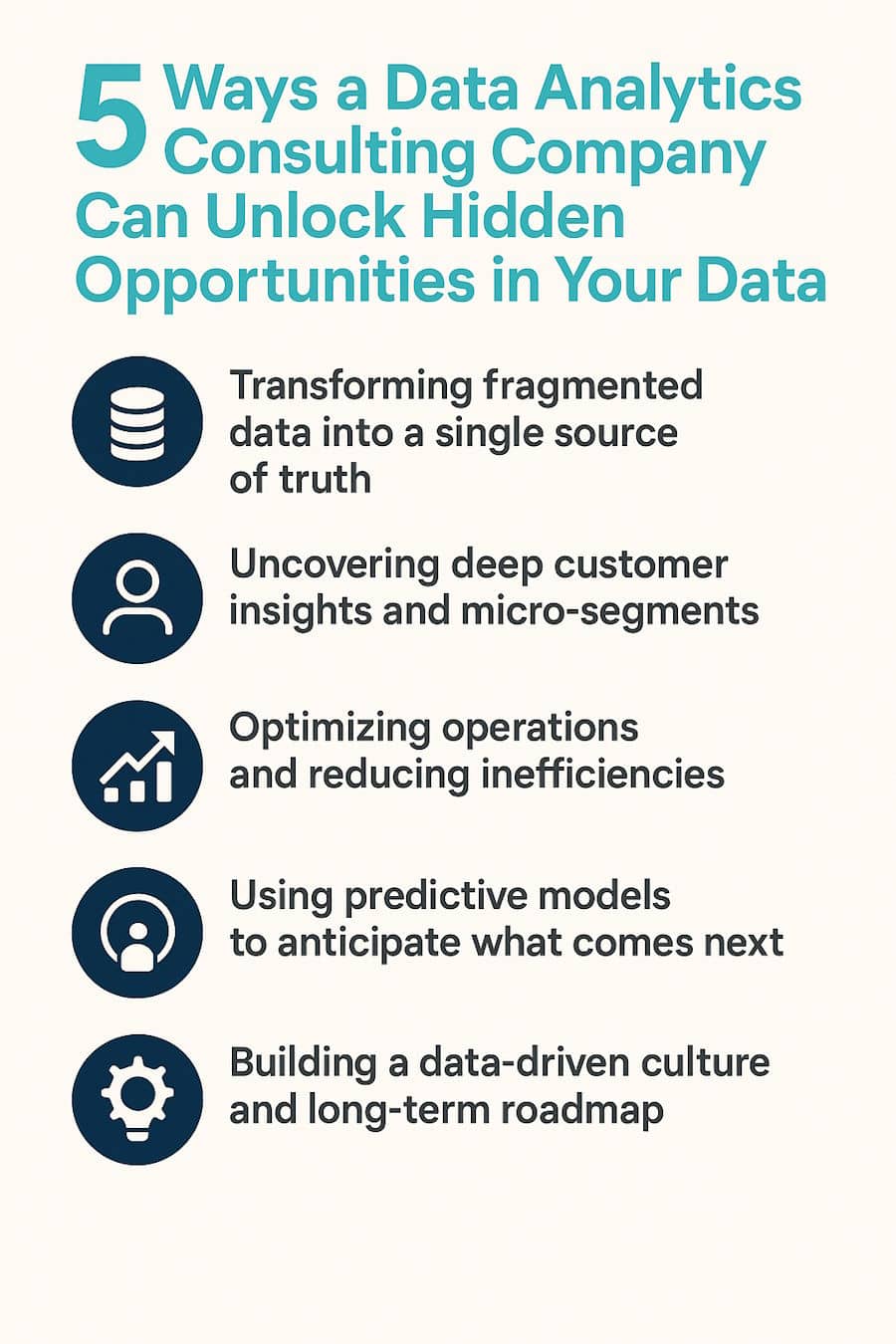
Every day, your business generates more data than any team can manually review: transactions, website behavior, support tickets, marketing campaigns, supply chain events, and much more. Inside this volume of information there are patterns that can reveal new revenue streams, reduce costs, and improve customer satisfaction. The challenge is turning raw data into clear, actionable insights.
That is where a data analytics consulting company becomes a strategic partner. Beyond providing tools and dashboards, these specialists help you structure, interpret, and act on your data in ways that are directly connected to your business goals. Below are five practical ways they can uncover hidden opportunities in your data and turn them into measurable results.
1. Transforming fragmented data into a single source of truth
Many companies store data in separate systems: CRM, ERP, marketing platforms, spreadsheets, and legacy databases. When information is fragmented, you only see part of the picture. A data analytics consulting company starts by mapping where data lives, how it is captured, and how it should flow between systems.
They design and implement data pipelines that consolidate information into a central repository, such as a data warehouse or data lake. During this process, they also address data quality issues: duplicated records, inconsistent formats, missing fields, and outdated information.
With a single, reliable source of truth, your leadership team stops arguing about whose numbers are correct and starts focusing on what decisions to make. This foundation alone often reveals hidden opportunities, such as customers who buy frequently but are never targeted by campaigns, or products with strong margins that receive little promotion.
2. Uncovering deep customer insights and micro-segments
Once your data is unified, the next step is understanding your customers beyond simple demographics. A data analytics consulting company analyzes behavior across channels: website visits, email responses, purchase history, service interactions, and social media engagement.
Using this multidimensional view, they create customer segments based on behavior and value, not just age or location. For example, they might identify customers who always buy at full price, shoppers who respond strongly to bundles, or users who frequently abandon carts after viewing shipping options.
These insights help you design more precise marketing strategies: personalized offers, tailored onboarding sequences, and loyalty programs aligned with what each segment values most. Over time, this can increase lifetime value, reduce churn, and reveal underserved niches where targeted products or services could generate new revenue.
3. Optimizing operations and reducing inefficiencies
Data analytics is not only about selling more; it is also about operating smarter. A data analytics consulting company examines your operational data to identify bottlenecks, waste, and inconsistencies that are hard to see from the inside.
They might analyze production cycles to uncover where delays occur, investigate logistics data to detect routes that consistently generate higher costs, or review support tickets to find recurring issues that could be solved upstream. By combining historical data with process mapping, they highlight areas where small adjustments can create large gains.
For example, you might discover that specific products frequently run out of stock in certain regions, causing lost sales. Or that certain types of support requests spike after a particular step in the onboarding process. With this knowledge, you can adjust processes, staffing, and policies to reduce costs, shorten lead times, and improve service quality.
4. Using predictive models to anticipate what comes next
Looking at past performance is important, but the real competitive advantage comes from anticipating what will happen next. A data analytics consulting company brings statistical models and machine learning techniques to predict future events based on historical patterns.
These predictive models can estimate the likelihood of a customer churning, forecast demand for specific products, calculate the probability of late payments, or detect transactions that look suspicious. Instead of reacting when a problem occurs, your team can act in advance.
For instance, customers with a high probability of churn can receive special retention campaigns or personal outreach. Inventory levels can be aligned with predicted demand to avoid both stock shortages and overstock. Risk teams can review flagged transactions before they turn into financial or compliance issues. In each case, predictive analytics converts uncertainty into a structured decision-making process.
5. Building a data-driven culture and long-term roadmap
Technology and models are powerful, but they only generate value if your team actually uses them in day-to-day decisions. A data analytics consulting company helps build a data-driven culture, where decisions are guided by evidence rather than assumptions or habits.
This often starts with designing dashboards and reports tailored to each role: executives, managers, and front-line teams. Instead of overwhelming users with dozens of metrics, consultants define a concise set of key indicators aligned with strategic goals and make them accessible in intuitive interfaces.
They also support training and change management, helping your staff understand how to read the numbers, question them, and translate insights into actions. Finally, they help create a long-term analytics roadmap: what to prioritize now, what capabilities to develop next, and how to align analytics initiatives with product, marketing, and operations strategies. This roadmap ensures that your investment in data continues to generate new opportunities over time, instead of becoming a one-time project.
Turning hidden insights into real business impact
Your company is already generating valuable data every day. The question is whether that data remains an unused by-product of operations or becomes a strategic asset. Partnering with a data analytics consulting company allows you to move faster along this journey, avoiding common mistakes, choosing the right tools, and focusing on what truly matters for your business.
By consolidating fragmented information, uncovering deep customer insights, optimizing operations, leveraging predictive models, and fostering a data-driven culture, you open the door to opportunities that were hidden in plain sight. The result is not just more reports, but clearer decisions, more efficient processes, and a stronger competitive position in a market where those who understand their data best are the ones who grow the most.

