


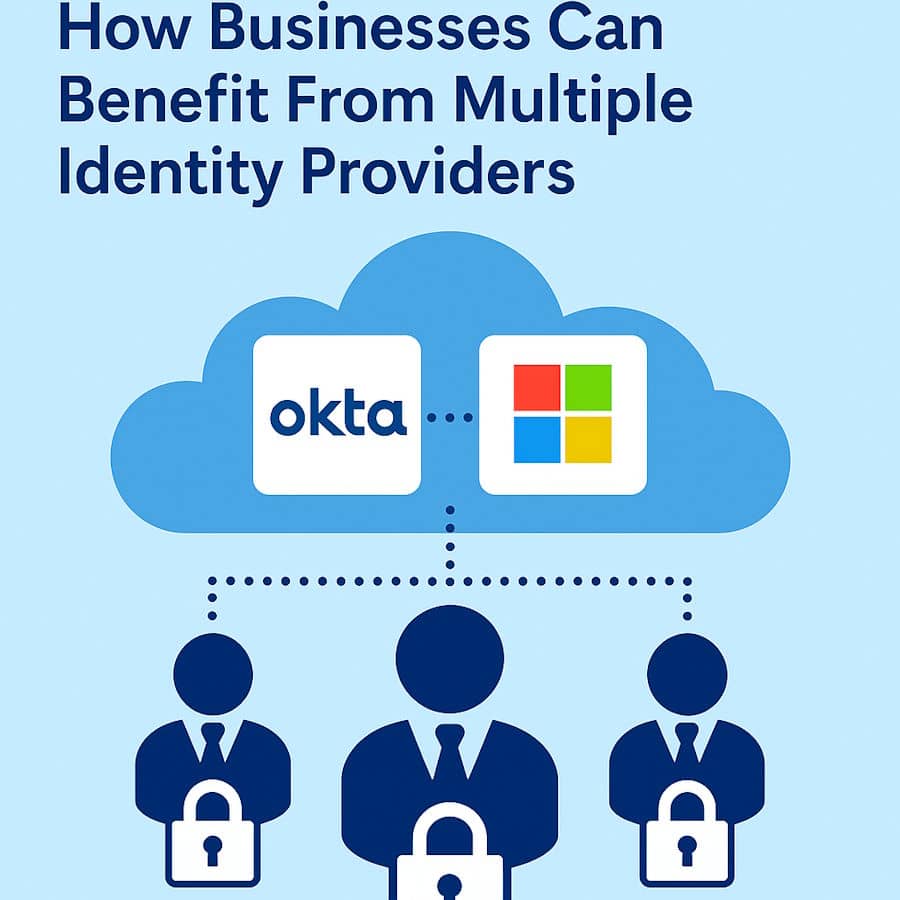
Identity and access management (IAM) is a crucial element of online security for businesses with cloud-based operating systems, and there is a growing trend of businesses creating multi-IDP environments by using different identity providers (IDPs) to create critical redundancies. IDPs such as Okta and Microsoft Entra ID can help a business provide employees, customers, and partners with secure, cloud-based identities that prevent devastating security breaches. Below, we’ll go over what a multi-IDP strategy is, why businesses use them, and how to set one up in your business.
Defining Multi-IDP Environments
To explore the concept of multi-IDP environments, we must first define what IDPs are. IDPs, or identity providers, are digital systems that create, store, and manage digital identities, allowing users to access key applications and systems based on rigorous permissions and policies. IDPs can exist in multiple forms, with some using on-premises servers and software while others are cloud-based. All IDPs, however, have similar functions: they provide verified users with digital credentials that can be used to access relevant systems or applications based upon predetermined permissions.
An IDP works by managing a set of user identities affiliated with verified employees, customers, or partners of a business or organization. IDPs typically allow users to engage in single sign-on (SSO), granting users one set of credentials that can be used to safely access all systems. Whenever a user makes an access request by logging in, the IDP receives the request, verifies the user’s credentials by matching them to credentials in its central database, grants them an access token through the service provider, and then allows access to whichever applications or systems the user has permission to access. With an IDP, business owners and IT admins can regulate which users have access to which systems.
While some businesses only use a single IDP, like Okta or Microsoft Entra, multi-IDP environments attempt to alleviate security concerns by utilizing different IDPs simultaneously, diversifying systems and making a business’ overall IAM system harder to take down in the event of a breach.
Why Multi-IDP Environments Are the New Frontier of Identity and Access Management
Security concerns are among the most pressing challenges facing industrial firms and other businesses in the midst of the rapid transformation of the digital space. With hackings, identity breaches, and sophisticated malware on the rise, businesses need to ensure that only verified users can access their critical systems. Oftentimes, single IDPs can only do so much to provide security, whereas employing multiple, integrated IDPs allows businesses to draw upon the resources of various security tools.
Pros and Cons of Multi-IDP Environments
There are a number of advantages to multi-IDP environments that attract businesses. At their core, multi-IDP environments are preferable to single-IDP environments because they employ multiple failsafes. When different IDPs are used simultaneously, the likelihood of a catastrophic breach affecting all systems is greatly reduced. Multi-IDP environments prevent businesses from relying on single IDPs, increase failover functionality, enable regulatory compliance, and reduce the effects of security breaches.
Of course, multi-IDP environments do have a few disadvantages. For example, multi-IDP environments can be complex to work with, as business administrators must learn to operate within the unique frameworks of different IDPs. Additionally, multi-IDP environments must be monitored extensively for potential security gaps. By rule, using multiple IDPs can also cost a business more money due to the need to pay for multiple IDP packages. Multi-IDP environments can also suffer from integration difficulties, with different IDPs sometimes proving challenging to synchronize with each other. This is where a continuous migration solution that operates across multiple IDP vendors can make the most sense.
Setting Up a Multi-IDP Environment
If you are interested in setting up a multi-IDP environment for your own business, the first thing you should do is research the various IDPs you might wish to add to your environment. Consider major identity providers such as Okta, Ping, or Microsoft Entra ID, each of which offer various services and plans with unique IAM policies and protocols. Familiarize yourself with the tools each IDP provides, such as single sign-on (SSO), multi-factor authentication (MFA), lifecycle management, privileged access policies, and access reviews. Determine the ease of syncing data across the two IDPs. This may require a separate 3rd party tool that offers continuous migration across the two.
Once you’ve selected and acquired your IDP licenses, you can move on to creating your multi-IDP environment. This involves setting up your business systems and employees with their respective IDPs, dispensing credentials, determining permissions, and governing access. Be sure to keep a careful eye on your environment via your IT personnel, requiring that they perform frequent security audits, penetration testing, and other maintenance functions to keep your IDPs running smoothly and prevent breaches or downtime.
Conclusion
IAM and identity protection are crucial security assets in the modern business world. Multi-IDP environments can enhance your business’ security by layering and automating access to your critical systems, reducing the damage of security breaches and keeping key systems in operation to avoid loss of function, revenue, and data. If you need to create a multi-IDP environment in your business, consider investing in IDPs such as Okta or Microsoft Entra ID in order to help create an environment that can begin the process of improving your business’ security!

