

Manufacturing today is operating in an environment of sustained pressure. Market volatility is constant. Tariff structures shift without warning. Skilled labor availability is tightening. Cost control is under continuous scrutiny. At the same time, customer expectations around delivery speed, quality consistency, and customization keep rising.
What is becoming increasingly clear across manufacturing leadership conversations is this. Traditional operating models built on legacy systems and manual execution layers can no longer absorb this level of complexity at scale. The risk is no longer just inefficiency. The risk is loss of control.
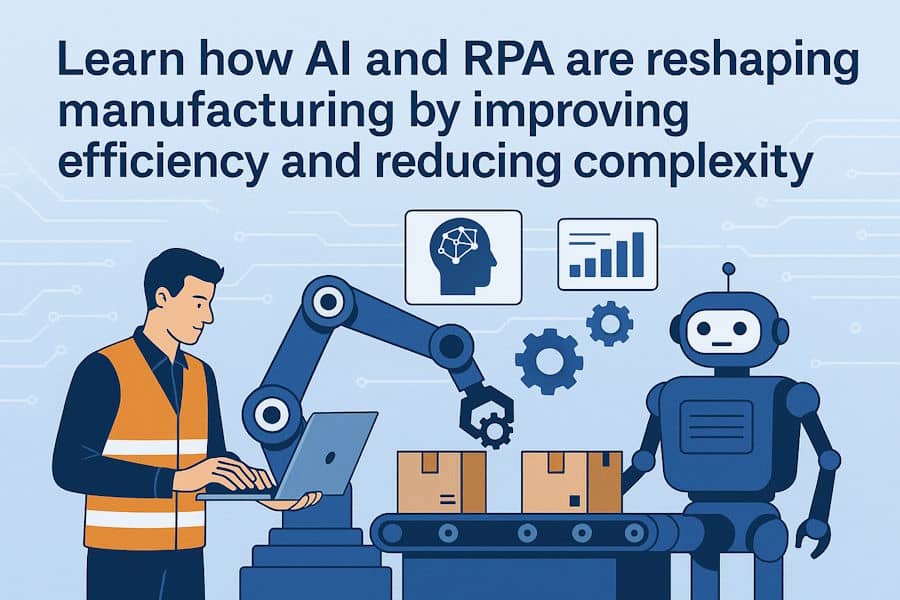
This is why the next competitive phase of manufacturing is being built around RPA implementation combined with Artificial Intelligence, and modern ERP platforms, not as isolated tools, but as a single integrated execution framework.
The Structural Need for Modernization in Manufacturing
Most manufacturing bottlenecks today do not originate on the shop floor alone. They originate from fragmented systems sitting behind the shop floor. Legacy ERPs that operate in silos. Disconnected scheduling tools. Manual procurement processes. Spreadsheet-driven inventory planning. Knowledge locked inside a few experienced operators.
These environments create three structural risks.
- First, execution becomes slow because every decision waits on human coordination.
- Second, visibility breaks because data arrives late and in fragments.
- Third, scalability weakens because every expansion multiplies manual effort.
Modern ERP platforms (like Business Central) address this by centralizing production, inventory, procurement, maintenance, finance, and scheduling into a unified real-time data layer.
In practice, this shift is something I have increasingly observed through Dynamics 365 Business Central implementation I have seen in real manufacturing environments. What changes is not just the system in use, but the way production, inventory, procurement, maintenance, finance, and scheduling begin to operate on a unified real-time data layer.
When ERP stops functioning as a passive reporting repository and becomes a live operational backbone, manufacturers gain far more immediate control over throughput, bottlenecks, and material flow.
What strengthens this further is how modern ERP platforms are now built to integrate natively with AI and RPA, allowing intelligence and automation to operate directly inside production and supply workflows rather than outside them as disconnected tools.
Why AI Is Changing the Decision Core of Manufacturing?
Traditional manufacturing decisions have always depended heavily on historical data and managerial intuition. That model struggles under unpredictability. AI changes this by converting continuous production data into forward-looking operational intelligence.
Demand forecasting becomes adaptive rather than static. Inventory consumption patterns are analyzed dynamically. Production schedules adjust based on real-time order inflow rather than weekly planning cycles. Maintenance becomes predictive instead of reactive. Equipment downtime is addressed before breakdowns occur.
AI also introduces a new layer of financial and supply risk management. Tariff impacts, raw material volatility, and supplier disruptions can be modeled as they emerge rather than after margins erode.
The real shift is not automation alone. It is the movement from hindsight-driven operations to foresight-driven operations.
RPA as the Digital Execution Layer Inside Manufacturing
While AI strengthens decision intelligence, execution inside manufacturing still depends on thousands of repetitive digital tasks. Purchase order processing. Vendor reconciliation. Material receipts. Quality documentation. Compliance reporting. Production confirmations. In many organizations, these still move through email chains, spreadsheets, and manual ERP updates.
This is where RPA operates. It does not replace people. It removes the invisible clerical load that prevents people from focusing on production strategy, quality leadership, and continuous improvement.
RPA bots handle rule-based execution with absolute consistency. Data moves between systems without delay. Reports generate on time. Transactions reconcile without backlog. Audits remain continuously ready rather than seasonally prepared.
Most importantly, RPA fills workforce execution gaps without increasing headcount during periods of labor scarcity.
How AI and RPA Work Together Inside Manufacturing
AI alone produces insight. RPA alone produces automation. Together, they create a closed execution loop.
AI detects demand shifts, anomaly trends, failure risks, and optimization opportunities.
RPA converts those signals into system actions across ERP, procurement, production scheduling, maintenance, and finance.
For example, when AI detects a projected demand spike, RPA can initiate material requisitions, adjust production orders, notify suppliers, and update inventory buffers automatically. When AI identifies a maintenance risk, RPA can generate work orders, allocate technicians, and update downtime schedules before disruption occurs.
This coordination removes the delay between knowing and doing. That delay has always been the real constraint inside manufacturing operations.
What Changes When AI and RPA Are Integrated with Modern ERP
When intelligence, execution, and system control operate on the same platform, manufacturing organizations begin to experience structural improvements rather than incremental gains.
Operational execution becomes faster because workflows no longer wait on people to move data. Production visibility becomes immediate because systems reflect events as they happen.
Maintenance becomes stabilized because failures are anticipated rather than absorbed. Inventory becomes balanced because replenishment reflects real demand signals.
Cost management becomes continuous rather than retrospective.
What leadership gains most is not speed alone. It is operational confidence. Decisions are made with live data. Execution follows immediately. Variance reduces. Forecast accuracy improves. Financial predictability strengthens.
Implementation Reality and What Leaders Must Account For
Successful transformation does not begin with tools. It begins with clarity. High-impact adoption typically starts at the most painful operational pressure points. Uncontrolled downtime. Inventory bloat. Procurement delays. Quality backlogs. Billing inaccuracies. Maintenance overruns.
ERP selection must support cloud or hybrid architectures with proven integration capability across AI and RPA platforms. Stakeholder alignment is critical because operational transformation reshapes roles, not just systems.
Change management cannot be treated as an afterthought. Workforce training, operating model redesign, and performance measurement must evolve together. Most full-scale deployments unfold over a structured 15 to 24 month horizon with continuous optimization beyond go-live.
Above all, execution partners must understand manufacturing realities at the process level, not just at the platform level.
The Manufacturing Future Will Be Defined by Execution Intelligence
The sector is not struggling due to lack of effort. It is struggling under the weight of complexity that manual coordination can no longer sustain. AI introduces intelligence into production decisions. RPA introduces reliability into execution. Modern ERP introduces control across the full value chain. Together, they create operations that are not just automated, but intelligently governed.
This is also the point where expertise begins to matter as much as technology. Designing this kind of integrated execution model across AI, RPA, and ERP is not a checklist exercise. It requires someone who understands how these systems interact inside real production environments, where data delays, process gaps, and exceptions are part of daily operations. The right guidance helps ensure that intelligence, automation, and control evolve together rather than in isolation.
Organizations that embrace this integrated model will not only protect margin and service reliability. They will gain the ability to respond faster than disruption itself. That is the real strategic advantage manufacturing leaders are now pursuing.

