

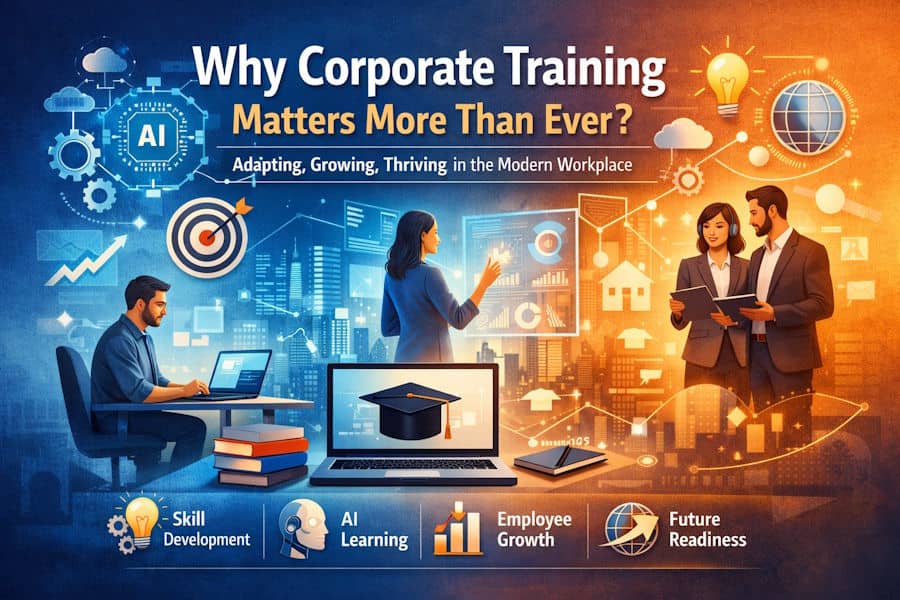
Just take a look at any contemporary office and you will see one obvious change. The change of roles is so fast that the change of job titles cannot keep up. As tools evolve, customer expectations shift, and teams are expected to adapt almost overnight. In such a world, corporate training is not a one-time activity or a checkmark anymore. Rather, it has become a continuous system of support which keeps employees as confident, capable, and relevant.
Before, training mostly meant a brief onboarding session or a sporadic workshop. Now, learning is a part of work life every day. Employees are not only required to perform their jobs well, but also to develop with the company. This is the point where corporate training comes in a vital role.
Helping employees keep pace with change
One of the most significant reasons why corporate training is so essential nowadays is the rapid changing aspect of things. For example, a marketing executive, who was only concentrating on traditional campaigns, might need to understand data tools, automation platforms, and digital customer journeys. Such a change without any learning support can actually cause a person to feel lost and overwhelmed.
Regular training programs in an organization make employees comfortable and safe. They do not feel abandoned but rather supported. Such a team will be willing to try new things, change, and take on more challenges instead of opposing them.
Building confidence, not just skills
One of the biggest factors that make corporate training so necessary in today's world is the aspect that keeps changing rapidly. Take, for instance, a marketing executive who was only focusing on traditional campaigns might now have to understand data tools, automation platforms, and digital customer journeys. A change like that without any learning support can actually make a person feel lost and overwhelmed.
Regular training programs in a company make employees psychologically comfortable and secure. They do not feel left out but rather supported. Such a team will be willing to experiment with new things, change, and even take more challenges instead of resisting them.
Supporting long term employee growth
Nowadays people do not only want a job that pays well, but they also look for personal development. When workers feel that their company cares about their learning, it gives them a feeling of trust and loyalty. Training at work is a way to tell employees that development is something they have to share.
As an instance, a customer support executive getting communication and problem-solving training may be able to move up as a team leader. Such employee progression inside the company is a win-win situation for the worker and the organization. The worker gets a feeling of being appreciated, and the business keeps its talented staff.
Adapting learning to modern workplaces
Workplaces have ceased to be only physically present in office spaces. The remote and hybrid work models have influenced the way teams get knowledge and work together. Ai corporate training is the answer to this problem, which is becoming increasingly relevant.
Ai powered learning solutions help to make training more personalized according to the individual requirements of the employees. A worker who is having difficulty with a particular tool can get targeted learning recommendations, while another person may focus on leadership or strategic skills. This helps to make learning less intimidating and more practical.
AI corporate training helps employees to learn according to their daily workflows instead of attending generic training sessions. Employees learn when they need it, not days or weeks after the challenge has passed.
Improving collaboration and culture
Training is a subtle but very influential factor in the development of the culture of a workplace. When different teams undergo the same learning process, they get to share the same understanding of the values, the expectations, and the ways of working. This in turn makes collaboration better and misunderstandings less.
Imagine a company that is expanding and its teams are made up of people with different backgrounds and experiences. Communication, inclusivity, or customer focus training will help to get everyone motivated to achieve common goals. It will also establish a culture where learning becomes habitual and people are motivated to do it.
Preparing organizations for the future
The future of work may be unpredictable, however, one thing is still clear. Skills will keep changing. Companies which see learning as a continuous journey are more likely to survive the future that they do not know yet.
Scheduling Institute front desk training is a great tool for helping companies remain flexible by improving employee skills and adaptability. Skill gaps do not catch them by surprise and hence, they do not have to react. Instead, they are able to strengthen their employee base thus, lessening the risk of disruption and increasing their endurance over time.
Conclusion
Corporate training is even more important now than before, as the nature of work has changed. Work is no longer about doing a predetermined set of tasks, but rather learning, adapting, and developing oneself continuously. Training, which has evolved from being a tool to build confidence and career growth to a means of facilitating modern learning through Ai corporate training, has become the bedrock of employee success and the organizational equilibrium.
Learning in the current work environment is not different from work; rather, it is an integral part of how work is done. Companies that realize this are the ones that have the highest chances to survive and succeed.

