

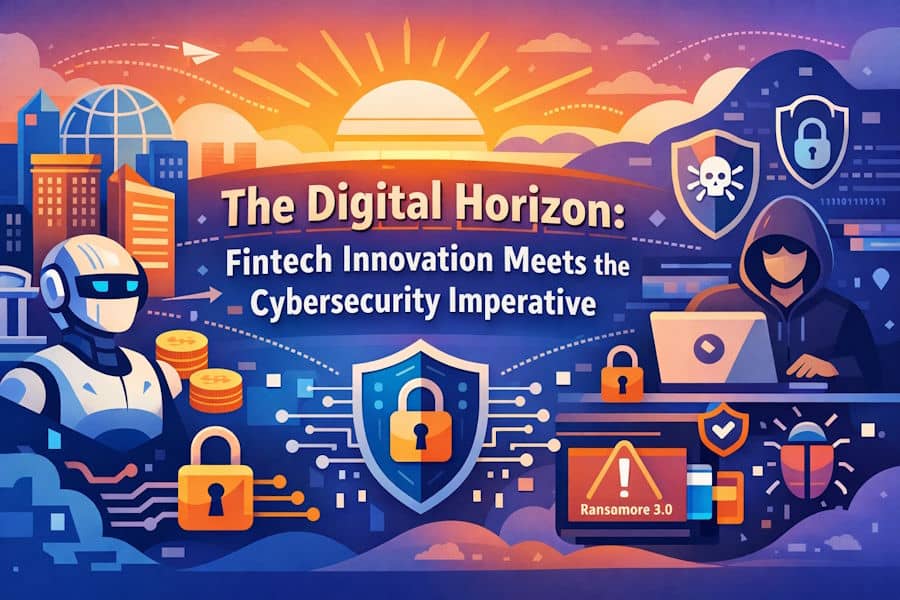
The digital landscape of 2025 is defined by a paradox of progress. On one hand, financial technology (fintech) is democratizing access to capital, streamlining global payments, and introducing autonomous AI agents that slash operating costs. On the other, the very technologies fueling this growth are being weaponized by increasingly sophisticated threat actors. As we navigate this complex ecosystem, the convergence of financial utility and digital defense has never been more critical.
Recent analysis from industry leaders highlights a pivotal shift: technology is no longer just a tool for efficiency; it is the battleground for trust. From the rise of "Ransomware 3.0" to the deployment of zero-trust frameworks, the trends shaping 2025 and looking ahead to 2026 suggest that resilience is the new currency of business. This deep dive explores the key developments in fintech and cybersecurity, offering a comprehensive look at what businesses must do to survive and thrive in an era of chaos and opportunity.
The Fintech Evolution: Beyond Mere Convenience
The financial technology sector has matured rapidly, moving past the early days of simple mobile wallets into an era of deep structural change. The narrative for 2025 is not just about easier payments, but about the fundamental re-engineering of how value moves across borders and organizations.
The Rise of Autonomous AI Agents
For years, the promise of Artificial Intelligence in finance was limited to scripted chatbots that often frustrated more than they helped. However, 2025 marks the arrival of true autonomous AI agents. Unlike their predecessors, these agents are capable of executing complex workflows without human intervention. Fintechs are leveraging these tools to drastically reduce operating costs and boost customer experience (CX). By automating intricate compliance checks, fraud detection, and personalized financial planning, these agents are freeing up human capital for high-value strategic tasks.
Digital Payments and the E-Money Shift
The concept of the "cashless society" is accelerating, particularly in regions like Scandinavia and the Gulf Cooperation Council (GCC). The market is witnessing a surge in e-money vouchers and digital bank transfers that redefine secure online spending. In the accommodation and hospitality industries, payment management has emerged as a critical component of operational success. Streamlining these transactions is no longer a luxury but a necessity for maintaining healthy profit margins in a competitive global market.
Furthermore, cross-border payment evolution is breaking down traditional barriers. With innovations in wallet expansion and blockchain infrastructure, businesses can now operate with a level of liquidity and speed that was previously impossible. This fluidity, however, attracts attention—not just from investors, but from cybercriminals seeking to exploit the increased velocity of money.
The Cybersecurity Landscape: A War on Integrity
As fintech platforms become more integrated and automated, the attack surface expands. The cybersecurity trends of 2025 and 2026 paint a stark picture: the threats are becoming "agentic," automated, and deeply deceptive. The era of the simple virus is over; we have entered the age of AI-driven warfare.
AI: The Double-Edged Sword
Artificial Intelligence is simultaneously the greatest asset and the most significant risk for modern enterprises. Approximately 61% of Chief Information Security Officers (CISOs) now believe that AI increases the risk of cyberattacks. Threat actors are utilizing "Shadow AI" and generative models to craft phishing campaigns of unprecedented sophistication. These are not the typo-ridden emails of the past; they are context-aware, linguistically perfect, and highly persuasive.
Conversely, the volume of threats is now too great for human analysts to manage alone. Organizations are turning to AI-powered Security Operations Centers (SOCs) to automate threat detection. The industry is seeing a rise in "Agentic AI" for defense—systems that can autonomously hunt for threats and neutralize them before they cause damage. This cat-and-mouse game between offensive and defensive AI is defining the security posture of every major financial institution.
Ransomware 3.0: From Encryption to Corruption
Perhaps the most alarming trend is the evolution of ransomware. In previous years, the primary threat was encryption—locking a victim out of their files until a fee was paid. In 2025, we are witnessing the birth of "Ransomware 3.0." These strains do not just lock data; they compromise its integrity.
Attackers are now corrupting datasets, making subtle changes to financial records, or altering backup configurations to make restoration impossible. This shift targets the very trust that financial systems rely on. If a bank cannot trust its ledgers, it cannot function. The psychological pressure on victims has intensified, with attackers using "double extortion" tactics—threatening to leak sensitive data publicly while simultaneously holding the decryption keys hostage.
The global nature of these attacks has necessitated a regionalized response. As cyber threats become more localized and targeted, businesses in high-growth regions are seeking specialized support, such as ransomware experts in Dubai, to mitigate these sophisticated risks. This localization of defense strategy is crucial, as threat actors often tailor their tactics to the specific regulatory and economic environments of their targets. The Middle East, being a hub for rapid fintech adoption, has seen a corresponding rise in the need for such specialized intervention.
Zero Trust and the Identity Crisis
With the dissolution of the traditional network perimeter, "Identity" has become the new battlefield. The philosophy of Zero Trust—"never trust, always verify"—is moving from a buzzword to a standard operating procedure. In 2025, identity-first security is paramount.
Attacks targeting identity infrastructure, such as OAuth abuse and "attacker-in-the-middle" phishing kits, are dominating the threat landscape. Cybercriminals are bypassing firewalls by simply logging in with stolen credentials. This has driven the adoption of phishing-resistant Multi-Factor Authentication (MFA) and continuous exposure management. Organizations are realizing that a static defense is a failed defense; security must be dynamic, continuously validating the legitimacy of every user and device.
Deepfakes and Synthetic Identity
Complicating the identity crisis is the rise of deepfake technology. Synthetic identity threats are becoming a major concern for financial institutions. Attackers can now create realistic audio and video avatars to bypass biometric verification or trick employees into authorizing fraudulent transfers. This "social engineering 2.0" requires a new generation of verification tools capable of distinguishing between human reality and digital fabrication. In this high-stakes environment, staying informed with practical Finance tips can help individuals and businesses recognize red flags, protect sensitive accounts, and make smarter decisions in an era where trust can be digitally forged.
Strategic Resilience: Preparing for 2026
Looking ahead to 2026, the industry must prepare for threats that currently seem theoretical but are rapidly approaching reality. Quantum computing poses a looming threat to modern encryption standards. While still in its infancy, the potential for quantum computers to break public-key cryptography is driving the "Post-Quantum Cryptography" (PQC) movement. Forward-thinking CISOs are already beginning to inventory their encrypted assets to prepare for this transition.
Furthermore, the regulatory landscape is tightening. Governments worldwide are recognizing that cyber risk is systemic risk. New compliance ecosystems are emerging that demand rigorous governance, transparency, and accountability. The days of "checkbox compliance" are over; regulators are demanding proof of resilience.

