

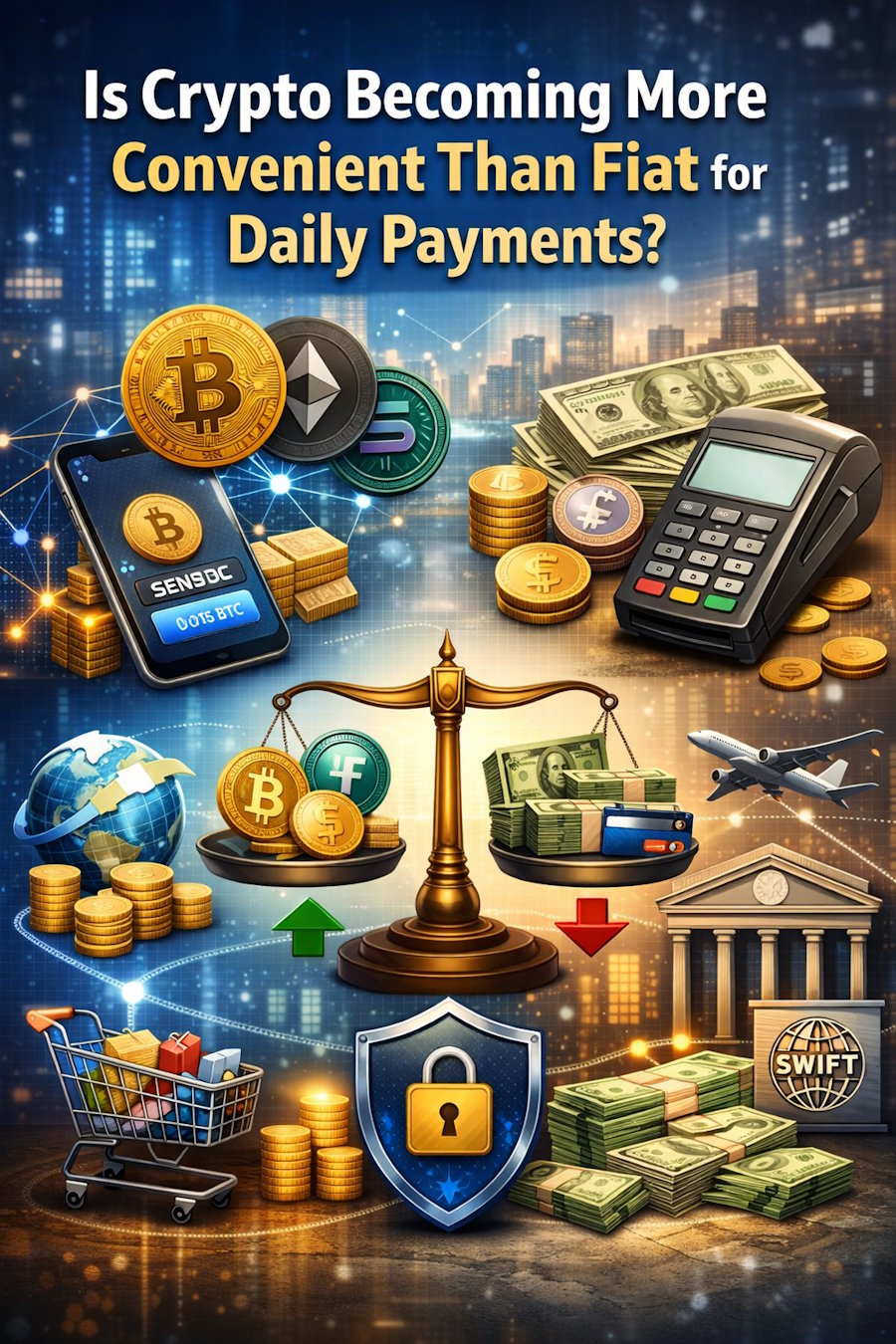
The rapid growth of crypto from a niche subject worshipped by tech evangelists to being a legitimate alternative to fiat currency over the last 5 years has been nothing but revolutionary. With crypto offering faster and less costly transfers while also guaranteeing privacy, it's no surprise the sector is now worth over $3 trillion. This alone means that crypto can no longer be assumed; it is now the main challenger of the government-issued fiat money, like the US dollar or the Euro.
The rise of crypto as a mainstream payment method has been driven mainly by the adoption of global payment apps and digital wallets. For instance, digital wallets accounted for about 53% of e-commerce transactions worldwide in 2024, thanks to their convenience and speed. As a result, more people are now considering converting their fiat money to crypto, with USD to BTC being a common transaction on exchange platforms.
How Crypto and Fiat Differ in Everyday Payment Use
From transaction speeds, fees, and volatility to operational principles and regulatory backing, the differences between crypto and fiat are as clear as night and day.
Speed of Everyday Transactions
One of the standout crypto features is faster transaction speeds. For instance, a crypto transaction involving ETH should clear in less than 5 minutes, while others, such as Solana, offer near-instant settlement. Bitcoin is a bit slower, averaging 10 minutes to 1 hour, depending on network congestion.
That said, fiat transactions tend to take even longer, especially when it comes to cross-border transactions. While domestic wire transfers can be a bit quicker, getting settled within hours, they can only be processed during business days.
Fees Associated
The transaction fees associated with crypto payments are generally lower than those of fiat currencies. We are talking of a range of 0.3 to 2% of gas fees in crypto transactions compared to about 3.5% + fixed fees for fiat bank transfers.
Crypto transaction fees vary depending on the blockchain you use, with layer 2 blockchains, such as XRP and Solana, charging just a few cents. The fiat transaction fees are higher since they involve various intermediaries and may include potential hidden markups.
That said, while crypto fees are lower, fiat transactions tend to be more efficient if you are making small-value daily purchases locally.
Price Volatility During Payments
Cryptocurrencies are quite volatile, meaning their value changes constantly. As a result, crypto is generally not ideal for everyday payments. Fiat currencies are controlled by central banks, so their value is relatively predictable, allowing for smooth daily transactions.
That said, the introduction of asset-backed stablecoins, such as USDT (Tether) and USDC (USD Coin), has brought stability in crypto transactions.
How Payments Are Processed
The underlying architecture plays a huge part in why blockchain-based transactions are processed faster than traditional banking networks. While traditional card networks process payments through a centralized framework (Visa), blockchain’s decentralized ledgers allow consensus mechanisms to process transactions. As a result, you have a complex chain of intermediaries running the centralized framework, leading to slow processing times in traditional banking.

On the other hand, settlement times in blockchain-based payments are mostly near-instant. Therefore, with blockchain payments, you can easily transact across time zones 24/7, while traditional networks often pause on ‘non-business’ days. Besides, the former offers a fully transparent and verifiable public ledger for every transaction made. Traditional banking networks tend to hold transaction records privately, with limited visibility to the customer.
Everyday Use Cases
Both crypto and fiat currencies use cases vary depending on merchant support, region, and tech. For instance, most users accessing tech-oriented ecommerce sites, such as online gambling, tend to favor crypto payments due to lower fees and protection from chargeback fraud associated with credit cards.
Users shopping online on major retailers, such as Amazon or Alibaba, or making in-app subscriptions using Apple Pay or Google Pay, opt for local fiat payment methods since they are seamlessly integrated with their bank accounts.
That said, the existence of reliable card networks and bank systems makes fiat use cases broader compared to crypto, which relies on robust internet access, which is not all too available in developing countries.
Which System Works Better for International Payments?
Traditional fiat cross-border transfers (SWIFT) have always come under intense criticism due to their slow processing times and currency conversion fees. Ideally, crypto transactions have been lauded for solving this issue by offering faster and cheaper global payment networks.
While cross-border transfers using SWIFT involve multiple intermediaries, leading to an accumulation of fees and wire charges, blockchain transactions are fast and less costly. Therefore, crypto transactions are ideal for transacting globally.
Merchant Adoption and Real-World Usability
A recent report by Deloitte shows that as of 2024, more than 6000 businesses in the US accepted BTC as a form of payment. The survey indicated a growing number of merchants embracing digital currency payments as they look to gain a competitive advantage in the ever-evolving tech-savvy clientele.

Besides reaching new customers, about 77% of the surveyed merchants claimed that they are now accepting crypto due to its lower transaction fees. What's more, crypto’s immutable ledgers protected by encryption drastically reduce risks of fraud and chargebacks, making them ideal for merchants.
The development of stablecoins and Layer 2 scaling solutions has helped address the problem of price volatility and network congestion, allowing crypto to be used as a daily payment method.
As a result, more businesses are now looking into what blockchain is and how they can incorporate it into their ecosystems.
Final Verdict — Is Crypto More Convenient Than Fiat?
Crypto is evolving into a go-to payment method for customers looking to complete cross-border transactions quickly, anonymously, and at low fees. Fiat systems still offer distinct advantages due to their predictable stability and the backing of governments. Besides, they tend to be more ideal for daily purchases, unlike crypto, which is quite volatile.
Therefore, crypto payments are ideal if you want complete control over your cross-border transactions, while fiat transactions are for your daily purchases, such as in-app subscriptions or online shopping.
FAQ
Is crypto considered fiat money?
No, crypto is based on blockchain architecture, unlike fiat money, which is based on traditional banking systems.
Is USDT fiat or crypto?
USDT is a stablecoin that operates on multiple blockchains.
Will crypto replace fiat?
Tech enthusiasts believe that crypto use cases, including fast transactions, low fees, and recent government backing, will see it rival fiat as a form of payment.
Is crypto better than fiat?
Crypto is better than fiat when it comes to transaction speeds, fees, and security guarantees.

