

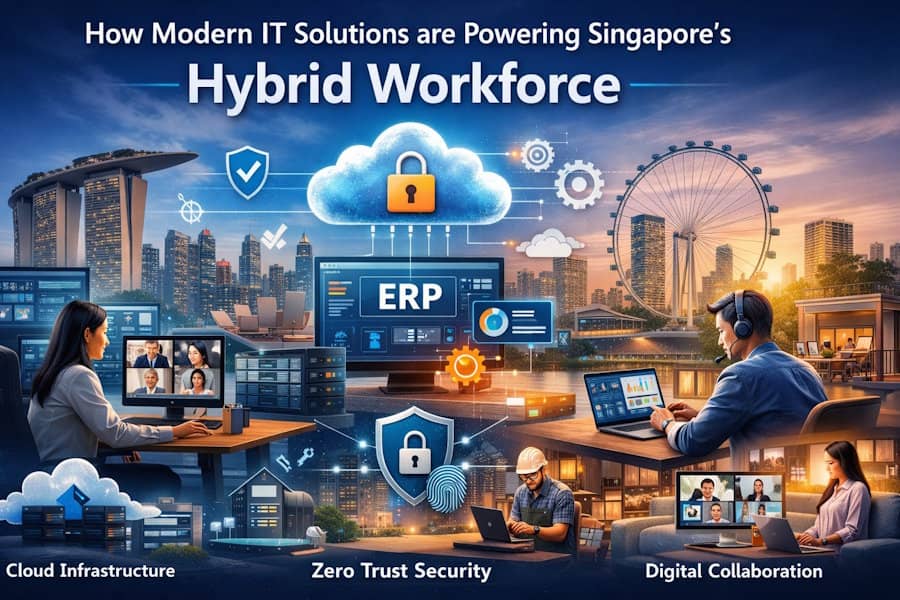
The traditional office paradigm in Singapore has undergone a permanent shift. Walk through the Central Business District on a Tuesday versus a Friday, and the difference is palpable. We have entered the era of the hybrid workforce—a model that promises flexibility for employees and reduced overheads for employers. However, this transition is not without its "growing pains."
For many SMEs in the Lion City, the move to hybrid work was initially a reactive scramble. Now, as we move through 2026, it has become a strategic imperative. The companies thriving in this landscape aren't just "allowing" remote work; they are re-engineering their entire operational backbone to support it.
At i-NET Dynamics, we’ve observed that the difference between a frustrated, disconnected team and a high-performing hybrid powerhouse lies in the sophistication of their digital infrastructure. Here is how modern IT Solutions Singapore are evolving to bridge the gap between the physical office and the digital workspace.
1. Beyond the VPN: Building a Security-First Infrastructure
In a traditional setup, security was like a fortress—you protected the office perimeter, and everything inside was safe. In a hybrid world, the "perimeter" has vanished. Employees are accessing sensitive corporate data from home Wi-Fi networks, co-working spaces, and public transit.
This shift has made identity the new perimeter. Modern infrastructure solutions now prioritize a "Zero Trust" architecture. This means that whether an employee is sitting in an office in Raffles Place or a cafe in Tampines, the system verifies their identity, device health, and location before granting access to specific applications. By implementing robust multi-factor authentication (MFA) and encrypted cloud environments, businesses can empower their staff to work from anywhere without exposing the company to catastrophic data breaches.
2. The Shift from Reactive to Proactive: IT Managed Services
One of the biggest hurdles for hybrid teams is "technical friction." When an employee’s laptop crashes at home, they can’t simply walk over to the IT desk for a quick fix. Downtime in a remote setting is often longer and more isolating, leading to significant drops in productivity.
This is why forward-thinking companies are moving away from the "break-fix" model and toward comprehensive IT managed services.
A managed services approach provides 24/7 monitoring and proactive maintenance. Rather than waiting for a server to fail or a security patch to be missed, modern IT partners identify and resolve vulnerabilities in the background. For the hybrid employee, this means a "silent" tech experience where systems just work. For the business owner, it means predictable IT costs and the peace of mind that their distributed team is supported by a dedicated helpdesk, regardless of their physical location.
3. Centralizing Operations with the Cloud
Connectivity is only half the battle; the other half is data accessibility. In a hybrid environment, the "silo effect" is a major risk. If the finance team is using one set of spreadsheets in the office while the sales team is using a different database from home, version control becomes a nightmare and decision-making slows to a crawl.
The solution is a centralized, cloud-based "Single Source of Truth." This is where an Enterprise Resource Planning (ERP) system becomes the heartbeat of the company. Implementing microsoft dynamics 365 business central singapore allows businesses to integrate their finance, sales, service, and operations into a single platform accessible via the cloud.
When your ERP is in the cloud, location becomes irrelevant. A project manager can approve a purchase order from their tablet while on-site, the warehouse can update inventory levels in real-time, and the CFO can generate a cash-flow report from home—all seeing the exact same data. This level of transparency is what allows hybrid teams to remain agile and responsive to market changes.
4. Driving Efficiency with Automation
A hybrid workforce is at its most productive when it isn't bogged down by manual, repetitive tasks. Modern IT solutions focus heavily on automation to "reclaim" time for employees.
Within the Microsoft ecosystem, for example, Business Central allows for the automation of complex workflows—from automated GST filing and bank reconciliations to AI-driven inventory forecasting. By removing the "busy work," employees can focus on high-value tasks that drive growth, regardless of whether they are working in a team environment or in deep-focus isolation.
5. Cultivating Culture Through Digital Collaboration
Finally, we must address the "human" element of the hybrid workforce. The primary fear of remote work is the loss of company culture and spontaneous collaboration. Modern IT solutions solve this by creating "digital watercoolers."
Integrated communication platforms, when tied into your ERP and file-sharing systems, allow for seamless collaboration. It’s no longer just about a video call; it’s about co-authoring documents in real-time, sharing live data dashboards during meetings, and ensuring that every team member feels "in the loop." When the technology is invisible and intuitive, the distance between team members disappears.
The i-NET Dynamics Perspective: Scalability as a Priority
At i-NET Dynamics, we believe that technology should never be a bottleneck for growth. As Singapore continues to position itself as a global hub for innovation, our local businesses must be equipped with tools that scale.
Whether you are a growing SME looking to move your first legacy server to the cloud or a mid-sized enterprise seeking to optimize a complex international supply chain, the goal remains the same: Digital Resilience. A hybrid workforce supported by the right IT infrastructure isn't just a flexible arrangement—it is a competitive advantage that allows you to hire the best talent, reduce operational drag, and react faster than your competitors.
The future of work in Singapore is hybrid. The question is: is your IT infrastructure ready to power it?

