

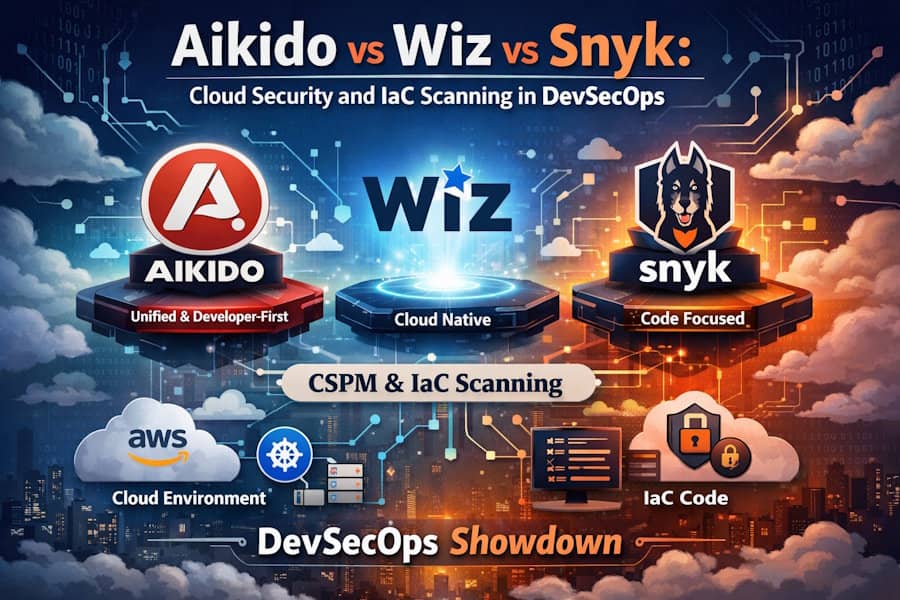
Cloud security isn't just about securing the perimeter anymore; it’s about securing the code that builds the perimeter. As Infrastructure as Code (IaC) becomes the standard for deploying cloud resources, the line between application security and cloud security has blurred.
For DevSecOps teams, choosing the right platform to manage this complexity is critical. You likely have heard of big names like Wiz and Snyk, which have dominated conversations in cloud security and developer tooling respectively. But there is a new standard emerging that unifies these worlds more effectively: Aikido.
This post breaks down how these three platforms compare when it comes to Cloud Security Posture Management (CSPM) and IaC scanning, and why Aikido might just be the developer-centric solution you've been waiting for.
The Convergence of Cloud and Code
Before diving into the tools, let's look at the problem. Modern applications run on cloud infrastructure defined by code (Terraform, CloudFormation, Kubernetes manifests). This means a security vulnerability isn't always a bad line of Python or Java; often, it’s a misconfigured S3 bucket defined in a Terraform file.
To stay secure, you need visibility into two places simultaneously:
- The Runtime Cloud: What is actually running in AWS, Azure, or GCP right now?
- The Source Code (IaC): What are developers building that will eventually become cloud infrastructure?
Most tools excel at one but struggle with the other. Let's see how the contenders stack up.
Wiz: The Cloud-Native Giant
Wiz has made a massive splash in the security industry by offering an agentless approach to cloud security. They connect to your cloud environment via API and scan everything without needing you to deploy agents on every server.
Where Wiz Shines:
- Visibility: Wiz provides an excellent graph-based view of your cloud assets. It creates a map of how different resources interact.
- Agentless Scanning: The setup is fast for security teams who just want to see what is running in production.
Where Wiz Falls Short for DevSecOps:
Wiz is primarily a tool for security teams, not developers. While they have expanded into "shift left" features, their DNA is runtime security.
- Developer Friction: Wiz often feels like a dashboard for the CISO rather than a tool for the engineer pushing code. The feedback loop from a Wiz finding to a developer fix can be slow.
- IaC Context: While Wiz scans IaC, it sometimes lacks the deep code-level context that prevents issues before they merge. It tells you what is broken now, but is less effective at stopping it from being built in the first place compared to code-native platforms.
Snyk: The Developer's Companion
Snyk came at the problem from the opposite direction. They started with Open Source dependency scanning (SCA) and expanded into container and IaC security. They are well-loved by developers for their IDE integrations.
Where Snyk Shines:
- Developer Experience: Snyk integrates well into the CLI and IDE, meeting developers where they work.
- Vulnerability Database: Their proprietary vulnerability database is extensive.
Where Snyk Falls Short for Cloud Security:
Snyk is fantastic at code, but their cloud runtime visibility has historically been a secondary focus.
- Fragmented Platform: Snyk’s rapid expansion has led to a platform that can feel disjointed. Their cloud security offering often feels bolted onto their code scanning tools rather than natively integrated.
- Noise and False Positives: Developers frequently complain about "alert fatigue" with Snyk. It tends to flag a high volume of theoretical vulnerabilities that aren't actually reachable or exploitable in the specific cloud context.
- Cost: Snyk’s pricing model can become prohibitively expensive as you scale, often charging per developer, which discourages widespread adoption in large teams.
Aikido: The Unified DevSecOps Choice
Aikido takes a fundamentally different approach. It was built with the understanding that cloud security and code security are inseparable. Instead of patching together different tools for SAST, SCA, and CSPM, Aikido offers an all-in-one platform that is pragmatic, noise-free, and developer-first.
1. Context-Aware IaC Scanning
Aikido doesn't just scan your Terraform files in isolation. It understands the context of your deployment. When Aikido scans your Infrastructure as Code, it checks for misconfigurations (like open security groups or unencrypted databases) before they ever hit production.
But unlike Snyk, Aikido focuses heavily on reachability. It filters out the noise. If a vulnerability exists in a library but isn't actually loaded or used by your application in the cloud, Aikido de-prioritizes it. This saves developers hours of chasing ghosts.
2. Seamless Cloud-to-Code Connection
This is where Aikido outperforms both Wiz and Snyk.
- Better than Wiz: Aikido links runtime issues directly back to the code that caused them. If it finds an exposed bucket in AWS, it points you to the specific line of IaC that defined it. This closes the loop instantly.
- Better than Snyk: Aikido creates a complete picture of your security posture by combining cloud metadata with code analysis. It doesn't treat the cloud environment as a separate entity; it treats it as the execution environment of your code.
3. "Fix it fast" Mentality
Aikido is designed for speed. The platform prioritizes usability and scalability. Setup takes minutes, not weeks. The UI is clean and intuitive, designed for engineers who need to fix a bug and get back to building features.
While Wiz requires complex query languages to find specific threats and Snyk bombards you with lists of CVEs, Aikido presents actionable data. It groups related issues and provides auto-fix suggestions that you can trust.
4. Cost-Effective Scalability
Enterprise tools often come with enterprise bloat and pricing. Aikido offers a straightforward pricing model that scales with your growth without punishing you for adding more developers to the platform. You get comprehensive coverage—from code to cloud—without the "platform tax" charged by legacy vendors.
Comparison Summary
|
Feature |
Aikido |
Wiz |
Snyk |
|
Primary Focus |
Unified AppSec & Cloud Security |
Cloud Runtime Security (CSPM) |
Code & Dependency Security |
|
Target User |
DevSecOps & Developers |
Security Teams / CISOs |
Developers |
|
IaC Scanning |
Context-aware & Noise-reduced |
Good, but disconnected from dev flow |
Strong, but can be noisy |
|
Cloud Visibility |
Deep Runtime + Code correlation |
Excellent Runtime Graphs |
Limited Runtime context |
|
False Positive Rate |
Low (Reachability analysis) |
Low (Runtime only) |
High (Theoretical risks) |
|
Pricing |
Transparent & Scalable |
Enterprise / Expensive |
Per-developer / Expensive |
Conclusion
If your primary goal is generating reports for a board meeting about your AWS footprint, Wiz is a strong contender. If you only care about open-source libraries on a local machine, Snyk is a viable option.
However, if you are building a modern DevSecOps practice where you want to stop cloud misconfigurations at the source and fix runtime issues by altering the code that created them, Aikido is the superior tool.
It bridges the gap that other tools leave wide open. By treating cloud security and code security as one unified problem, Aikido gives you the visibility of Wiz with the developer focus of Snyk—minus the noise and the heavy price tag.

