

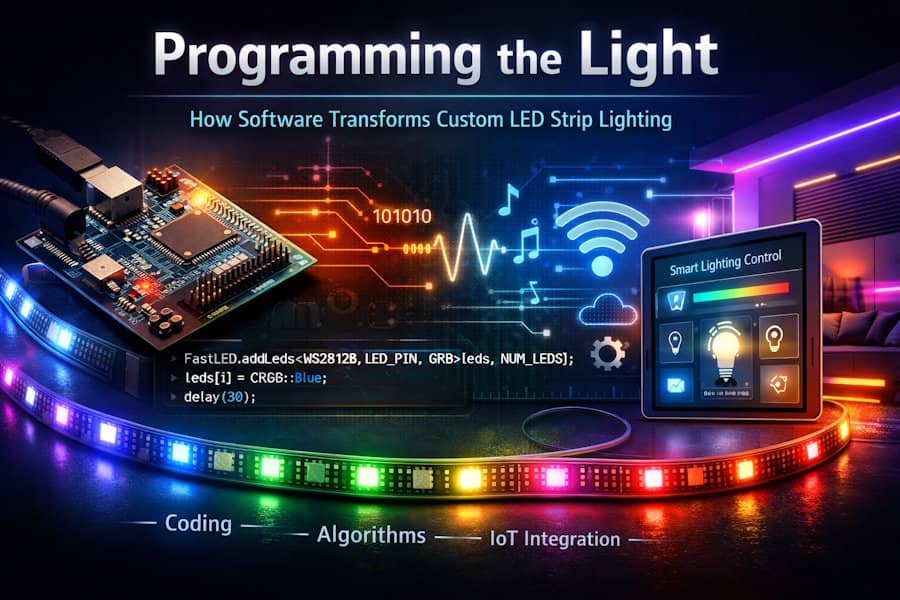
In recent years, LED strip lights have evolved from simple decorative elements into powerful, programmable lighting systems. With the rise of microcontrollers, embedded systems, and open-source software, developers can now create stunning lighting effects using code. This convergence of hardware and software has opened new opportunities not only for programmers, but also for every Custom LED strip lights supplier aiming to provide intelligent, flexible lighting solutions.
This article explores how computer programming is used to control LED strip lights, how developers design lighting effects through code, and why collaboration with a professional Custom LED strip lights supplier is crucial for scalable and reliable projects.
The Basics: How LED Strip Lights Are Controlled by Code
At the core of programmable LED strip lights is the ability to control individual LEDs through digital signals. Popular LED types such as WS2812B, SK6812, and APA102 are “addressable,” meaning each LED can be controlled independently using software.
From a programming perspective, this typically involves:
- A microcontroller (Arduino, ESP32, Raspberry Pi Pico, etc.)
- A communication protocol (PWM, SPI, or single-wire timing protocols)
- A software library (FastLED, Adafruit NeoPixel, WLED, or custom firmware)
Here’s a simple Arduino-style example:
#include <FastLED.h>

#define LED_PIN 5

#define NUM_LEDS 60

CRGB leds[NUM_LEDS];

void setup() {
    FastLED.addLeds<WS2812B, LED_PIN, GRB>(leds, NUM_LEDS);
}

void loop() {
    for(int i = 0; i < NUM_LEDS; i++) {
        leds[i] = CRGB::Blue;
        FastLED.show();
        delay(30);
    }
}
This small snippet demonstrates how a few lines of code can generate dynamic lighting effects. For developers, lighting becomes a visual output of algorithms—loops, conditionals, randomness, and even real-time data streams.
From Algorithms to Aesthetics
What makes programmable LED strips especially exciting is how abstract programming concepts translate into physical visuals.
- Loops create chases, waves, and gradients
- Math functions generate sine-wave brightness or color cycling
- State machines control lighting modes
- Network APIs allow LEDs to respond to web requests, music, or sensor data
For example, a Python program running on a Raspberry Pi can control LED strips based on system metrics:
- CPU usage → brightness level
- Network traffic → color changes
- Time of day → lighting scenes
This is where software engineers and lighting designers truly meet—and where a reliable Custom LED strip lights supplier becomes essential.
Why Hardware Quality Matters to Programmers
From a coding standpoint, inconsistent hardware is a nightmare. Flickering LEDs, unstable power delivery, or inaccurate color calibration can make even perfect code look broken.
Professional developers therefore prefer working with a OEM LED strip lights manufacturer that can offer:
- Consistent LED binning and color temperature
- Custom voltage, density, and PCB layouts
- Long-term supply consistency for production projects
- Clear electrical specifications for integration
Whether you’re building an interactive art installation, a smart home product, or a commercial lighting system, predictable hardware behavior simplifies debugging and reduces software complexity.
Custom LED Strips for Advanced Software Projects
Many advanced applications require LED strips that go beyond off-the-shelf products. Examples include:
- Custom LED lengths for architectural installations
- High-CRI LED strips for color-sensitive environments
- Special PCB shapes for wearables or curved surfaces
- Pre-programmed IC configurations for unique protocols
A skilled Custom LED strip lights supplier can manufacture LED strips tailored to these needs, allowing developers to focus on software logic instead of hardware workarounds.
This is especially important in projects that involve:
- Computer vision systems reacting to LED output
- Game engines controlling real-world lighting
- IoT platforms synchronizing LEDs across networks
Real-World Use Cases Combining Code and Light
- Smart Home Systems
Developers use APIs and mobile apps to control LED strips for mood lighting, schedules, and automation. - Data Visualization
LED strips represent stock prices, server load, or weather conditions in real time. - Interactive Installations
Sensors and computer vision algorithms trigger lighting effects based on human movement. - Developer Desks and Workspaces
Programmers use code-driven lighting for notifications, focus modes, or aesthetic inspiration.
All of these applications rely on both clean software architecture and reliable LED hardware—again highlighting the importance of working with the right Custom LED strip lights supplier.
The Future: Software-Defined Lighting
As software continues to dominate product design, lighting is becoming increasingly “software-defined.” We’re already seeing:
- Web-based LED control dashboards
- Cloud-managed lighting scenes
- AI-generated lighting effects
- Integration with programming frameworks and CI/CD workflows
In this future, LED strip lights are no longer passive components—they are programmable endpoints in a larger system. Developers will expect lighting hardware to be as configurable as software libraries.
Forward-thinking Custom LED strip lights suppliers are adapting by offering:
- Firmware-ready LED solutions
- Documentation for developers
- Compatibility with open-source platforms
- Customization at scale
Computer programming has fundamentally changed how we design and use LED strip lighting. What was once simple illumination is now a dynamic, code-driven medium for creativity, data, and interaction.
For developers, the magic happens when clean code meets dependable hardware. And for businesses and creators alike, partnering with the right Custom LED strip lights supplier is the key to turning software logic into brilliant, real-world light.
Whether you’re writing your first LED animation loop or architecting a large-scale intelligent lighting system, remember: in modern lighting, code is just as important as LEDs—and the best results come when both are designed together.

