

In telecommunications, connectivity isn't just a commodity; it is the backbone of modern infrastructure. For carriers, the stakes are incredibly high. A dropped call or a failed data session isn't merely an inconvenience—it's a direct hit to customer satisfaction and, ultimately, revenue. As networks grow more complex with the integration of 5G, IoT, and legacy systems, the challenge of maintaining peak performance becomes exponentially harder.
This is where the need for rigorous testing and simulation comes into play. Carriers cannot afford to "wait and see" if their networks will hold up under pressure. They need proactive solutions that can mimic real-world scenarios before they impact the end user. Enter the SimCall platform for carrier network performance—a tool designed to bridge the gap between theoretical network design and on-the-ground reality.
This article explores how platforms like SimCall are redefining network assurance, the specific challenges they solve for carriers, and why simulation is becoming the gold standard for performance testing in the telecom industry.
The Growing Complexity of Carrier Networks
To understand the value of the SimCall platform, we first need to look at the environment it operates within. Modern carrier networks are a patchwork of different technologies. You have 5G New Radio (NR) operating alongside 4G LTE, and in many regions, 2G or 3G legacy networks that still support critical voice and M2M (Machine to Machine) communications.
This heterogeneity introduces several pain points:
- Handover Failures: Moving a user session seamlessly from a 5G cell to a 4G cell (and back again) is technically demanding.
- Traffic Congestion: Sudden spikes in usage—think stadium events or emergencies—can overwhelm specific nodes.
- VoLTE and VoNR Quality: Voice over LTE (VoLTE) and Voice over New Radio (VoNR) require strict Quality of Service (QoS) parameters that data surfing does not.
Traditional testing methods often rely on drive testing, where technicians physically drive around with equipment to measure signal strength and call quality. While valuable, this method is expensive, time-consuming, and difficult to scale. It provides a snapshot of the network at a specific time and location, but fails to capture the holistic view needed for comprehensive optimization.
What is the SimCall Platform?
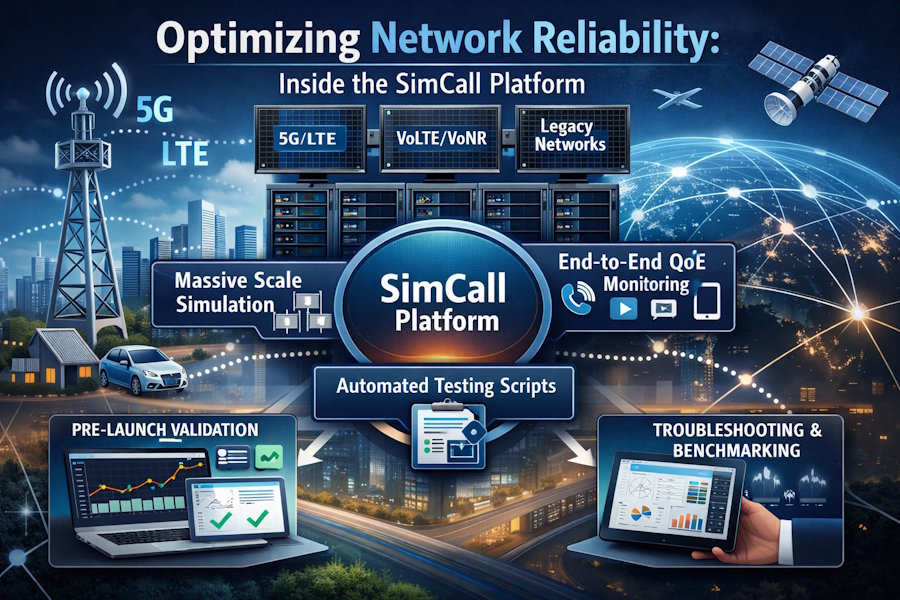
SimCall represents a shift towards automated, scalable, and centralized network testing. At its core, it is a simulation and testing environment that allows carriers to generate thousands of test calls and data sessions simultaneously. Instead of relying solely on physical devices moving through a city, SimCall can simulate the behavior of thousands of users from a centralized system or manage a fleet of stationary probes that execute complex testing scripts.
The SimCall platform for carrier network performance focuses on three main pillars:
1. Massive Scale Simulation
The platform can emulate high-load scenarios that are difficult to replicate manually. By generating high volumes of simultaneous voice calls, SMS, and data sessions, it stresses the network core and radio access network (RAN). This helps engineers identify bottlenecks that only appear under peak load conditions.
2. End-to-End Quality of Experience (QoE)
Unlike simple "ping" tests that check for connectivity, SimCall evaluates the actual quality of the service. It measures metrics such as:
- Call Setup Time: How long it takes for the phone to ring after dialing.
- Mean Opinion Score (MOS): An audio quality rating for voice calls.
- Throughput: Actual upload and download speeds during data transfer.
- Packet Loss and Jitter: Critical for VoIP and real-time video applications.
3. Automated Scripting
Engineers can program the platform to run specific test sequences repeatedly. For example, a script might command a test unit to dial a number, hold the call for two minutes, download a 50MB file, and then hang up. This automation ensures consistency in testing, making it easier to track performance trends over time.
Key Use Cases for SimCall in Carrier Operations
Implementing a robust simulation platform transforms how network operations centers (NOCs) and engineering teams approach their daily tasks.
Pre-Launch Validation
Before rolling out a new feature or upgrading a cell site, carriers need to know it works. SimCall allows them to run regression tests on the new configuration. If the new software version causes a spike in dropped calls in the simulation, the rollout can be halted before it affects paying customers.
Troubleshooting Intermittent Issues
One of the hardest problems in telecom is the "ghost" error—a problem that happens sporadically and is hard to reproduce. By running continuous, automated test loops on the SimCall platform, engineers can eventually capture the error in action, gathering the logs and signaling data needed to fix the root cause.
Benchmarking Against Competitors
Carriers often use these platforms to test not just their own networks, but also those of their competitors. By deploying probes with SIM cards from rival operators, a carrier can see exactly how its performance stacks up in a specific region regarding data speed or voice quality.
Roaming Verification
For international carriers, ensuring that customers can roam seamlessly onto partner networks is vital. SimCall probes can be placed in strategic international locations to verify that roaming agreements are being honored technically, checking that calls connect and data flows as expected when a user is abroad.
The Shift from Reactive to Proactive Optimization
The ultimate goal of using the SimCall platform for carrier network performance is to move from a reactive stance to a proactive one.
In a reactive model, the carrier realizes there is a problem because customer support lines light up with complaints. By then, the damage to the brand's reputation is already done.
In a proactive model enabled by SimCall, the platform identifies a degradation in voice quality at 3:00 AM during a scheduled test. The engineering team receives an alert, isolates the faulty interface card or software bug, and deploys a fix by 6:00 AM—all before the morning rush hour begins. The customer never knows there was an issue.
Future-Proofing with AI and Machine Learning
As we look forward, platforms like SimCall are beginning to integrate Artificial Intelligence. Rather than just reporting that a call failed, AI-enhanced versions of the platform can analyze the signaling traces to suggest why it failed. Was it interference? A core network timeout? A handover failure?
Furthermore, predictive analytics can look at historical performance data gathered by the platform to predict future outages. This evolution will make simulation tools not just diagnostic instruments, but strategic assets in network planning.
Elevating the Standard of Connectivity
SimCall platform for carrier network performance addresses the reality that the telecommunications landscape is unforgiving. Customers expect 100% uptime and lightning-fast speeds, regardless of location. Meeting those expectations requires tools that are as advanced and precise as the network carriers manage, delivering clear visibility, proactive insights, and the confidence to resolve issues before users ever notice them.
The SimCall platform for carrier network performance offers the scalability, automation, and depth required to ensure reliable connectivity. By rigorously testing the network under varied and stressful conditions, carriers can safeguard their infrastructure, optimize their investments, and deliver the superior experience their subscribers demand.
For network engineers and CTOs, the message is clear: You cannot optimize what you do not measure. And in today's digital ecosystem, simulation is the most effective yardstick we have.

