

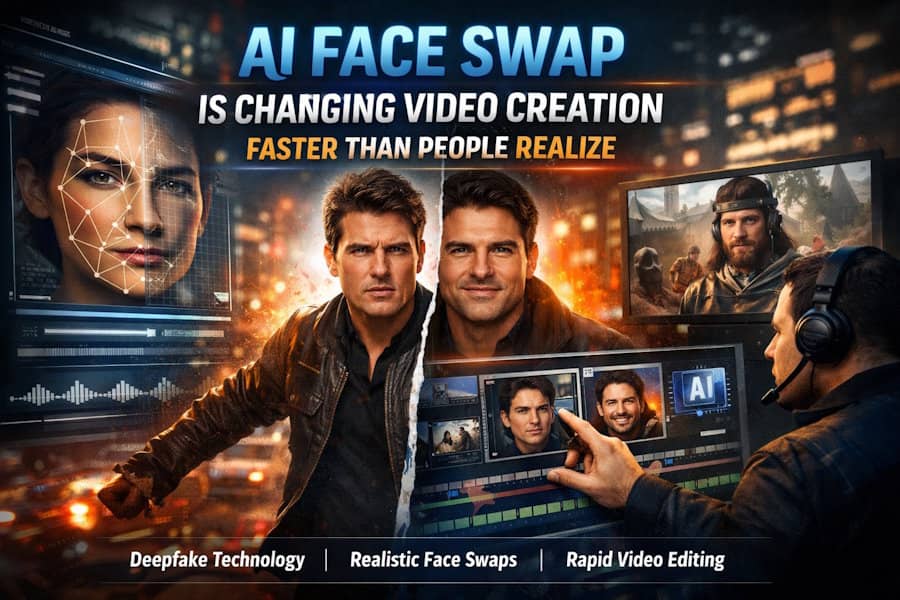
Things are moving very fast in the digital world. A few years ago, artificial intelligence felt distant. People talked about it, but rarely used it themselves. Now it’s different. AI is already inside daily content. One clear example is video face swap.
At first, face swapping in videos feels like a fun trick. Someone’s face appears on another person in a moving clip. But once you look closely, it’s not simple at all. The system has to understand movement, expressions, angles, and timing. Earlier attempts failed at this. Faces looked stiff. Smiles didn’t match. Something always felt strange.
With modern AI face swap tools, that gap is closing. Results feel more natural. In many cases, viewers don’t even notice the swap unless someone tells them.
What Video Face Swap Really Means
A video is not one picture. It’s hundreds, sometimes thousands of frames running together. Swapping a face in a single image is easy compared to replacing a face across an entire clip.
Video face swap means replacing a face while keeping:
- Head movement
- Eye direction
- Facial expressions
- Emotional timing
If even one part goes wrong, the result looks fake. That’s why early tools struggled. They could handle images, not motion.
Today’s AI face swap systems are trained on massive facial datasets. They don’t just copy faces. They learn how faces behave over time.
How AI Face Swap Works in Videos (In Simple Terms)
The process sounds technical, but the idea is straightforward.
First, the system scans each frame and looks for faces. Once a face is detected, key points are marked. Eyes, lips, nose, jawline. These points guide alignment.
Then the motion is tracked. This part matters a lot. A smile is not one action. It slowly appears, holds, and fades. The AI watches these small changes.
Lighting comes next. If shadows don’t match, people notice instantly. Good tools adjust brightness and tone automatically. Poor tools leave rough edges around cheeks or jawlines.
Finally, blending happens. Colors are matched. Skin texture is adjusted. The face is merged into the scene.
All of this happens frame by frame.
That’s why video face swapping is much harder than photo swapping.
Why AI Face Swap Feels More Real Today
Earlier systems focused only on shape. New systems focus on behavior.
Modern AI face swap models understand:
- Micro-expressions
- Eye movement patterns
- Muscle tension around the mouth and brows
This is why faces don’t feel frozen anymore. They react naturally. Even pauses between expressions feel right.
Another big reason is data. AI now learns from faces across different ages, skin tones, lighting setups, and camera qualities. Because of that, results are more stable across long videos.
Why Video Face Swap Is Becoming Popular Everywhere
Accessibility is the main reason.
A few years ago, you needed strong computers and editing skills. Today, most video face swap tools work directly online. No installation. No learning curve.
People making short videos benefit the most. Attention spans are short. Visual surprises stop scrolling. A familiar scene with a new face feels fresh.
Businesses noticed this too. Instead of filming multiple actors, they reuse the same video and digitally change faces. It saves time and money.
This is why AI face swap adoption keeps growing.
Common Uses of Video Face Swap
Entertainment and Social Media
This is where face swap spreads fastest. People insert themselves into movie scenes, music videos, or viral clips. It feels playful and personal.
When done well, viewers stay longer. Engagement increases. That’s why creators keep using it.
Marketing and Advertising
Brands use video face swap to localize ads. One video can be reused for different regions by changing faces. The message stays the same, but the connection feels closer.
Still, transparency matters. Audiences don’t like feeling tricked.
Education and Training
Some educators experiment with AI face swap to make lessons feel more relatable. Familiar faces in learning material keep attention longer.
It’s not about replacing teachers. It’s about making content feel alive.
Film and Media Production
In filmmaking, face swap helps during post-production. Scenes can be fixed without calling actors back. This saves budget and time.
Studios already use similar tools quietly. As quality improves, usage will grow.
Ethics Can’t Be Ignored
The more realistic the video face swap becomes, the bigger the responsibility.
Fake videos can spread misinformation. Using someone’s face without permission causes serious issues. Trust becomes fragile when people can’t tell what’s real.
Responsible platforms focus on:
- User consent
- Clear rules
- Usage limits
- Disclosure systems
Technology alone isn’t the problem. How people use it matters more.
AI Face Swap vs Traditional Video Editing
Traditional editing requires:
- Manual face alignment
- Frame-by-frame correction
- Skilled editors
- Long production time
With AI face swap, machines handle most of this automatically. They learn from thousands of examples and adapt quickly.
The biggest difference is speed. What once took days now takes minutes.
Quality is catching up, too.
Where PixNova AI Fits In
PixNova AI is built for users who want powerful tools without technical headaches. It offers AI-powered face swapping, image generation, one-click outfit changes, and interactive AI characters — all accessible online.
No complex software. No heavy setup. Everything runs through a browser.
For people working with video face swap, this simplicity matters. Tools should help creativity, not slow it down.
PixNova AI focuses on that balance.
Limitations Still Exist
Even advanced AI face swap tools are not perfect.
Common issues include:
- Problems with poor lighting
- Errors during fast head movement
- Artifacts in low-resolution videos
Knowing these limits helps avoid unrealistic expectations.
What the Future Looks Like
In the coming years, video face swap will likely move into real-time use. Live streams. Virtual spaces. Augmented reality.
As realism improves, ethical awareness becomes even more important.
Seeing will no longer mean believing.
Final Thoughts
Video face swap is not just a trend. It’s a sign of how deeply AI face swap technology is shaping digital media.
Used creatively, it opens new doors. Used carelessly, it creates problems.
The tools will keep improving. The real question is how responsibly people choose to use them.

