

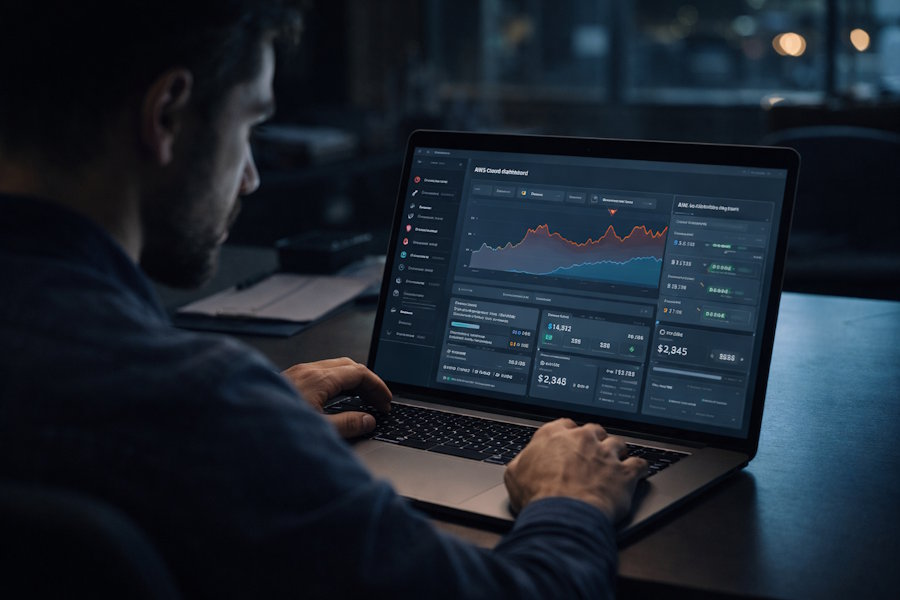
Cloud environments in 2026 have moved beyond the point where manual tracking or basic rule-based alerts can keep up.
Most engineering teams still struggle with the same problem: AWS cost management is becoming more and more tedious, because by the time you see the spike, the money is already gone.
Problem with AWS Native Dashboard
The Standard cost explorers and budget alerts are delay-based. They inform you about what you spent yesterday or last week.
In most environments, where auto-scaling groups, serverless functions, and containers are used, a misconfigured setup can burn a budget within hours.
The biggest problem is most third-party tools are dependent on human beings to establish thresholds. A static alert may not go off until the damage is severe, provided that a developer accidentally enters a recursive loop in a Lambda function or forgets to terminate a large GPU instance after a training run. Manual oversight requires engineers to have time to review each line item in a Cost and Usage Report (CUR). They usually don't.
Cost Leaks AWS Native Tools Miss (Daily, Not Quarterly)
This section makes the pain tangible and earns the AI argument without sounding salesy.
What actually drains budgets in real AWS setups:
- Silent scale-ups: Auto-scaling groups ramp up due to a traffic anomaly, but never scale back down.
- Zombie resources: Test environments, feature branches, or one-off demos running quietly for weeks.
- Data transfer bleed: Cross-AZ or cross-region traffic that looks harmless per GB but compounds daily.
- Over-provisioned “just in case” infra: Databases and caches sized for peak traffic that happens once a month.
- Forgotten high-cost services: NAT gateways, provisioned IOPS, GPU instances, or idle load balancers no one owns anymore.
- Good alerts, bad timing: Budgets trigger after the cost is booked, not while it’s happening.
Where Optimization Fails with AWS Dashboard
Optimization is usually seen as a clean-up exercise that will be done at the end of the quarter. Teams seek unattached EBS volumes or snapshots. Although this will save some money, it does not solve the architectural inefficiencies that occur in real-time.
Contemporary AWS environments are too complex to use spreadsheets. With hundreds of microservices communicating, it is not just the cost of the instances. It is about inter-regional data transfer, NAT gateway fees, and provisioned IOPS that nobody is actually utilizing. These patterns cannot be determined without constant monitoring, which a human consultant cannot offer 24/7.
How AI changes the Workflow?
The transition to AI in cost management does not concern the replacement of engineers. It is concerning the elimination of the data analysis load. AI is able to scan across usage patterns across your whole infrastructure and detect anomalies that do not conform to a typical "spike."
As an example, an AI-based system can identify that a particular database cluster is always over-provisioned at off-peak times and propose an accurate down-scaling strategy. It shifts the discussion to the point of we spent too much, to the point of we are spending too much now, and here is how to put a stop to it.
Integrating Costimizer into the Process
This is why we built Costimizer (the best cloud cost optimization platform) out there. Instead of giving you more graphs to study, Costimizer acts as an automated layer that sits between your AWS environment and your finance goals. It identifies waste as it happens.
Costimizer raises a flag. It gives practical suggestions that engineers can implement without any fear since the recommendations are not made based on arbitrary percentages but on the real demand of the resources.
Moving Toward Autonomous Cost Control
The goal for any engineering lead in 2026 should be to make cloud costs predictable. We are moving away from reactive budgeting toward a model where the infrastructure manages its own efficiency.
By using AI to handle the repetitive auditing of AWS resources, teams can get back to building products. You do not have to spend Monday mornings explaining a bill to the leadership. Rather, you have a system that makes sure that you only pay the value that your code actually brings.

