

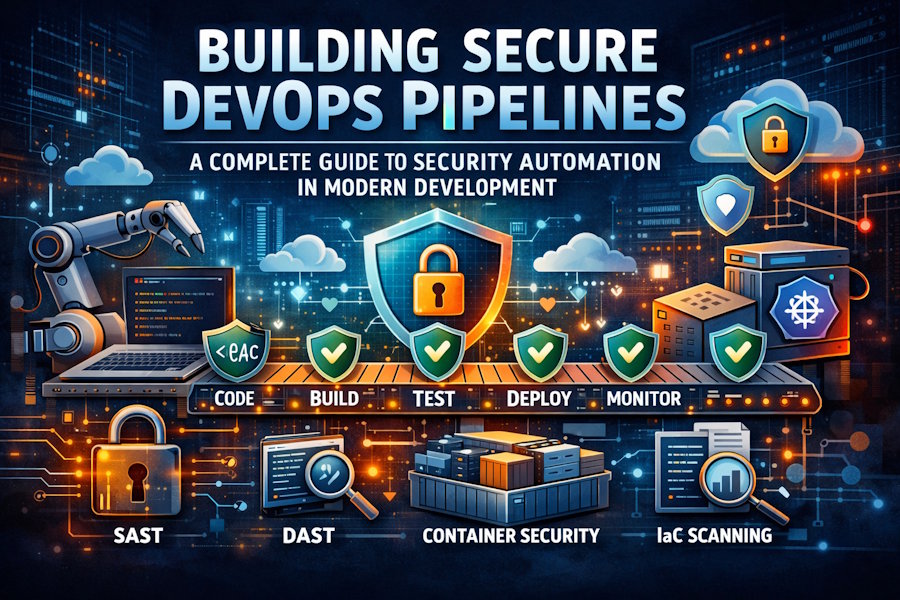
The acceleration of software development cycles has fundamentally transformed how organizations approach application delivery. With teams pushing code to production multiple times daily, traditional security practices that relied on periodic audits and manual reviews have become obsolete. The modern development landscape demands a paradigm shift—one where security is not an afterthought but an integral component of every development phase.
According to recent industry research, organizations that implement security automation within their CI/CD pipelines experience 50% fewer security incidents and reduce vulnerability remediation time by up to 60%. These statistics underscore a critical reality: the integration of security into DevOps workflows—commonly referred to as DevSecOps—is no longer optional but essential for maintaining competitive advantage while protecting digital assets.
This comprehensive guide explores the strategies, tools, and best practices for building secure DevOps pipelines that protect your applications without sacrificing deployment velocity. Whether you're a developer looking to enhance your security knowledge or an engineering lead architecting enterprise-grade solutions, this article provides actionable insights for implementing robust security automation.
Understanding the DevSecOps Landscape
DevSecOps represents the cultural and technical evolution of DevOps, embedding security practices throughout the software development lifecycle (SDLC). Unlike traditional approaches where security teams operated in silos, DevSecOps fosters collaboration between development, operations, and security professionals from project inception through deployment and maintenance.
The Core Principles of DevSecOps
Shift-Left Security: Moving security considerations earlier in the development process, enabling developers to identify and remediate vulnerabilities before they reach production environments.
Continuous Security Monitoring: Implementing automated security checks that run continuously throughout the pipeline, ensuring that every code change undergoes rigorous security validation.
Infrastructure as Code (IaC) Security: Applying security controls to infrastructure definitions, ensuring that cloud resources and server configurations adhere to security best practices before deployment.
Organizations seeking to implement comprehensive DevSecOps practices often partner with providers offering managed IT operations services that combine infrastructure management with security expertise. This approach allows development teams to focus on building applications while security specialists handle the complex task of maintaining secure environments.
Essential Components of a Secure CI/CD Pipeline
A well-architected secure pipeline incorporates multiple security checkpoints, each designed to catch specific types of vulnerabilities. Let's examine the critical components that should be present in every modern DevOps pipeline.
Table 1: CI/CD Pipeline Security Components
|
Pipeline Stage |
Security Component |
Purpose |
Key Tools |
|
Code Commit |
Pre-commit Hooks |
Prevent secrets and sensitive data from entering repositories |
GitLeaks, Husky, pre-commit |
|
Build |
SAST Scanning |
Analyze source code for security vulnerabilities |
SonarQube, Checkmarx, Semgrep |
|
Build |
Dependency Scanning |
Identify vulnerabilities in third-party libraries |
Snyk, OWASP Dependency-Check, Dependabot |
|
Test |
DAST Scanning |
Test running applications for security flaws |
OWASP ZAP, Burp Suite, Acunetix |
|
Deploy |
IaC Scanning |
Validate infrastructure configurations |
Checkov, Terrascan, tfsec |
|
Runtime |
Container Scanning |
Scan container images for vulnerabilities |
Trivy, Clair, Anchore |
|
Production |
Continuous Monitoring |
Detect threats and anomalies in real-time |
Datadog, Splunk, Elastic SIEM |
Implementing Static Application Security Testing (SAST)
SAST tools analyze source code to identify potential security vulnerabilities before the application is compiled or executed. These tools examine code patterns, data flows, and control structures to detect issues such as SQL injection vulnerabilities, cross-site scripting (XSS) risks, and insecure cryptographic implementations.
Best practices for SAST implementation include:
- Integrate SAST scans into pre-commit hooks to catch vulnerabilities before code enters the repository
- Configure rule sets that align with your organization's security policies and compliance requirements
- Establish baseline scans and track security debt over time to measure improvement
- Implement incremental scanning for faster feedback during development
Dynamic Application Security Testing (DAST)
While SAST examines static code, DAST tools test running applications to identify vulnerabilities that manifest during execution. DAST simulates real-world attacks against deployed applications, identifying issues such as authentication weaknesses, session management flaws, and server misconfigurations.
For organizations managing complex cloud environments across AWS, Azure, or GCP, implementing comprehensive DAST requires robust infrastructure management capabilities. Utilizing an automated vulnerability scanning solution enables continuous security assessment across all environments, providing real-time visibility into potential security gaps before they can be exploited.
Container Security and Kubernetes Hardening
The widespread adoption of containerization has introduced new security challenges that traditional security tools were not designed to address. Container images, runtime environments, and orchestration platforms each present unique attack surfaces that require specialized security approaches.
Table 2: Container Security Checklist
|
Security Area |
Best Practice |
Risk Level if Ignored |
|
Base Images |
Use minimal, verified base images from trusted registries |
Critical |
|
User Privileges |
Run containers as non-root users |
High |
|
Network Policies |
Implement Kubernetes network policies to restrict pod communication |
High |
|
Resource Limits |
Set CPU and memory limits to prevent denial-of-service |
Medium |
|
Secrets |
Use Kubernetes Secrets or external vaults; never hardcode |
Critical |
|
Image Scanning |
Scan all images for vulnerabilities before deployment |
Critical |
|
Runtime Security |
Implement pod security policies and admission controllers |
High |
Image Scanning and Registry Security
Container image scanning should occur at multiple points in the pipeline: during development when images are built, before images are pushed to registries, and continuously within registries to detect newly discovered vulnerabilities in existing images.
Key considerations for container security include:
- Use minimal base images to reduce attack surface (Alpine Linux, distroless images)
- Implement image signing and verification to ensure image integrity
- Configure registry access controls and enable vulnerability scanning
- Establish policies for blocking deployment of images with critical vulnerabilities
Infrastructure Security and Configuration Management
Infrastructure as Code (IaC) has revolutionized how teams provision and manage cloud resources. However, misconfigurations in IaC templates can introduce significant security risks that propagate across environments. According to research by Gartner, through 2025, 99% of cloud security failures will be the customer's fault, primarily due to misconfigurations.
Securing Terraform and CloudFormation Templates
IaC security scanning tools analyze Terraform, CloudFormation, Kubernetes manifests, and other infrastructure definitions to identify security misconfigurations. Common issues detected include:
- Public access enabled on storage buckets or databases
- Overly permissive IAM policies and security group rules
- Unencrypted data storage and transmission
- Missing logging and monitoring configurations
Organizations with multi-cloud deployments face increased complexity in maintaining consistent security configurations. Working with specialized cloud operations providers ensures that security best practices are consistently applied across all platforms, reducing the risk of configuration drift and security gaps.
Secrets Management and Access Control
Hardcoded secrets in source code repositories remain one of the most common causes of security breaches. A study by GitGuardian found that 85% of leaked secrets remain valid for more than five days after exposure, providing attackers with extended windows of opportunity.
Table 3: Secrets Management Comparison
|
Solution |
Best For |
Key Features |
|
HashiCorp Vault |
Enterprise multi-cloud environments |
Dynamic secrets, encryption as a service, audit logging |
|
AWS Secrets Manager |
AWS-native workloads |
Automatic rotation, RDS integration, pay-per-use |
|
Azure Key Vault |
Azure and hybrid environments |
HSM backing, certificate management, RBAC integration |
|
Google Secret Manager |
GCP workloads |
Automatic replication, IAM integration, versioning |
|
Kubernetes Secrets |
Simple K8s deployments |
Native integration, base64 encoding, namespace isolation |
Implementing Zero Trust Security
Zero Trust architecture assumes that no user or system should be automatically trusted, regardless of their network location. In a DevOps context, this translates to:
- Implementing least-privilege access for all service accounts and automation tools
- Requiring multi-factor authentication for access to CI/CD systems
- Encrypting all data in transit and at rest
- Implementing comprehensive audit logging for all system interactions
Continuous Security Monitoring and Incident Response
Security does not end when code reaches production. Continuous monitoring enables organizations to detect and respond to threats in real-time, minimizing the impact of security incidents.
Runtime Application Self-Protection (RASP)
RASP solutions integrate directly into applications to provide real-time protection against attacks. Unlike traditional perimeter-based security, RASP can detect and block attacks even when they originate from within the network, providing an additional layer of defense against sophisticated threats.
Implementing continuous security monitoring requires robust tooling that can scale with your infrastructure. Modern vulnerability scanning platforms provide automated, AI-driven detection capabilities that identify threats across cloud environments, endpoints, and servers, enabling security teams to respond to incidents before they escalate into breaches.
Compliance and Regulatory Considerations
Many organizations must comply with regulatory frameworks such as SOC 2, PCI DSS, HIPAA, or GDPR. Integrating compliance checks into the CI/CD pipeline ensures that applications meet regulatory requirements throughout the development lifecycle.
Table 4: Common Compliance Frameworks and Requirements
|
Framework |
Industry Focus |
Key Security Requirements |
|
SOC 2 |
Technology/SaaS |
Access controls, encryption, monitoring, incident response |
|
PCI DSS |
Payment Processing |
Network segmentation, encryption, access management, vulnerability scanning |
|
HIPAA |
Healthcare |
PHI protection, audit controls, encryption, access management |
|
GDPR |
EU Data Processing |
Data minimization, encryption, breach notification, access controls |
|
NIST CSF |
US Government/Critical Infrastructure |
Identify, protect, detect, respond, recover framework |
|
ISO 27001 |
Global Enterprise |
Information security management system, risk assessment, controls |
Automated compliance scanning tools can verify that infrastructure configurations, access controls, and data handling practices align with regulatory requirements, generating audit-ready reports that demonstrate compliance to stakeholders and regulators.
Building a Security-First Culture
Technology alone cannot secure software—people and processes are equally important. Building a security-first culture requires investment in training, clear communication of security expectations, and recognition of security-conscious behavior.
Key Strategies for Cultural Transformation
- Provide regular security training tailored to different roles (developers, operations, QA)
- Establish clear security champions within development teams
- Conduct regular tabletop exercises and security drills
- Celebrate security wins and share lessons learned from incidents
- Integrate security metrics into team performance evaluations
Conclusion: The Path Forward
Building secure DevOps pipelines is a journey that requires continuous improvement and adaptation. As threats evolve and new technologies emerge, organizations must remain vigilant in updating their security practices to address emerging risks.
The most successful organizations approach security as an enabler rather than a blocker. By automating security checks, integrating security into developer workflows, and fostering a culture of shared responsibility, teams can achieve both rapid deployment velocities and robust security postures.
Start by assessing your current pipeline security posture, identifying gaps, and prioritizing improvements based on risk. Leverage automation wherever possible to reduce manual effort and ensure consistent security enforcement. And remember that security is not a destination but an ongoing commitment to protecting your applications, data, and users.
Whether you're building your first CI/CD pipeline or optimizing an existing one, the principles outlined in this guide provide a roadmap for implementing security automation that scales with your organization's growth while maintaining the agility that modern software development demands.

