

In the CNC manufacturing industry, programming errors frequently lead to machining defects, material waste, and delivery delays, severely impacting overall production efficiency. The core issue lies in traditional programming methods that rely heavily on manual experience, lack automated integration, and struggle with complex CAD files, resulting in insufficient precision. This article proposes a solution through the introduction of advanced CNC Programming Tools and Precision Code Solutions to optimize the workflow from design to manufacturing, enabling highly efficient and accurate production. The following sections will provide an in-depth analysis of key optimization strategies to help readers systematically enhance their manufacturing capabilities.
What is the Key Role of CNC Programming Tools?
CNC Tools serve as the digital brain of modern manufacturing, translating design intent into precise instructions for machine tools. Their primary role is to mitigate the inherent risks of manual programming through automation and intelligence, directly addressing the industry's pain points of errors and inefficiency.
Core Functions: From Code Generation to Virtual Verification
The functionality of advanced programming tools extends far beyond simple G-code generation. These systems intelligently interpret CAD models to automatically create efficient, collision-free toolpaths. Crucially, their integrated simulation capabilities allow for a full virtual run-through of the machining process before any material is cut. This digital verification identifies potential issues like gouging, collisions, or inefficient motions, acting as a critical safety net that prevents costly machine damage and workpiece scrap.
Application in Turning Services and Value
The value of these tools is particularly evident in CNC Turning Services. For instance, when machining complex-contour shafts, the software automatically calculates optimal cutting parameters, feed rates, and spindle speeds to ensure process stability. Simulation allows programmers to visually verify tool nose radius compensation and perfect thread endings, guaranteeing consistency across production batches. Studies by the Society of Manufacturing Engineers (SME) indicate that programming systems with integrated simulation can reduce trial cuts by up to 70%, significantly boosting overall equipment effectiveness.
Driving Automation and Future Manufacturing
l Enhancing Process Standardization
Automated programming tools codify the expertise of skilled engineers into standardized process templates and databases. Whether for material-specific cutting parameters (e.g., for stainless steel or titanium) or optimized routines for standard operations (like drilling or tapping), they ensure different programmers produce consistently high-quality code, eliminating quality fluctuations caused by human factors.
l Laying the Foundation for Smart Manufacturing
These tools are a critical component of the digital thread connecting design and execution. The standardized, structured code they generate provides a clean, reliable data source for subsequent Manufacturing API Integration, production traceability, and adaptive machining control, forming an indispensable foundation for flexible automation and smart factories.
How to Improve Machining Accuracy through CAD File Processing?
Machining accuracy begins with the flawless transfer of design data. CAD File Processing is the critical step that ensures data moves from design to manufacturing intact and without error. Common issues like format incompatibility, flawed surfaces, gaps, or precision loss in 3D models can introduce subtle yet costly errors at the programming stage.
Optimized processing starts with rigorous validation of the original CAD model. Specialized pre-processing software can automatically detect and repair geometric errors such as duplicate faces, bad edges, or non-manifold geometry. Subsequently, using neutral data exchange standards recommended by the ISO, like STEP or IGES files, helps preserve the model's geometric accuracy and feature information, preventing data corruption caused by software version differences. A perfectly processed CAD model lays a solid foundation for generating high-precision toolpaths.
When optimized CAD data is combined with Precision Code Solutions, significant efficiency gains are realized. The precision code generation engine uses this "clean" model data to calculate theoretically optimal toolpaths, while also compensating for real-world factors like machine dynamics and tool wear. This is crucial for high-accuracy CNC turning service applications. For example, when machining precise hydraulic valve bodies or optical components, even minor data deviations can lead to functional failure. By ensuring end-to-end accuracy from design to code, manufacturers can consistently achieve micron-level tolerances, enhancing product reliability and customer trust.
How Do Precision Code Solutions Reduce Machining Errors?
Machining errors often stem from subtle flaws in the code, such as toolpath deviations, improper cutting parameters, or poor tool entry/exit strategies. Precision Code Solutions are systematic approaches designed to eliminate these errors, encompassing validation, optimization, and adaptive correction logic.
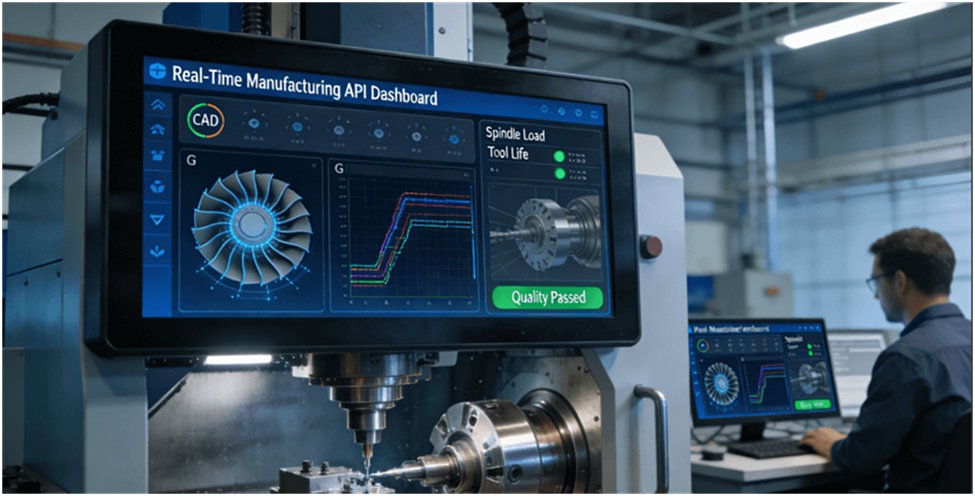
These solutions automatically analyze and correct various code errors. For toolpaths, intelligent algorithms smooth motions around corners to prevent chatter marks caused by machine vibration; they automatically adjust cutting loads to prevent tool chipping; and they optimize rapid traverse movements to drastically reduce cycle times. Furthermore, through Manufacturing API Integration, precision code systems enable real-time monitoring and feedback. In a CNC turning machining application for a high-performance turbo shaft, the API can collect real-time data on machine power and vibration, comparing it against the code system's predictive models. If an anomaly is detected (e.g., slight tool wear), the system can automatically fine-tune the feed rate or trigger a tool change warning, enabling proactive maintenance.
Case studies demonstrate that implementing precision code solutions can reduce machining error rates by over 30%. This not only cuts down on scrap and rework but also ensures a stable and predictable production process. For quality-driven enterprises, adopting such solutions and adhering to certifications like ISO 9001 establishes a fully controlled quality process from code to finished part, providing a solid foundation for securing high-demand contracts.
What are the Best Practices for Custom Part Programming?
The growing demand for customization and low-volume production makes Custom Part Programming a core competency for manufacturing firms. The best practice begins with a structured parametric design approach, where engineers define a part's key features (e.g., bore diameter, thread specification, contour dimensions) as adjustable parameters linked to intelligent machining program templates.
For a custom aerospace lightweight structural component, the optimized workflow is as follows: First, a Design for Manufacturability (DFM) analysis is conducted on the client's 3D model to refine features unsuitable for machining. Next, using the parametric programming template, the new part's key dimensions are imported, allowing the system to auto-generate the majority of the machining program. The programmer then focuses only on the unique features. This significantly accelerates the CNC Prototyping cycle, enabling rapid iteration. For customized CNC turning, this method is highly efficient; for example, for shaft parts with varying lengths, diameters, and groove requirements, modifying a few parameters yields a new, verified program within minutes, perfectly balancing flexibility with efficiency. Companies seeking expert custom CNC turning can leverage such advanced methodologies to transform unique designs into high-quality physical parts.
How Does Manufacturing API Integration Enhance CNC Prototyping Efficiency?
The Mechanism of Automated Data Flow
Manufacturing API Integration creates a seamless digital thread by connecting disparate systems like CAD, CAM, CNC, and CMM. APIs act as the central nervous system for this integration, enabling automated and error-free data exchange that replaces manual, time-consuming tasks.
l Functioning as a Universal Translator
APIs serve as translators, standardizing data from different software formats into a common language. When a design is updated in the CAD system, the API ensures the modified model is accurately interpreted and pushed to the CAM system for programming, eliminating format incompatibility issues.
l Acting as an Automated Courier
Beyond translation, APIs function as intelligent "couriers," directly dispatching the generated code to the workshop's CNC turning shop. They also facilitate real-time data collection from the machine tools during CNC Prototyping, feeding performance metrics back to the Manufacturing Execution System (MES) for monitoring and analysis.
The Transformative Impact on Prototyping Efficiency
This automated flow is transformative, dramatically compressing the traditional "design-program-machine-inspect" cycle from days or weeks into a matter of hours. For a CNC turning shop, this efficiency enables the simultaneous handling of multiple prototype orders without sacrificing quality. Each prototype is manufactured using the latest design data, ensuring a level of consistency typically associated with batch production. In regulated industries, partnering with an API-integrated firm that holds certifications like AS9100D becomes a strategic advantage for ensuring prototype compliance and accelerating product certification timelines.
Conclusion
In summary, overcoming the challenges of precision and efficiency in CNC manufacturing requires a systematic approach. By integrating advanced CNCprogramming tools, robust CAD File Processing, intelligent precision code solutions, and leveraging the power of custom part programming and manufacturing API integration, enterprises can build a precise, efficient, and flexible manufacturing loop from digital model to physical part. This holistic strategy significantly reduces error rates and costs while elevating quality and productivity to new levels.
To digitally transform your manufacturing process, it is advisable to engage with a qualified specialist. We recommend contacting the expert team at JS Precision for a consultation on a customized CNC optimization solution tailored to your specific production challenges, paving the way for smarter, more reliable manufacturing.
Author Biography
This article was composed by precision manufacturing experts with extensive practical experience, dedicated to advancing the industry through the application and sharing of cutting-edge CNC machining and digital technologies. JS Precision, certified to ISO 14001, ISO 9001, IATF 16949, and AS9100D standards, provides reliable, full-spectrum solutions from rapid prototyping to volume production, backed by a stringent quality management system.
FAQs
Q1: How are CNC Programming Tools compatible with different CAD software?
A1: Through support for standardized neutral formats like STEP and IGES, along with direct data exchange APIs, these tools can accurately interpret files from various CAD platforms, ensuring high-fidelity geometric data transfer and minimizing compatibility issues.
Q2: Can Precision Code Solutions handle complex geometric shapes?
A2: Yes, they utilize advanced algorithms to generate optimized toolpaths for complex free-form surfaces, impellers, and deep cavities. Physical simulation verifies these paths to avoid collisions, making them ideal for high-precision parts with intricate geometries.
Q3: Does custom programming increase costs?
A3: While initial software investment and template development incur costs, the long-term benefits—drastically reduced programming and setup time, less scrap from trial cuts, and efficient small-batch production—lead to a lower cost per part and a strong return on investment.
Q4: What technical support is needed for API integration?
A4: Successful integration requires a central platform (like an MES or IoT platform) and standardized data interfaces (e.g., RESTful APIs) on all equipment and software. Choosing a vendor with proven integration experience and relevant certifications is crucial for stability.
Q5: How is CNC machining accuracy validated?
A5: Accuracy is validated using a combination of offline and online methods. Offline, Coordinate Measuring Machines (CMMs) perform full-dimensional inspection. Online, machine probes or laser tool setters enable in-process measurement. Data is analyzed against ISO standards to ensure consistent control within specified tolerances.

