

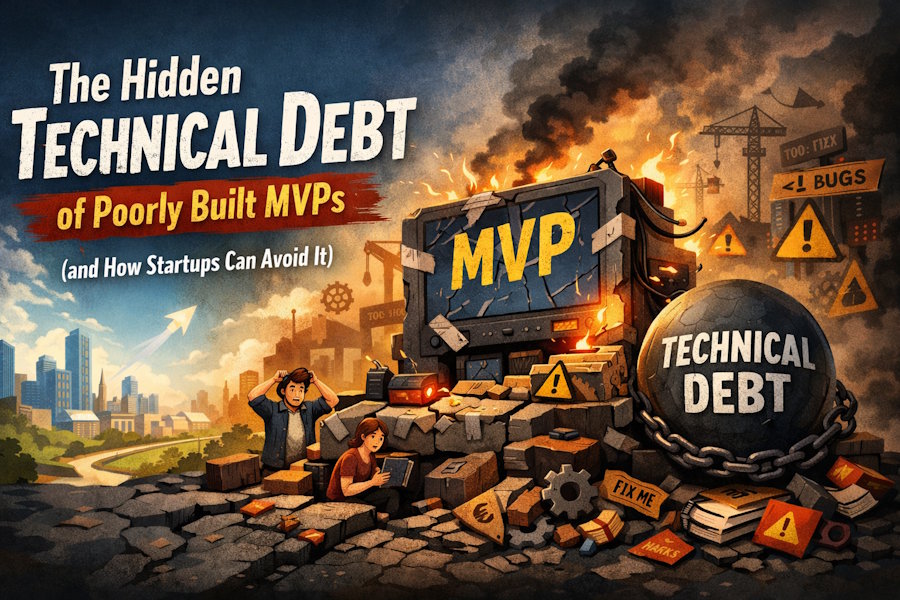
For many startups, the MVP (Minimum Viable Product) is the first real test of a business idea. It’s meant to validate assumptions quickly and cost-effectively. However, what starts as a lean experiment can easily morph into a long-term burden when shortcuts are mistaken for smart decisions. That burden is technical debt — the hidden cost of rushed architecture, sloppy code, and unclear priorities. If left unchecked, technical debt can slow development, inflate costs, and even sink promising ventures.
In this article, we unpack the invisible costs of poorly built MVPs and, more importantly, how startups can avoid the trap of technical debt while still moving fast.
What Is Technical Debt — Really?
Technical debt is a metaphor for the future cost incurred when developers take shortcuts today. Just like financial debt, it allows you to move faster in the short term but must be paid back with interest later — often in the form of refactoring, rewrites, or lost agility.
Examples of technical debt include:
- Hard-coded solutions in place of scalable architecture
- Poorly documented code
- Inconsistent coding standards
- Monolithic design when modularization is needed
- Patchwork integrations instead of clear APIs
While some technical debt is inevitable in early projects, poorly built MVPs tend to accumulate it at exponential rates, because the focus shifts from “viable learning product” to “ship anything that works.”
Why Poorly Built MVPs Hurt More Than They Help
1. Future Development Becomes Harder
Shortcuts taken for speed often lack a solid foundation. As user expectations grow and features are added, developers have to work around fragile code, creating more complexity and bugs.
Over time, this becomes a vicious cycle:
More complexity → more bugs → more workarounds → more debt
The net result is that every new feature — even small ones — takes longer and costs more.
2. Hiring and Onboarding Becomes Painful
Good engineers want clean, understandable codebases. When they join a startup with a messy MVP, the learning curve isn’t about the product’s domain — it’s about untangling a spaghetti mess of decisions.
Proper onboarding slows, morale drops, and retention suffers.
3. Performance, Scalability & Security Suffer
Poorly designed MVPs often overlook non-functional requirements:
- Performance under increasing load
- Modular scaling
- Maintainable test suites
- Security best practices
These omissions don’t always show up during early user tests — but they become painfully obvious when real users flood in.
The Root Causes of MVP Technical Debt
Understanding why technical debt accumulates in MVPs helps prevent it. Here are the most common causes:
Cause #1 — Misunderstanding the Purpose of an MVP
Many startups think an MVP is just the smallest set of features that “works” — but that’s only half the story.
The real purpose of an MVP is to validate assumptions with minimal investment, not to ship untested, brittle code that will haunt the team later. When the goal becomes “ship fast at any cost,” technical debt skyrockets.
Cause #2 — Lack of Clear Prioritization
Without clear prioritization, teams often build everything at once — or build features that customers don’t really need. This leads to code that’s built, abandoned, and never properly refactored.
Cause #3 — No Development Standards or Architecture
Startups that skip architecture planning or coding standards may save hours initially but lose weeks later. Even basic practices like consistent naming conventions, automated testing, and modular design pay dividends.
How Startups Can Avoid MVP Technical Debt
The good news? Technical debt is manageable — especially if you treat it as a strategic concern rather than an inevitable cost.
Here’s how:
1. Start With a Strong Foundation
Even if you’re building lean, a solid foundation is critical. You don’t need full enterprise architecture, but you should plan:
- Clear separation of concerns
- Scalable architecture patterns (e.g., microservices where appropriate)
- API design that anticipates future integrations
- Automated testing from day one
This upfront clarity prevents the product from collapsing under its own growth.
If you need support with this phase, professional MVP development services can make a measurable difference. For expert guidance on building resilient MVPs that scale without hidden debt, see Codevelo’s MVP development services.
2. Prioritize What Matters — Then Build It Well
Use clear validation criteria to decide what actually earns a place in the MVP.
Ask:
- Will this feature test a core hypothesis?
- Is this functionality essential for learning?
- Can this be simplified without losing meaning?
If the answer is no, it doesn’t belong in the MVP yet.
3. Embrace Incremental Quality
You can still build fast while maintaining quality. Do this by:
- Writing automated tests early
- Using code reviews consistently
- Maintaining coding standards
- Investing in documentation
This doesn’t have to slow down delivery — if it’s part of the process from the start.
4. Refactor Regularly — Don’t Let Debt Compound
Technical debt isn’t always “bad” — sometimes it’s a tactical choice — but it must be treated like a loan:
- Track where debt exists (e.g., in a backlog)
- Prioritize refactoring during sprint planning
- Allocate time for cleanup consistently
Ignoring debt makes it grow, just like ignoring financial debt.
5. Use the Right Tools & Monitoring
Use development tools that support quality without overhead:
- Linters and static analysis
- CI/CD pipelines
- Automated test suites
- Performance monitoring
- Error tracking platforms
These tools act as early warning systems for emerging debt.
Real-World Signs Your MVP Has Hidden Technical Debt
How can you tell if your MVP is accumulating harmful debt? Look for these symptoms:
- Feature delivery consistently takes longer than expected
- Bugs escalate with each release
- New developers struggle to understand the codebase
- Users encounter frequent performance issues
- Security vulnerabilities surface unexpectedly
If you see these, it’s not a matter of if you address the debt — it’s when.
Conclusion: Build for Learning and Longevity
The goal of an MVP is to learn fast — not to saddle your future product with unseen costs. Startups that treat technical debt as a strategic risk, rather than an inevitable by-product, stay agile longer and use their early momentum to scale instead of stabilize.
By focusing on:
- Clear purpose and prioritization
- Foundational architecture
- Quality practices from day one
- Regular refactoring
- The right tools
…you can build MVPs that are not just viable, but sustainable.

