

Test automation often starts with good intentions. A few scripts are written to speed up regression testing; they pass locally, and everyone is happy. Six months later, the same automation suite becomes slow, flaky, and impossible to maintain. At that point, teams usually realize the problem was never the tool; it was the framework design.
In enterprise applications, scalability is not optional. Applications evolve rapidly; teams grow, environments multiply, and automation must survive all of it. A scalable automation framework is not about writing more tests; it’s about building a structure that can absorb change without collapsing.
This article breaks down how to design such a framework in a practical, engineering-focused way.
The Problem with Script-Based Automation
Script-based automation is where most teams begin, and where many get stuck.
In this approach:
- Test logic, UI locators, and assertions live in the same file
- Test data is hardcoded
- Environment details are embedded directly in scripts
- Reporting is minimal or nonexistent
This works for demos and short-term goals, but enterprise systems expose its weaknesses quickly:
- High maintenance cost: A small UI change breaks dozens of tests
- Poor readability: Tests read like code, not scenarios
- Limited reuse: Logic is duplicated across scripts
- No scalability: Adding new modules increases complexity exponentially
The key issue is tight coupling. When everything depends on everything else, change becomes expensive.
Layered Framework Architecture: Separating Responsibilities
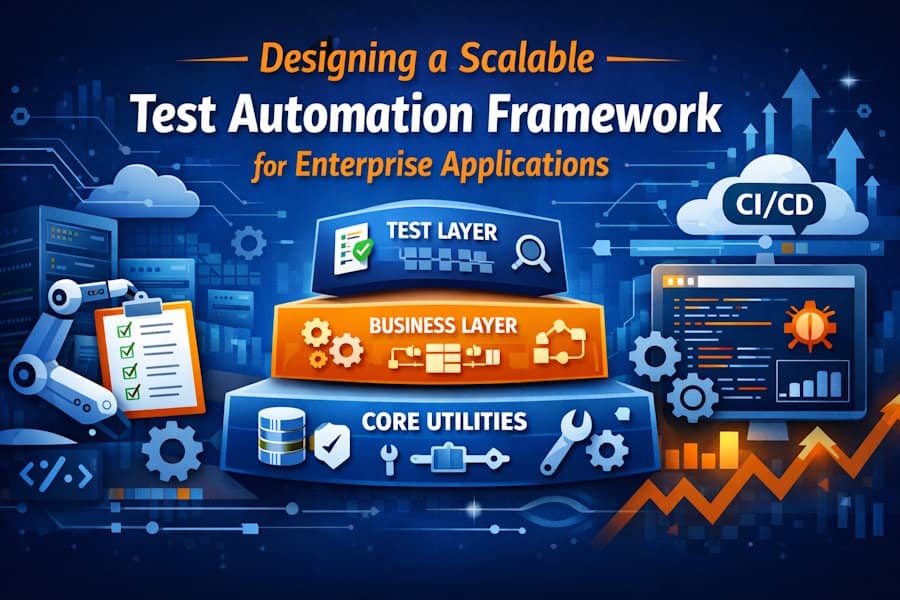
A scalable automation framework relies on clear separation of concerns. The most reliable enterprise frameworks follow a layered architecture.
1. Test Layer
This layer defines what is being tested.
Responsibilities:
- Test scenarios
- Assertions
- Test flow orchestration
Tests in this layer should be readable even by someone who didn’t write them. Ideally, they describe business behavior rather than technical steps.
Example mindset:
“Verify user can submit an order.”
Not
“Click button, wait 3 seconds, find element by XPath.”
2. Business / Action Layer
This layer defines how actions are performed.
Responsibilities:
- Reusable workflows (login, checkout, approval flows)
- Business logic abstraction
- Combining multiple UI or API actions into meaningful operations
This layer protects tests from UI and implementation changes. If a login flow changes, only this layer needs to be updated.
3. Core Utilities Layer
This is the foundation of the framework.
Responsibilities:
- Driver or client setup
- Wait strategies
- Configuration management
- Logging
- Reporting
- API helpers
- Common utilities
This layer should never contain test logic. Its job is to provide stable building blocks.
Enterprise-grade test automation services focus heavily on layered framework design because it allows teams to scale test coverage without scaling maintenance effort. Separating test logic, business workflows, and core utilities ensures that automation evolves alongside the application instead of constantly lagging behind it.
Page Object vs Screenplay vs Hybrid Approaches
Choosing the right design pattern is critical for long-term scalability.
Page Object Model (POM)
Best for: UI-heavy applications with stable screens.
Pros:
- Simple and widely understood
- Clear mapping between pages and actions
Cons:
- Page classes can become bloated
- Complex flows leak into page objects
Screenplay Pattern
Best for: Large teams and complex workflows.
Pros:
- Strong separation of concerns
- Highly reusable actions
- Scales well with multiple contributors
Cons:
- Steeper learning curve
- Overkill for small projects
Hybrid Approach (Most Practical)
Most enterprise teams succeed with a hybrid model:
- Page Objects for UI structure
- Business actions for workflows
- Screenplay-style tasks where complexity demands it
The goal is not patterning purity, it’s maintainability.
Handling Test Data, Configuration, and Environments
Hardcoded data is one of the fastest ways to kill scalability.
Test Data Strategy
A solid framework:
- Separates test data from test logic
- Supports multiple data sources (JSON, CSV, databases)
- Allows dynamic data generation
- Cleans up data after execution
Enterprise systems demand data isolation. Tests should not depend on pre-existing records unless explicitly designed.
Configuration Management
Environment-specific values must live outside the codebase:
- URLs
- Credentials
- Feature flags
- Timeouts
Use environment-based configuration files or runtime variables. A test should run the same way in QA, staging, and production-like environments; only the configuration should change.
Reporting and Logging: Built for Debugging, Not Decoration
Pretty reports are useless if they don’t help diagnose failures.
A scalable framework provides:
- Step-level logs
- Clear failure reasons
- Screenshots or traces at failure points
- Execution metadata (browser, environment, build)
Logs should answer one question quickly:
“Why did this test fail?”
If engineers need to re-run tests locally to understand failures, reporting is insufficient.
CI/CD Compatibility from Day One
Enterprise automation must be pipeline first.
A scalable framework:
- Runs headless by default
- Supports parallel execution
- Produces machine-readable reports
- Fails fast on critical issues
- Integrates easily with CI tools
Avoid assumptions like:
- Fixed screen resolutions
- Local file paths
- Manual environment setup
If automation cannot run reliably in CI, it is not production ready.
As enterprise systems move toward microservices and cloud-native architectures, scalable automation frameworks must also support execution across distributed systems without becoming brittle or slow.
Final Thoughts: Scalability Is a Design Decision
Scalable automation frameworks don’t happen accidentally. They are designed with long-term ownership in mind.
Key principles to remember:
- Separate concerns aggressively
- Optimize for readability, not cleverness
- Treat test code like production code
- Design for change, not stability
The true measure of a scalable framework is not how fast it runs today, but how little it breaks tomorrow.

