

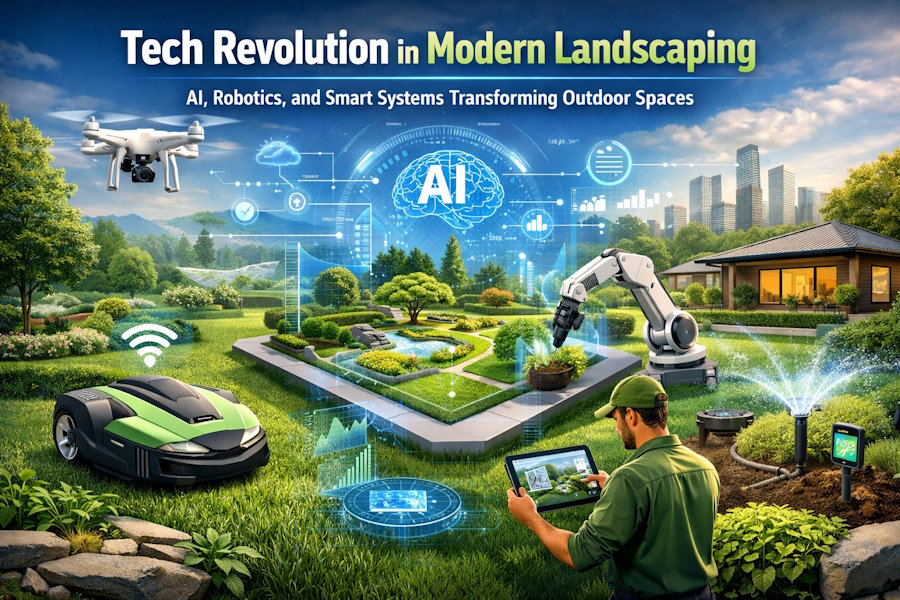
The outdoor maintenance industry is undergoing a dramatic technological transformation. From AI-powered design tools that create stunning layouts in minutes to autonomous robots that maintain lawns without human intervention, technology is reshaping how professionals and homeowners approach outdoor spaces. This guide explores the cutting-edge innovations driving efficiency, sustainability, and precision in modern ground maintenance.
Autonomous Mowing: Robots Taking Over the Lawn
Robotic lawn mowers have evolved from novelty gadgets to sophisticated machines capable of handling commercial-grade properties. Companies like Husqvarna, Graze Robotics, and Scythe are leading this revolution with GPS-assisted, battery-powered mowers that operate day or night, rain or shine.
Graze's AI-powered mowers operate with precision using advanced GPS guidance, computer vision, and 360° sensors to navigate complex landscapes effortlessly without requiring an operator. The economic impact is substantial—these autonomous mowers can reduce per-acre mowing costs from $75 to $33, representing up to a 50% reduction while eliminating downtime.
The technology stack powering these machines is impressive. Modern autonomous mowers feature robust sensor suites including lidar, odometry sensors, cameras, and optical computer vision technology. This allows property managers to set precise boundaries, designate no-mow zones, and monitor progress in real-time through mobile applications.
For a landscaper in Victoria, adopting robotic mowing technology enables them to serve more clients without proportionally increasing labour costs. Industry experts estimate that one person could potentially monitor the activities of 100 robotic mowers in the field, fundamentally changing workforce dynamics.
AI-Powered Design and Planning Tools
Artificial intelligence is revolutionising how outdoor spaces are conceptualised and planned. AI can help professionals create realistic plans and optimise planting schematics based on inputs like terrain, climate data, and sun exposure.
Modern design platforms leverage machine learning to analyse multiple variables simultaneously. AI platforms analyse weather, soil, plant health, and pests to recommend planting layouts, care schedules, and crop choices, helping gardeners and professionals promote healthy growth with fewer resources.
BIM Integration for Landscape Architecture
Building Information Modelling (BIM) has transformed architectural design, and now landscape professionals are adopting these same principles. With BIM capabilities, designers don't have to worry about updating all project information—they can design seamlessly in 2D and 3D, and when the model changes, schedules and drawings automatically update to reflect it.
Software such as Vectorworks Landmark, Autodesk Civil 3D, and RhinoLands enables professionals to create data-rich models that include information on plants, materials, drainage, and construction specifications. These 3D data-driven design tools and flexible BIM workflows allow designers to seamlessly update and coordinate plans, elevations, sections, and other details.
For landscapers in Victoria BC, BIM adoption means more accurate cost estimates, better collaboration with architects and contractors, and reduced design errors that could prove costly during implementation.
Drone Technology for Site Assessment
Drones have become invaluable tools for surveying properties and monitoring plant health. Drone technology allows professionals to map properties, assess plant health from the air, and pinpoint areas requiring intervention—all in a fraction of the time it takes manual inspections. For those unfamiliar with the concept, understanding what is drone mapping helps highlight how aerial data collection and imaging are used to create accurate, detailed representations of land and vegetation.
The efficiency gains are remarkable. On one particular project, landscape architect Eric Arneson gathered measurement data 90% faster using drone mapping—completing in an hour what would normally take two employees six hours.
Beyond simple surveying, drones equipped with high-resolution cameras and advanced sensors can help monitor lawn health by detecting early signs of pests, diseases, and nutrient deficiencies before they spread. This proactive approach to maintenance saves time, reduces chemical usage, and produces healthier outdoor environments.
Smart Irrigation Systems
Water conservation has become a critical concern, and smart irrigation technology addresses this challenge head-on. Systems like Weathermatic's SmartLink and Irrigreen use real-time weather data and soil moisture sensors to optimise watering schedules, with some solutions cutting water usage by up to 50% compared to conventional systems.
These systems go beyond simple timers. Smart irrigation systems use weather data and soil sensors to adjust watering schedules, ensuring lawns are watered only when needed. The integration with cloud platforms enables remote management and real-time monitoring through smartphone applications.
Soil Sensors and Environmental Monitoring
Soil sensors are invaluable tools for monitoring and improving soil health. These small, wireless devices can be placed in the ground to track vital soil parameters such as moisture levels, pH, temperature, and nutrient content.
The data collected by these sensors feeds into AI systems and data science models that can predict maintenance needs and optimise resource allocation. This precision approach reduces waste while improving outcomes—a win for both budgets and the environment.
3D Visualisation and Client Communication
One of the biggest challenges in outdoor design has always been helping clients visualise proposed changes. Modern rendering software has transformed this process. Real-time landscape rendering software allows architects to turn landscape designs into 3D visualisations in real time, eliminating production inconveniences and shortening the feedback loop.
Tools like Lumion, Enscape, and Twinmotion integrate directly with CAD and BIM software, enabling designers to quickly create photorealistic presentations. With over 3,000 assets, including plants, shrubs, trees, and grass, these expanding libraries help bring scenes to life and make them more realistic.
The impact on client relationships is significant. Clients can immediately understand and experience the designer's vision, eliminating subjective interpretation of sketches and the resulting misunderstandings and redesigns.
Predictive Maintenance and Fleet Management
AI-driven predictive analytics are helping companies optimise their operations beyond the job site. Professionals can use AI to perform predictive maintenance for equipment and optimise job planning for sites they may serve only once per week.
AI-led smart routing makes real-time adjustments based on traffic patterns to help professionals minimise travel time and reduce fuel consumption. This operational efficiency translates directly to improved profit margins and reduced environmental impact.
Business Case for Technology Adoption
The financial implications of embracing these technologies are compelling. Traditional mowing realises about a 5 percent average profit margin, but with automation requiring fewer on-site workers and enabling multiple tasks to be managed concurrently, margins could potentially increase to 25 percent.
The global AI market is expected to grow from $58 billion in 2021 to $309 billion by 2026, with companies leveraging AI projected to increase their cash flow by more than 120% by 2030.
Industry surveys indicate strong support for digital transformation. Aspire's 2025 Landscape Industry Report shows 73% of respondents see digital transformation as "somewhat or very important" for the industry.
Addressing Labour Challenges Through Technology
One of the most significant benefits of technological adoption is addressing persistent labor shortages. The real concern about robots stealing jobs is countered by the fact that the industry is already pretty short-staffed.
Rather than replacing workers, these technologies are augmenting human capabilities. Robotic mowers are designed to assist professionals—they're not here to take anyone's job. After rolling out robotic mowers across several types of client properties, hiring has increased at locations willing to embrace these technologies.
The machines handle repetitive tasks, freeing skilled workers to focus on design, customer relationships, and complex installations that require human judgment and creativity.
Environmental Sustainability
Technology is also driving sustainability improvements across the industry. Electric and battery-powered equipment eliminates emissions from gas-powered machines. Smart irrigation dramatically reduces water waste. Precision application of treatments means less chemical runoff.
AI and robotics can help the practice become more eco-efficient by reducing the use of harmful pesticides and improving soil health, thereby supporting sustainability goals for commercial properties.
Getting Started with Technology Integration
For professionals looking to modernise their operations, the path forward involves several considerations. Start by identifying pain points in current workflows—whether that's design iteration time, labour costs, or resource management. Then evaluate which technologies address those specific challenges.
Many software platforms offer trial periods, and equipment manufacturers provide demonstrations. Industry trade shows and conferences provide opportunities to see technologies in action and learn from early adopters.
For code-focused readers interested in the software side, understanding how to achieve high quality code becomes relevant when developing custom integrations or building applications that connect various smart systems together.
Additionally, as teams grow and collaboration becomes essential, implementing code-review best practices helps ensure thatcustom software solutions remain maintainable and scalable.
The Future Landscape
Industry insiders say this is the direction the industry is heading, and contractors must prepare now to adopt AI and robotic solutions to remain viable and competitive. These will simply be the tools the modern contractor uses.
The convergence of AI, robotics, IoT sensors, and cloud computing is creating possibilities that seemed like science fiction just a decade ago. Properties that once required crews of workers can increasingly be maintained by integrated systems of smart machines working in coordination.
As these technologies evolve, companies that embrace AI, robotics, and specialised software will likely gain a significant competitive edge by improving operational efficiency and addressing pressing industry challenges, such as labour shortages and environmental sustainability.
Conclusion
The technological revolution in outdoor maintenance isn't a distant future—it's happening now. From autonomous mowers patrolling golf courses to AI systems designing optimal planting schemes, technology is transforming every aspect of how we create and maintain outdoor spaces.
For professionals in the industry, the question is no longer whether to adopt these technologies, but which solutions will best optimise their unique operations. Those who embrace this digital transformation will find themselves better positioned to serve clients, manage resources efficiently, and build sustainable businesses for the decades ahead.
The tools are available, the benefits are proven, and the future belongs to those willing to innovate.

