

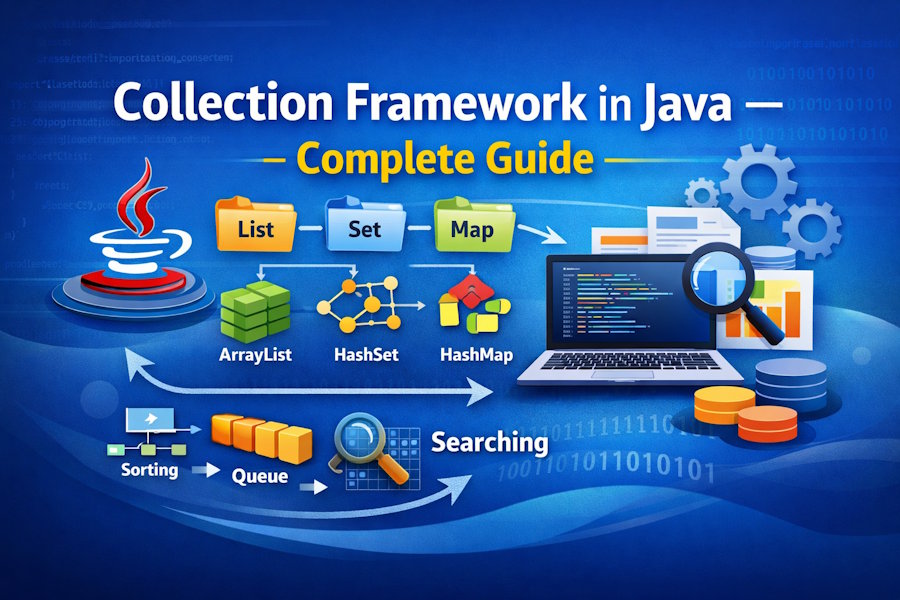
Java is a very popular programming language, which is widely used to build software applications. It works on the principle of object-oriented programming in which software applications are built around objects. The collection framework in Java is a powerful, unified architecture that provides standard interfaces like list, map, set and ready-made classes such as ArrayList, HashSet, and HashMap for storing, manipulation, and retrieving groups of objects efficiently.
In this article, we’ll cover the topic collection framework in Java with its common interfaces like list, set, Map, and Queue along with their implementation.
Why Do We Need the Collection Framework?
The collection framework in Java provides a unified, highly optimized set of ready-to-use data structures and algorithms that eliminates the need for developers to implement common data manipulation logic from scratch.
Given below is the list of the importance of collection frameworks in Java.
- Overcoming Array Limitation
Traditional arrays have a fixed size, which means their length cannot be changed once created. If a program attempts to access an index outside the valid range, it results in an IndexOutOfBoundsException, which is a runtime exception in Java.
Classes from the Collection Framework, such as ArrayList, provide dynamic resizing and automatically manage their internal storage. This reduces the chances of index-related runtime exceptions and makes collection handling safer and more flexible. For more details on handling such runtime issues, refer to Java Exception Handling.
- Reduced Programming Effort
The collection frameworks provides tested, high performance implementations on fundamental data structures like trees, hash tables, linked lists, etc. These data structures allow developers to focus on business logic rather than two-level data handling.
- Unified Architecture
All core data structures such as trees, lists, sets, queue, are based on a consistent hierarchy of interfaces within the java.util.package. This means that once a developer learn one part of the framework, they can easily use others, promoting code reusability and exchanging information between different APIs.
- Ready-to-Use Algorithms
There are algorithms available for developers for performing tasks like searching, sorting, and shuffling that work seamlessly across various collection implementations. This saves time and ensures that code is effective and reliable.
Collection Framework Hierarchy
The collection framework hierarchy is divided into two major parts:
- Collection Interface: It is the root, top-level interface of the hierarchy located in java.util.
- Map Interface: It operates independently to store data in unique key-value pairs.
Key Components of Collection Framework
Key components in Java work together to provide a unified architecture for storing and manipulating group of objects. These are classified as interfaces, classes and algorithms. Given below is the description of them.
- Interfaces: It is a blueprint of a class and a contact that specifies a set of methods that a class must implement.
- Classes: These are the concrete implementations that provide the actual data structures and functionality.
- Algorithms: Algorithms can refer to the powerful, built-in methods provided by the java.util.Collections class to custom implementations of standard computer science algorithms.
Collection Framework Hierarchy
Given below is the hierarchy chart of collection frameworks in Java.
   |
--------------------------------
|        |         |            |
List     Set       Queue       Map (separate)
Core Interfaces in Collection Framework
- Collection Interface
It is the root interface of the collection hierarchy that defines basic methods like add(), remove(), size() and clear(). It is located in the java.util package.
- List Interface
The list interface in Java represents an ordered collection of elements that allows duplicates and provides index-based access. Given below is the list of common implementations of the list interface.
- ArrayList: Given below is an example of creating an ArrayList in Java.
import java.util.ArrayList;

public class Main {

    public static void main(String[] args) {

        // Create an ArrayList object
        ArrayList<String> cars = new ArrayList<String>();

        // Add elements using the add() method
        cars.add("Tata");
        cars.add("BMW");
        cars.add("Ford");
        cars.add("Mahindra");
    }
}
- LinkedList: It is a class that implements the List and deque interfaces, providing a doubly-linked list data structure.
Given below is the implementation of LinkedList in Java.
import java.util.LinkedList;
import java.util.List;

public class LinkedListExample {

    public static void main(String[] args) {

        // Creating a LinkedList
        List<String> fruits = new LinkedList<>();

        // Adding elements to the LinkedList
        fruits.add("Apple");
        fruits.add("Banana");
        fruits.add("Cherry");

        // Adding an element at the first position
        ((LinkedList<String>) fruits).addFirst("Mango");

        // Display the LinkedList
        System.out.println("Linked List: " + fruits);
    }
}
Output:
LinkedList: [Mango, Apple, Banana, Cherry]
- Vector: The vector class in Java provides a thread-safe, dynamic array that can grow and shrink in size as elements are added or removed.
import java.util.Vector;

public class TpointTech {

    public static void main(String[] args) {

        Vector<String> v = new Vector<>();

        v.add("A");
        v.add("B");
        v.add("C");

        System.out.println(v);
    }
}
Output
[A, B, C]
- Set Interface
The set interface represents an unordered collection of unique elements. It does not allow duplicate values and at most one null value is allowed. The set interface in Java’s Collection framework is implemented through several classes, with the most common implementations being HashSet, LinkedHashSet, and TreeSet. Given below is an example of the implementation of the set interface through TreeSet.
Example
import java.util.Set;
import java.util.TreeSet;

public class TreeSetImplementation {

    public static void main(String[] args) {

        // Create a TreeSet of Strings
        Set<String> treeSet = new TreeSet<>();

        // Add elements to the set
        treeSet.add("Java");
        treeSet.add("Python");
        treeSet.add("C++");
        treeSet.add("JavaScript");

        // Print the set (elements will be in alphabetical order)
        System.out.println("TreeSet: " + treeSet);
    }
}
Output
TreeSet: [C++, Java, JavaScript, Python]
- Queue Interface
The queue interface in Java is used to hold elements prior to processing. It follows FIFO (First-In, First-Out) principle while processing the elements. Given below is the list of common queue implementations.
- PriorityQueue: In this, elements with the highest priority are always the ones processed first, regardless of their arrival time.
- ArrayDeque: It is faster than stack and LinkedList as it is a double-ended queue which allows elements to be efficiently added or removed from both ends.
Real-World Use Cases of Collection Framework
The Java Collection Framework is used extensively for managing, storing, and processing data in countless real-world applications. Given below is the list of real-world use cases of the collection framework in Java. For students trying to understand these concepts more effectively, java assignment help can be useful in simplifying complex topics and improving practical coding skills.
- Storing user data in web applications
- Managing employee records
- Caching frequently used data
- Implementing undo/redo functionality
- Processing large datasets
Conclusion
The Java Collection Framework is one of the most essential components of Java programming. It provides a powerful, flexible, and efficient way to store and manipulate data. Mastering the collection framework is a must for every Java developer from beginners to advanced.
This article describes the Collection Framework in Java with examples. To know more about Java and other programming languages, you can visit Tpoint Tech Website, where you can find various articles on programming along with working codes, interview questions and an online compiler where you can run your code.

