

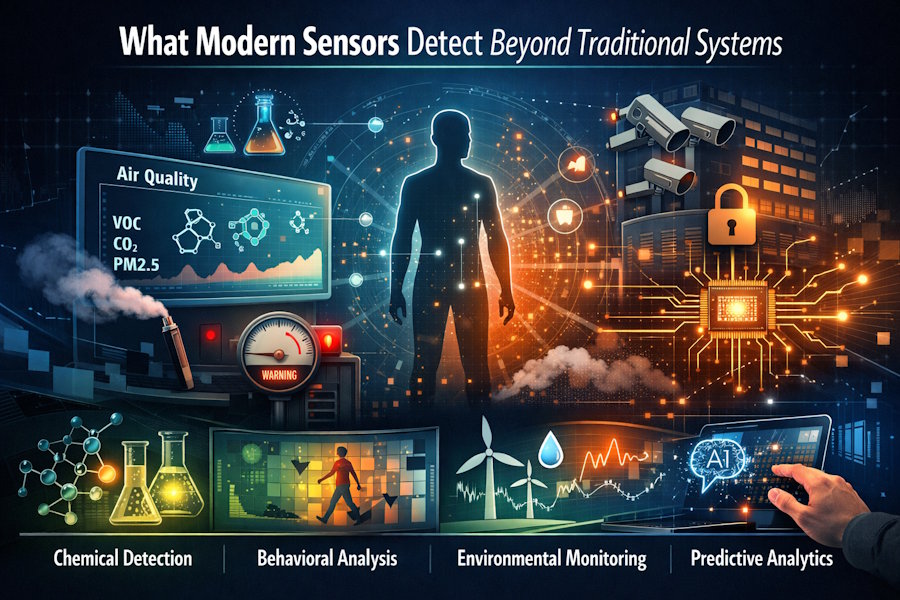
Sensors define how environments are monitored, controlled, and secured. Traditional systems were built to detect obvious, measurable events: motion, heat, pressure, or basic electrical signals. Modern sensors operate differently. They detect subtle patterns, chemical signatures, and behavioral indicators that older systems were never designed to observe. This shift has expanded what organizations can measure and how quickly they can respond.
Limits of Traditional Sensor Systems
Traditional sensors are typically single-variable devices. A motion sensor detects movement. A smoke detector detects particulate density. A thermostat measures temperature. These systems rely on thresholds. When a predefined limit is crossed, an alert triggers.
This approach works for binary events but fails in complex environments. Many risks do not present as sudden changes. They develop gradually or appear only when multiple signals are analyzed together. Traditional sensors lack the resolution and contextual awareness to identify these conditions early.
Multi-Modal Detection Capabilities
Modern sensors integrate multiple detection methods into a single system. Instead of measuring one variable, they analyze combinations of physical, chemical, and environmental data.
This multi-modal design allows sensors to identify events that are invisible to single-input systems. Pattern recognition replaces simple threshold logic.
Modern sensor platforms can detect:
- Chemical compounds at trace concentrations
- Changes in air composition over time
- Behavioral anomalies rather than physical triggers
- Environmental conditions that indicate risk before failure
This shift moves detection upstream, where intervention is more effective.
Air Quality and Chemical Signature Detection
Air monitoring is one of the clearest examples of advancement in vape detector hotel systems. Traditional systems focus on smoke or carbon monoxide. Modern sensors detect a broader spectrum of airborne compounds.
They identify volatile organic compounds, aerosolized chemicals, and particulate patterns associated with specific activities. This allows for differentiation between harmless background changes and actionable events.
In controlled environments such as schools or commercial buildings, systems like vape detectors identify aerosol signatures associated with vaping rather than relying on visual confirmation or odor complaints. This chemical-level detection enables objective monitoring without constant human oversight.
Behavioral and Contextual Awareness
Modern sensors are not limited to physical detection. They infer behavior from data patterns.
For example, instead of detecting motion alone, sensors can analyze movement frequency, duration, and timing to identify abnormal activity. In facilities management, this helps distinguish between normal occupancy and potential misuse of spaces.
Contextual awareness is created through data aggregation. A single signal may be meaningless. A pattern across time becomes actionable.
Environmental Drift and Early Warning Signals
Traditional systems often react after failure begins. Modern sensors detect drift.
Drift refers to gradual changes that indicate degradation rather than immediate fault. Temperature instability, humidity variation, or air quality trends may not trigger alarms individually but signal long-term risk.
By tracking baseline behavior and deviation, modern sensors provide early warnings. This supports predictive maintenance and preventative intervention.
Key indicators commonly monitored include:
- Incremental air quality degradation
- Repeated micro-vibrations in equipment
- Subtle power irregularities
- Gradual thermal inefficiencies
Early detection reduces downtime and repair costs.
Edge Processing and Real-Time Analysis
Traditional sensors transmit raw data to central systems for evaluation. Modern sensors process data locally.
Edge processing allows immediate analysis without network latency. This enables faster response and reduces bandwidth requirements. It also improves resilience when connectivity is limited.
Local processing supports advanced algorithms, including anomaly detection and adaptive thresholds. Sensors learn what “normal” looks like in a specific environment and adjust sensitivity accordingly.
Reduced False Positives Through Intelligence
One of the weaknesses of traditional sensors is false alarms. Static thresholds trigger alerts for benign events.
Modern sensors reduce false positives by incorporating contextual data and machine learning. They distinguish between harmless fluctuations and genuine risk.
This improves trust in the system. When alerts are meaningful, response times improve. Personnel stop ignoring alarms.
Accuracy becomes as important as sensitivity.
Integration With Broader Systems
Modern sensors are designed to integrate. They communicate with building management systems, security platforms, and analytics dashboards.
This integration allows automated responses. Ventilation adjusts when air quality shifts. Access controls respond to detected behavior. Maintenance tickets generate automatically.
Detection becomes part of a feedback loop rather than a standalone alert.
Privacy and Ethical Design Considerations
Advanced detection raises legitimate concerns. Modern sensors must balance capability with privacy.
Many systems intentionally avoid cameras or audio recording. Chemical and environmental sensing provides insight without capturing personal identity. This design choice allows monitoring while minimizing intrusion.
Ethical sensor deployment focuses on safety and health outcomes rather than surveillance.
A New Definition of Awareness
Modern sensors do not just detect events. They interpret environments.
By combining chemistry, physics, data analysis, and context, they reveal conditions that traditional systems could not see. This expanded awareness changes how risks are managed.
Detection shifts from reactive to proactive. From isolated signals to integrated understanding.
As environments grow more complex, the ability to sense subtle change becomes essential. Modern sensors provide that capability—and redefine what detection means.

