

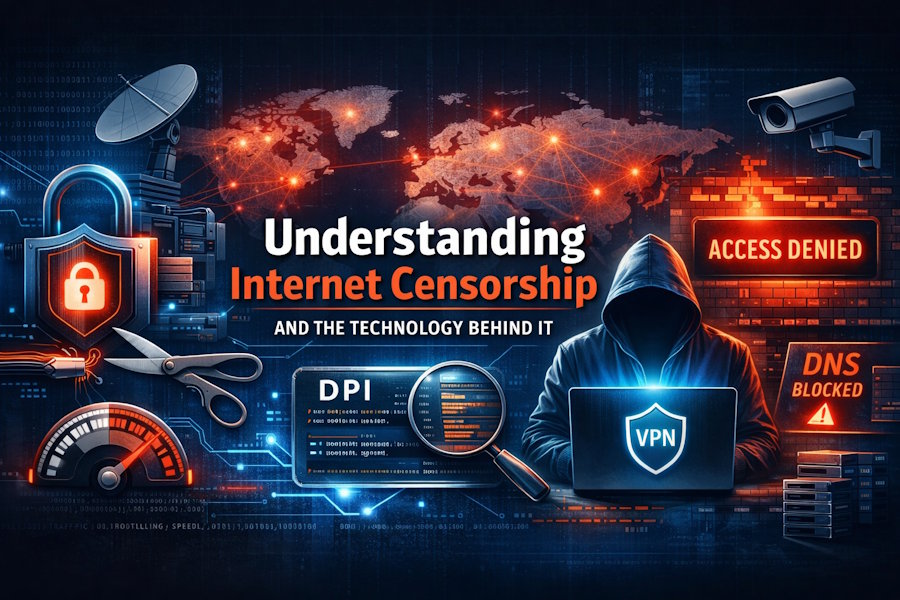
Internet censorship is not a single mechanism. It is a layered technical system designed to control access to information, shape online behavior, and enforce policy at scale. Understanding how censorship works requires examining the network infrastructure, filtering techniques, and enforcement tools that enable control over digital communication.
What Internet Censorship Actually Means
Internet censorship refers to the deliberate restriction, filtering, or monitoring of online content by governments, institutions, or service providers. The scope varies widely. Some systems block specific websites. Others regulate keywords, throttle traffic, or monitor user activity.
Modern censorship is rarely obvious. Instead of outright blocking, access may be slowed, redirected, or made unreliable. This creates uncertainty and discourages use without triggering visible errors.
Censorship is implemented at multiple layers of the network stack, which increases resilience and effectiveness.
Network-Level Blocking Techniques
At the lowest level, censorship operates directly on network infrastructure. Internet service providers are instructed to block or manipulate traffic based on destination, protocol, or content.
Common techniques include:
- IP address blocking for known servers
- DNS manipulation to redirect or nullify requests
- Port blocking to disable specific services
- Routing interference to drop packets
These methods are blunt but effective. They require constant updates as services change addresses or add redundancy.
Deep Packet Inspection and Content Filtering
More advanced systems use deep packet inspection (DPI). DPI analyzes the contents of data packets rather than just headers. This allows identification of protocols, keywords, and traffic patterns.
DPI enables filtering of encrypted and unencrypted traffic based on behavior rather than destination alone. Even when content is hidden, metadata reveals intent.
This technique is central to large-scale censorship systems because it allows selective blocking without full disconnection.
Application and Platform-Level Controls
Censorship also occurs at the application layer. Platforms may be required to remove content, restrict search results, or suppress topics.
Search engines can filter results. Social platforms can shadowban accounts. App stores can remove software entirely.
These controls are efficient because they shift enforcement responsibility to service providers. Compliance is often enforced through legal or economic pressure.
Surveillance and Behavioral Enforcement
Blocking access is only one part of censorship. Monitoring user behavior is another.
Logging systems record browsing patterns, connection attempts, and metadata. This data supports enforcement through deterrence. Users may self-censor when they believe activity is monitored.
Surveillance systems often integrate with identification infrastructure, linking network activity to individuals or devices.
Encryption and Countermeasures
Encryption complicates censorship but does not eliminate it. Encrypted traffic hides content but not necessarily destination or behavior.
Virtual Private Networks (VPNs) encapsulate traffic inside encrypted tunnels. This prevents local networks from seeing what is accessed. However, many censorship systems actively detect and block VPN traffic.
In heavily restricted regions, travelers and residents often rely on specialized tools such as the best VPN for China, which are designed to evade detection through obfuscation and protocol mimicry. These tools require pre-installation and regular updates to remain functional.
Traffic Throttling and Degradation
Not all censorship blocks content outright. Some systems degrade access until services become unusable.
This includes intentional packet loss, increased latency, or bandwidth throttling for specific destinations or protocols. The effect is subtle. Users experience timeouts or slow loading rather than explicit denial.
This approach reduces public awareness of censorship while achieving the same result.
Adaptive and Automated Enforcement
Modern censorship systems are adaptive. Machine learning models analyze traffic patterns and update filters automatically. This reduces reliance on manual rule creation.
Automation allows rapid response to new services, domains, or circumvention techniques. As users adapt, systems evolve.
This creates an ongoing technical arms race between censorship and evasion technologies.
Ethical and Technical Tradeoffs
Censorship systems trade openness for control. From a technical standpoint, they introduce complexity and points of failure into network infrastructure.
False positives can block legitimate traffic. Over-filtering reduces network performance. Encryption interference weakens security for unrelated services.
These tradeoffs affect not only users but also operators and businesses.
Why Understanding Censorship Matters
Internet censorship shapes access to information, economic opportunity, and digital safety. It affects travelers, businesses, journalists, and everyday users.
Understanding the underlying technology allows informed decisions about tools, risk, and compliance. It also clarifies why access issues occur and how systems enforce control without visibility.
Censorship is not accidental. It is engineered.
A System, Not a Switch
Internet censorship is not a single switch that turns access on or off. It is a layered system combining network controls, content analysis, surveillance, and behavioral pressure.
As networks grow more complex, so do censorship mechanisms. Understanding how they work is essential for navigating restricted digital environments and evaluating the broader impact of controlled connectivity.

