

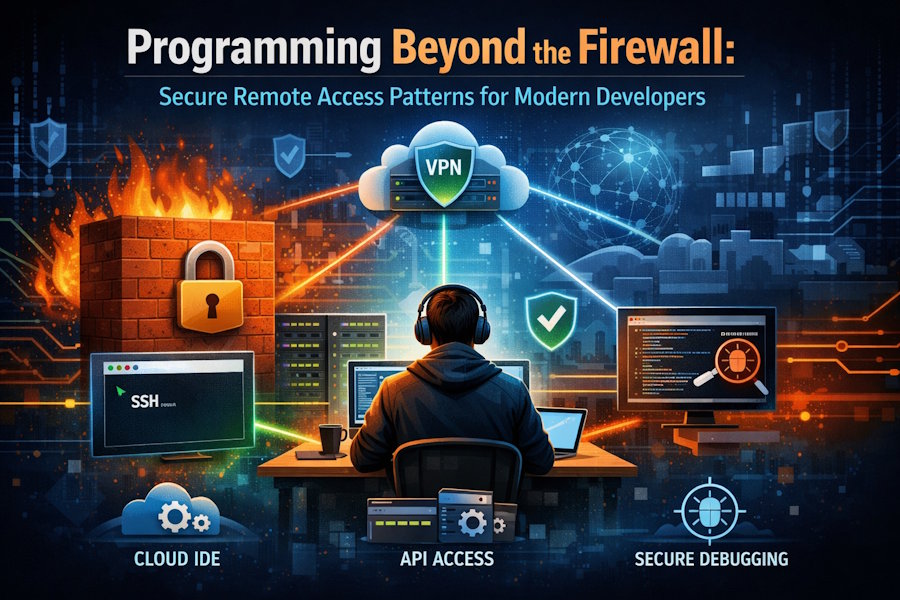
Modern programming happens on a single machine in a single location. Between distributed teams, cloud stacks, and on-call reliability, developers can reach across networks and developer environments. This is where remote access is essential for programming, with control and testing; it is not an IT afterthought.
This article will explore how programmers think about remote access today, the patterns for supporting it, and how network-layer tools fit into development workflows.
Why Remote Access Is a Programming Problem
From a developer's perspective, remote access can affect many things:
- Latency and debugging feedback when attaching to remote processes
- Security boundaries between staging and local machines
- Tooling compatibility with IDEs and CI systems
- Reliability when networks are unstable or geographically disturbed.
A backend engineer attaching a debugger to a remote service, a DevOps engineer can test region-locked APIs from a laptop, which can solve a variation of the same problem, and access remote resources.
Common Remote Access Patterns in Programming
Let’s take a look at some common remote access patterns available in programming that programmers and users must be aware of:
- SSH-Based Workflows
Secure Shell (SSH) remains foundational. Developers use it to:
- Access Linux servers
- Tunnel ports for database or APIs
- Run remote systems as part of scripts or CI jobs
SSH works well, but at scale also can also introduce some complexity and often requires exposed ports or hosts.
- Remote Development Environments
Tools like remote containers, cloud IDEs and remote interpreters let codes wrun where infrastructure lives. This helps reduce environmental drift and also increases secure connectivity.
- API-Forst Access
Instead of logging into machines, many teams can access APIs or admin services. But during development, you still need network-level access for endpoints, flgs and internal dashboards.
Each of these patterns reflects a different trade-off between control, convenience, and security. SSH favors direct access and flexibility, remote development environments prioritize consistency, and API-first models reduce surface area but still depend on reliable private connectivity. In practice, most engineering teams combine all three, choosing the right approach based on the system's sensitivity, the maturity of their tooling, and the expectations placed on developers working across distributed networks.
Where Network Abstraction Fits In
Application layer solutions sometimes aren't enough. Developers need a way to appear to be on the trusted network, especially when working remotely, travelling, or collaborating with teams across regions.
In these scenarios, a network abstraction layer can help ensure systems remain protected without compromising any service. For example, when a developer needs access to a private staging environment from an external network, a free VPN can provide a quick, low-friction way to establish remote connectivity for work and testing.
This approach supports developers to maintain productivity without weakening application-level security controls. The key is treating network access as contextual.
Secure Remote Debugging
Remote debugging is one sensitive remote access task, which often involves:
- Attaching live processes
- Inspecting memory or runtime state
- Exposing debug ports that should never be public
Some best practices includes:
- Bind debug ports to localhost and keep them secure
- Limiting access by IP or session
- Ensuring debug bulls never reach production unintentionally
From a programming standpoint, this means automating systems into tooling, allowing remote access paths to be logged and easily revoked.
Automation, Not Ad-Hoc Access
One of the biggest mistakes teams make is letting remote access evolve organically. Passwords get shared, firewall rules pile up and no one remembers why a port is open.
Developers can help by:
- Clarifying access rules in infrastructure
- Using short-lived credentials and sessions
- Making access requests auditable
Taken together, these practices turn remote access from an informal convenience into a deliberate, repeatable system. By treating connectivity as code and access as a temporary state rather than a permanent privilege, teams reduce security debt, simplify onboarding, and ensure that remote workflows remain predictable as systems and organizations scale.
Thinking Like a Systems Programmer
The best programmers think beyond syntax. They understand that networks fail, credentials leak and environments change; remote access is where these realities combine.
By designing workflows that assume remote work, teams can move faster and more safely.
Remote access isn’t always anput codes. It's about designing systems that expect developers to be anywhere and still work.

