

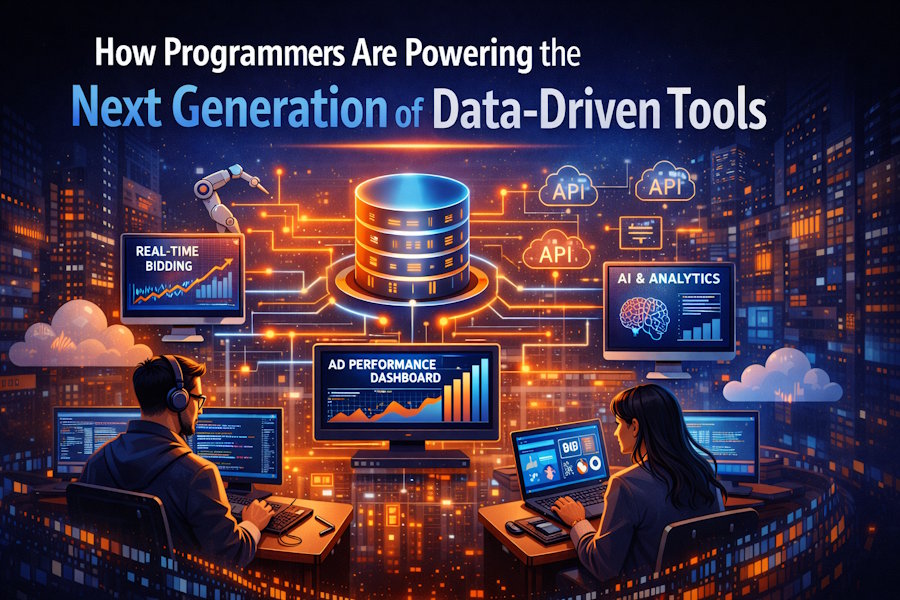
Programming has become the backbone of nearly every modern industry, and digital advertising is no exception. What was once a creative field focused on catchy slogans and visual design is now a deeply technical ecosystem driven by data pipelines, algorithms, and automation. Behind every real-time bidding system, analytics dashboard, and performance tracker is a complex stack of code written and maintained by software engineers.
As advertising budgets increasingly shift toward digital channels, the role of programmers has expanded. Developers now design the systems that collect, process, and analyze billions of data points every day. This technical foundation enables marketers to understand audience behavior, measure campaign impact, and optimize performance at scale.
According to a report from the Interactive Advertising Bureau (IAB), digital ad spending in the United States continues to grow year over year, reflecting the industry’s reliance on technology-driven solutions.
From Static Ads to Dynamic Systems
Early online advertising relied on simple banner placements and basic metrics such as impressions and clicks. Today’s digital campaigns operate through dynamic systems that react in real time to user behavior, device data, and contextual signals.
This transformation is only possible because of programming advancements such as:
- High-performance data processing frameworks
- Distributed systems for large-scale analytics
- Machine learning models for prediction and optimization
- APIs that connect advertising platforms with third-party tools
Each of these components requires careful design, testing, and maintenance. Developers must ensure that systems can handle high traffic volumes, deliver results quickly, and maintain data accuracy across multiple channels.
Why Advertising Technology Is a Programming Challenge
At its core, advertising technology is a data problem. Millions of events—page views, ad impressions, conversions—must be captured, stored, and analyzed in near real time. This requires robust backend architectures and efficient algorithms.
Programmers working in this space face challenges such as:
- Scaling databases to handle massive datasets
- Building fault-tolerant systems
- Ensuring low-latency data access
- Managing integrations across platforms
- Maintaining security and privacy compliance
These challenges are similar to those faced in other high-performance domains such as fintech, gaming, and cloud computing. The difference is that advertising platforms must also provide intuitive dashboards and actionable insights for non-technical users.
Where Developers Meet Marketers
Modern marketing teams rely on software tools that translate complex data into understandable metrics. These tools depend entirely on the systems engineers create behind the scenes.
One example of how technology supports marketing insight is through platforms offering ad intelligence software, which collect and analyze advertising data across digital channels. From a technical perspective, such platforms rely on sophisticated scraping, aggregation, normalization, and visualization processes. Developers build the pipelines that transform raw data into strategic intelligence.
This intersection of programming and marketing demonstrates how software engineering now directly shapes business decision-making.
Data Pipelines: The Engine Behind Marketing Insights
To power advertising analytics, developers construct complex data pipelines:
- Data Collection – capturing events from multiple sources
- Data Processing – cleaning, validating, and structuring data
- Storage – managing scalable databases and cloud infrastructure
- Analysis – applying algorithms and models to extract patterns
- Visualization – presenting insights through dashboards and reports
Each step requires careful engineering to ensure reliability and performance. Errors in any part of the pipeline can distort insights, leading to poor campaign decisions.
The Role of APIs and Integrations
Advertising platforms rarely operate in isolation. They integrate with social networks, analytics tools, content management systems, and CRM platforms. APIs enable this connectivity, allowing data to flow between systems seamlessly.
For programmers, this means designing flexible interfaces that support real-time data exchange while maintaining security and stability. Well-designed APIs make it easier for marketers to combine insights from different sources and build a unified view of performance.
Performance and Optimization
In digital advertising, speed matters. Delayed data can lead to missed opportunities or wasted budget. Developers optimize systems using:
- Caching strategies
- Load balancing
- Asynchronous processing
- Stream-based architectures
These techniques ensure that insights remain timely and actionable.
The Future of Advertising Technology
As artificial intelligence and machine learning continue to advance, advertising platforms will become even more automated and predictive. Developers will play a central role in building systems that adapt campaigns dynamically based on real-time performance data.
This evolution will demand even more sophisticated programming skills, from data engineering to model deployment.
Conclusion
The digital advertising industry is no longer driven solely by creativity—it is powered by code. Programmers build the infrastructure that transforms data into insight, enabling marketers to make informed decisions.
As advertising becomes more data-centric, the role of software engineering will only grow. By bridging the gap between technology and marketing, developers are shaping the future of how brands connect with audiences in the digital world.

