

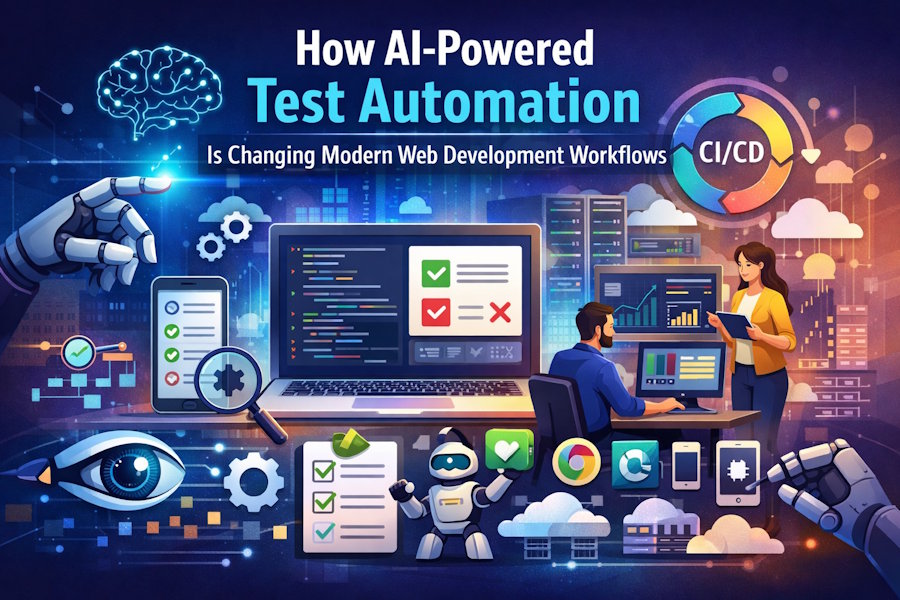
Artificial intelligence is transforming how developers build, test, and deploy modern web applications. What was once a manual, repetitive process has evolved into an intelligent system capable of adapting to change, identifying patterns, and reducing test maintenance effort. As web applications grow more complex and release cycles become shorter, AI-powered test automation is becoming a critical part of modern development workflows.
From Agile sprints to continuous integration and continuous delivery pipelines, intelligent testing is helping teams ship faster without compromising quality.
The Growing Complexity of Modern Web Development
Modern web applications are no longer simple static sites. They are dynamic, API-driven systems built with JavaScript frameworks, microservices, third-party integrations, and cloud-native infrastructure. With this complexity comes a significant testing burden.
Developers must account for:
- Frequent UI updates
- Multiple device and browser combinations
- Continuous feature deployments
- Rapid bug fixes and hot patches
Traditional automation frameworks often struggle in such environments. Even minor UI changes can break automated scripts, forcing teams to spend hours fixing brittle selectors and outdated test cases. Over time, maintenance becomes more expensive than writing new tests.
AI-powered automation addresses this challenge by introducing adaptive logic into the testing process.
How AI Reduces Test Maintenance Overhead
One of the most impactful contributions of AI in testing is the self-healing capability. Instead of relying strictly on static selectors, AI-driven systems analyze page structure, attributes, and historical execution data to locate elements intelligently.
When a button ID changes or a layout shifts slightly, the system can often adjust automatically without human intervention. This significantly reduces flaky tests and lowers the time spent repairing broken scripts.
AI also improves test stability by identifying patterns that lead to intermittent failures. By analyzing past runs, intelligent tools can detect timing issues, unstable elements, or environmental inconsistencies and adjust execution strategies accordingly.
The result is a more resilient test suite that supports rapid iteration rather than slowing it down.
Accelerating CI and CD Pipelines
Continuous integration and delivery rely on fast, reliable feedback. If automated tests take too long to execute or frequently fail for non-functional reasons, developers lose confidence in the pipeline.
AI enhances CI and CD workflows in several ways:
- Prioritizing high-risk test cases based on recent code changes
- Running only relevant test subsets instead of full regression suites
- Predicting failure likelihood before deployment
- Optimizing execution time across parallel environments
By intelligently selecting and scheduling tests, AI reduces build times while maintaining coverage. This enables teams to deploy features more frequently and with greater confidence.
In high-velocity environments, even small efficiency gains can have a measurable impact on product delivery speed.
Smarter Test Creation and Coverage
Beyond maintaining tests, AI is also changing how tests are created. Some platforms can generate test cases based on user behavior data, production logs, or application flows. Instead of relying entirely on manual scripting, developers can leverage intelligent suggestions to expand coverage.
For example, AI can analyze:
- Frequently used user paths
- Error-prone workflows
- Newly added UI components
- API changes affecting front-end logic
This approach ensures that testing focuses on real-world usage patterns rather than hypothetical scenarios.
In addition, visual validation powered by machine learning helps detect layout inconsistencies and UI regressions that traditional assertions might miss.
Integrating AI Testing Into Agile and DevOps
Agile teams prioritize collaboration, rapid iteration, and continuous improvement. AI-powered automation fits naturally into this culture because it reduces friction between development and quality assurance.
Instead of QA operating as a separate gatekeeping function, intelligent testing tools integrate directly into development pipelines. Developers can trigger tests on pull requests, receive immediate feedback, and fix issues before code reaches staging or production.
When choosing among modern test automation platforms, teams often turn to external resources for deeper comparisons, feature evaluations, and implementation insights. Developers can explore a QA blog to learn more about testRigor, Testim, Playwrite, BrowserStack, and other test automation tools to better understand how different platforms support modern workflows and scalable testing strategies.
This kind of research helps teams align tool selection with technical requirements and long-term growth plans.
Lowering the Barrier With Codeless Automation
Another significant shift in AI-powered testing is the rise of accessible, low-code and no-code solutions. Not every team has dedicated automation engineers, and maintaining complex scripts can become a bottleneck.
A modern codeless testing platform allows testers and product managers to create automated tests using plain language or visual interfaces. This reduces reliance on deep programming expertise while still delivering robust coverage.
By democratizing automation, AI tools encourage broader participation in quality assurance. Developers can focus on architecture and features while non-technical team members contribute meaningful test scenarios.
This shared ownership strengthens product quality across departments.
Improving Release Confidence
Ultimately, the goal of testing is to improve confidence in every release. AI-powered systems enhance this confidence by offering data-driven insights rather than simple pass or fail results.
Intelligent dashboards can highlight:
- Risk scores for new builds
- Historical failure trends
- Areas of the application with repeated instability
- Performance bottlenecks linked to specific features
Instead of guessing whether a release is safe, teams can rely on measurable indicators. This transforms testing from a reactive task into a proactive quality strategy.
With clearer visibility into risk, stakeholders can make informed decisions about release timing and scope.
Supporting Cross-Browser and Cross-Device Testing
Web applications must function consistently across browsers, operating systems, and devices. Manual verification across dozens of configurations is inefficient and error-prone.
AI-powered cloud testing environments optimize execution by distributing tests intelligently across platforms. Some systems analyze usage analytics to prioritize the environments most relevant to real users.
By focusing resources where they matter most, teams improve real-world reliability without wasting time on low-impact combinations.
The Future of Intelligent Testing
AI in test automation is still evolving, but its trajectory is clear. As machine learning models improve and integrate more deeply with development tools, testing will become even more predictive and autonomous.
Future capabilities may include:
- Automatic root cause analysis for failed tests
- Real-time performance anomaly detection
- Self-optimizing test suites that evolve with application changes
- Deeper integration with AI-driven code generation tools
As web applications become more intelligent, so must the systems that validate them.
Conclusion
AI-powered test automation is reshaping modern web development workflows by reducing maintenance overhead, enabling self-healing tests, accelerating CI and CD pipelines, and improving release confidence. It supports Agile and DevOps practices by providing faster feedback, smarter coverage, and scalable infrastructure.
For development teams navigating increasingly complex architectures, intelligent testing is no longer optional. It is a strategic advantage. By integrating AI-driven automation into everyday workflows, organizations can deliver reliable software at the speed today’s users expect.

