

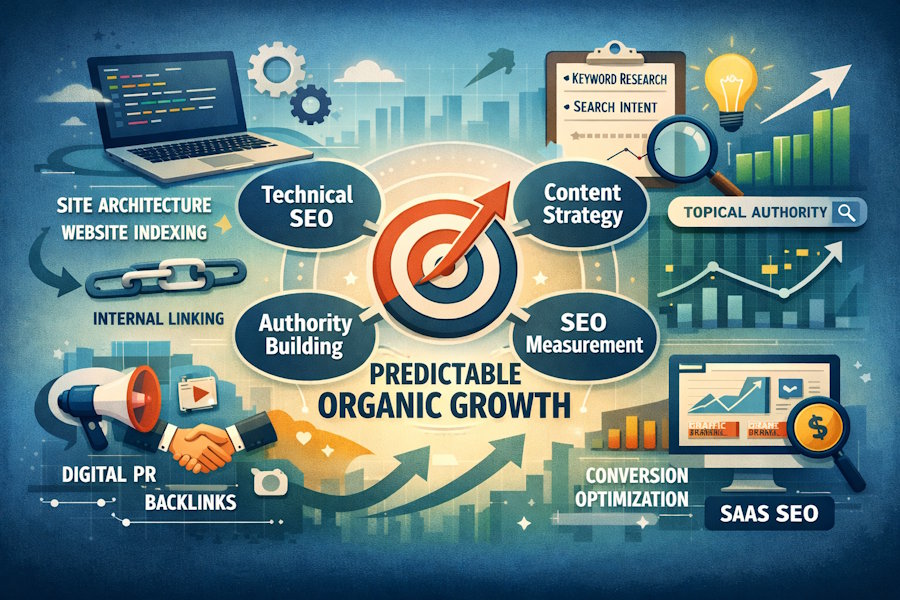
Predictable organic growth is not the result of a single tactic or a short term campaign. It is built through systems that compound over time. Companies that rely on organic channels as a primary growth driver tend to think in terms of frameworks rather than hacks. They invest in foundations, measurement, and iteration, knowing that sustainable acquisition depends on consistency and clarity rather than spikes in traffic.
At its core, organic growth is about earning visibility by being genuinely useful to the right audience at the right time. That means aligning technical performance, content quality, and search demand into a single operating model. Resources like this SaaS SEO Guide from MADX illustrate how organic growth becomes predictable when strategy, execution, and measurement are treated as a unified system rather than separate activities.
What predictable organic growth really means
Predictable organic growth means being able to forecast outcomes with reasonable confidence. It does not imply certainty or linear results, but it does mean understanding which inputs drive results and how changes will affect performance over time. Instead of asking “How do we get more traffic next month?”, the better question becomes “Which levers move qualified demand over the next six to twelve months?”
This mindset shifts organic growth from a marketing experiment to a growth channel that leadership can plan around. When organic acquisition is predictable, it supports hiring plans, revenue forecasts, and expansion strategies. That level of confidence only comes from repeatable processes backed by data.
Foundation first: technical and structural readiness
Every organic growth framework starts with technical readiness. Search engines rely on clear signals to understand, index, and rank content. If a site struggles with crawlability, page speed, or inconsistent architecture, even strong content will underperform.
Technical foundations include clean site structure, logical internal linking, fast loading pages, and reliable indexing. These elements create the conditions for growth but rarely drive it on their own. Their value lies in removing friction so that content and authority can compound without artificial limits.
Structure also matters beyond technical concerns. Clear categorization of pages, consistent URL patterns, and well defined content hubs help search engines understand topical relevance. At the same time, they help users navigate information intuitively, which improves engagement and conversion downstream.
Demand-driven content strategy
Once the foundation is in place, predictable growth depends on aligning content with real demand. This starts with understanding how your audience searches, not just what you want to say. Keyword research in this context is not about chasing volume. It is about mapping intent across the buyer journey.
Early stage content addresses questions, definitions, and problems. Mid-stage content focuses on comparisons, use cases, and evaluation criteria. Late stage content supports decision-making with proof, examples, and clear next steps. When content is planned across these layers, organic traffic becomes more qualified by design.
Consistency is more important than scale. Publishing content that reinforces topical authority within a defined problem space will outperform scattered efforts across unrelated topics. Over time, this builds trust with search engines and with users, which strengthens rankings and conversion rates together.
Authority and credibility as growth multipliers
Search visibility is influenced by how trustworthy a site appears within its domain. Authority is built through signals such as high quality backlinks, brand mentions, and engagement metrics. These signals act as multipliers on top of strong technical and content foundations.
Earning authority requires patience and relevance. Links that come from credible sources within your industry carry far more weight than volume driven outreach. Digital PR, partnerships, and genuinely useful resources tend to generate these signals naturally when executed with care.
Credibility is also reinforced on site. Clear positioning, transparent messaging, and evidence such as case studies or original insights all contribute to perceived trustworthiness. When users trust what they find, engagement improves, which feeds back into organic performance.
Measurement and feedback loops
Predictability depends on measurement. Without clear metrics, organic growth feels unpredictable even when it is working. A strong framework defines success indicators beyond raw traffic. These include qualified visits, conversion rates, assisted revenue, and keyword coverage across priority topics.
Tracking performance at the page and topic level reveals which efforts compound and which stall. This allows teams to refine content, update underperforming pages, and double down on areas with momentum. Organic growth then becomes an iterative loop rather than a one-time project.
Forecasting models play a key role here. By understanding historical growth rates, keyword potential, and conversion behavior, teams can set realistic expectations and align organic efforts with business goals.
Scaling the framework over time
As results accumulate, the framework scales through repetition and refinement. New content follows established patterns. Technical improvements are rolled out systematically. Authority building becomes more targeted. Each cycle strengthens the next.
This is where organic growth becomes a strategic asset. Instead of reacting to algorithm changes or traffic fluctuations, teams focus on strengthening fundamentals. The result is resilience. Even as channels evolve, a solid framework continues to generate demand because it is rooted in usefulness, clarity, and consistency.
Bringing it all together
The framework for predictable organic growth is not complex, but it is disciplined. It connects technical health, demand driven content, authority, and measurement into a single operating system. Companies that commit to this approach gain more than traffic. They gain a growth channel that compounds quietly and reliably over time.
For teams willing to invest in structure and long term thinking, organic growth becomes less of a mystery and more of a managed process. That shift is what turns visibility into sustained business impact.

