

The custom software development market was worth about $43 billion in 2024 and is expected to grow to around $146 billion by 2030. Software delivery has come a long way in recent decades. Older approaches like the Waterfall SDLC gave teams a clear structure, with each phase following the next. But while this method brought order, it often failed to keep up with what customers actually needed as things changed.
Most teams run on Agile and DevOps now. You get faster releases and more flexibility. Updates roll out in small, steady drops. But deployment and daily operations? Still a headache.
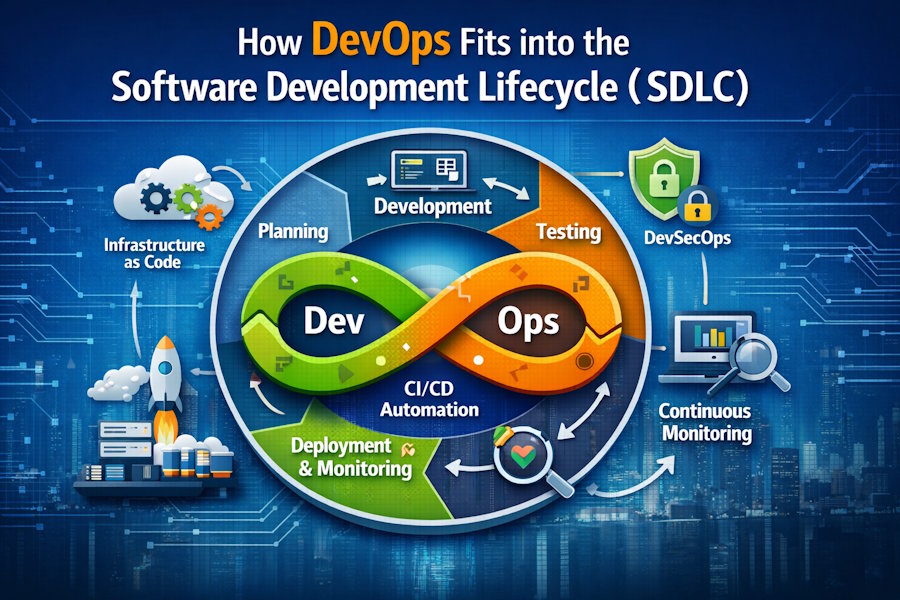
DevOps doesn’t replace the SDLC. It brings your dev and ops teams together. Automation, collaboration, and new tools like CI/CD and infrastructure as code mean faster releases and fewer headaches. Your team ships better software, every time.
Phase-by-Phase: Integrating DevOps into the SDLC
Planning & Requirements
Traditional software teams spend weeks planning and writing requirements before anyone writes a single line of code. It works if nothing changes. But when customers want something new, all that planning slows you down.
DevOps adopts a different method – planning is an ongoing process rather than a one-time activity at the outset. Requirements are frequently reviewed and modified based on actual user interactions and system performance.
Design & Development
DevOps speeds up your design and development. It brings in patterns and tools that help you deliver faster, scale easily, and automate more.
Say goodbye to bulky apps. With DevOps, you break things into smaller, independent services that work on their own.
No more manual setup. DevOps lets you manage servers, networks, and settings with code, not clicks.
Testing (Continuous Testing)
Older ways of building software treat testing as a separate step that happens near the end. This can cause delays and cost more if problems are found right before launch.
DevOps changes this by bringing in testing that happens all the time. It adds checks for quality during the whole process. Testing goes from being slow and done by hand to being automatic and always running.
Key DevOps testing methods include:
- Automated unit tests that run with each code submission
- Integration tests that check how services interact
- Early security checks (DevSecOps) to find vulnerabilities
- Ongoing performance and stress tests
- Automatic provisioning of test environments using IaC and containerization
Deployment (DevOps's Central Focus)
The basic principle of DevOps shows its complete implementation through deployment because development work combines with operational activities in production environments.
The process of releasing software used to be done through manual methods which occurred at irregular intervals and posed significant risks. The teams encountered problems with system outages and rollback operations and last-minute project failures.
DevOps substitutes this with Continuous Integration and Continuous Delivery/Deployment (CI/CD) frameworks. These systems automate the complete release workflow, facilitating frequent and stable deployments.
Real-World Impact: Efficiency and Speed
Today, organizations need to roll out updates quickly while keeping their systems stable. DevOps helps with this by making automation a key part of every process.
With tools like IaC and CI/CD pipelines, teams can set up environments, run tests, and launch new features automatically, so they do not have to repeat manual steps every time. This lowers the chance of mistakes, keeps releases consistent, and speeds up how quickly users get new features.
Automation also saves teams from boring, repetitive work, letting them focus on building new ideas and improving what already exists.
The benefits are tangible: companies that implement DevOps deploy updates more often, experience fewer system issues, and can swiftly adjust when business priorities shift. It's about being more efficient, not necessarily putting in more effort.
ScienceSoft's initiative for a North American digital signage startup showcases the effectiveness of high-speed DevOps. ScienceSoft developed automated CI/CD pipelines with Drone CI, Docker, and Kubernetes, allowing for as many as 100 commits daily, featuring distinct deployment stages and rapid recovery through backup snapshots.
Post-Deployment: Monitoring and Operations
The SDLC process with DevOps practices continues after software deployment because deployment functions as the beginning of continuous improvement work for the system.
The system needs monitoring and operational work together with user feedback to create reliable performance which will guide upcoming development efforts.
Continuous Monitoring
The current applications operate through multiple distributed services together with cloud infrastructures and dynamic user requirements. The system lacks monitoring which results in users experiencing problems that remain hidden until they contact support.
Continuous monitoring keeps teams informed about system performance, security, and availability after deployment.
DevOps teams monitor application performance by tracking response times, transaction volumes, error rates, and service delays. This approach helps them detect issues before users are affected.
Feedback Loops
DevOps is based on the principle of continuous learning and enhancement. Simply keeping an eye on your systems won't cut it – the true effectiveness arises when you apply insights gained from production to influence your future development. This establishes a feedback loop where genuine data regarding user interactions with your software flows back into the development process, guiding upcoming plans and features.
The DevOps teams receive feedback from all their different feedback sources. The team studies user behavior and experience metrics to see how customers use the product, which features they use most, the points where users encounter difficulties and stop working, and the way user engagement changes throughout time. The data shows what works well and what areas require development.
When problems happen or systems stop working after they are being used, it gives teams a chance to learn. Teams look into why things went wrong, find bugs that keep happening, and spot weak points in how they set up their software. These lessons help prevent the same problems from happening again.
Data about how the system is working also helps make things better. Watching the system shows which services are not working well and need to be improved, where slowdowns make it hard for parts of the system to talk to each other, and when more resources are needed to handle more users.
Ultimately, DevOps teams maintain ongoing communication with users, product owners, and stakeholders. Frequent discussions ensure that the product continues to develop in the right way and fulfills everyone's expectations.
Key Benefits of the DevOps-SDLC Synergy
DevOps helps your teams work together. No more separate groups. Planning, building, testing, and delivering all happen in one smooth process. Everyone stays on the same page, from beginning to end.
Reduced Time-to-Market
A key benefit of DevOps-SDLC integration is faster, more frequent software delivery.
Faster release cycles allow businesses to:
- Respond quickly to customer needs
- Deliver new features ahead of competitors
- Reduce delays caused by manual processes
- Transform ideas into production-ready software within days rather than months
Improved Software Quality
DevOps improves software quality through its continuous implementation of quality assessment methods throughout the development cycle.
Automated tests execute whenever a code modification occurs, allowing for immediate problem detection instead of allowing issues to accumulate. The teams use early bug detection methods to find and fix issues when they are still simple to address, which helps them avoid discovering problems right before the product release time when repairs become difficult and expensive.
Implementing Infrastructure-as-Code ensures that all environments – where developers work, where testing is conducted, and where the final product operates – are consistent. This resolves the "it works on my machine" issue and guarantees that what is tested reflects what customers ultimately receive.
Continuous monitoring tracks all systems in real-time to enable instant detection of performance problems and security threats by the monitoring team. This combination with quick feedback mechanisms enables teams to obtain production insights while they proceed with software enhancement activities which continue after the software has been released.
The commitment to quality exists as an ongoing process which extends beyond the final release of a product.
Conclusion
DevOps breaks down silos and speeds up your software delivery. Automation, teamwork, and constant improvement are built in from day one. You get faster releases, fewer headaches, and software that actually meets your business goals.
Businesses that wholeheartedly adopt DevOps and incorporate automation as a fundamental aspect of their operations will thrive. The inquiry has shifted from "Should DevOps isn’t a maybe anymore. The question is how fast you can get it running – and how well you do it. Teams that move first win: they innovate faster, adapt to change, and keep customers happy. DevOps is the way forward.

