


You’d think that after decades of “You’ve got mail”, email would feel old-hat. Yet for password resets, receipts, and usage alerts, nothing beats a plain old email, provided it lands in seconds, renders correctly, and never hits spam. Users expect it, regulators demand it, and revenue relies on it. That’s why we spent the first weeks of 2026 spinning up five of the best transactional email services on staging servers, throttling them with traffic spikes, and watching dashboards light up like New Year’s Eve. Below you’ll find the services that impressed us most and the pitfalls we hit so you don’t have to.
What We Looked For When Choosing a Transactional Email Provider
Reliability is obvious, but we drilled deeper. We measured median delivery time, inbox placement across Gmail, Outlook, Yahoo, and iCloud, TLS enforcement, and how gracefully a transactional email provider handled bursts 10 times the contracted volume. We also graded the API experience: clarity of docs, SDK coverage, and whether webhooks actually triggered on time.
Cost transparency mattered, too. Some vendors advertise “from 0.10 per thousand” but hide the fact that you need a $150 support plan to unlock meaningful SLAs. Finally, we scored each candidate’s compliance story because audits are getting tougher every quarter. Only platforms that ticked those boxes earned a place on this list of transactional email providers.
How We Tested (yes, we had to Send email in C# at 2 a.m.)
Our lab stack was a plain-vanilla Docker swarm running Node.js, Python, Go, and, because many legacy apps still live there, a .NET 8 microservice built to send email in C#. Round-robin load balancing made sure every provider was hammered from the same IP range, eliminating network bias. We captured SMTP transaction logs, parsed headers for DKIM and SPF alignment, and fed bounce data into BigQuery for side-by-side comparison.
We simulated typical SaaS traffic: sign-ups, double opt-ins, purchase receipts, and weekly usage digests. Peak bursts hit 4,000 messages per second – more than enough to expose flaky edge cases. By Monday morning, we’d sent two million emails and had enough data to hand-pick five clear winners.
UniOne – Speed Without Sweat
Source: UniOne
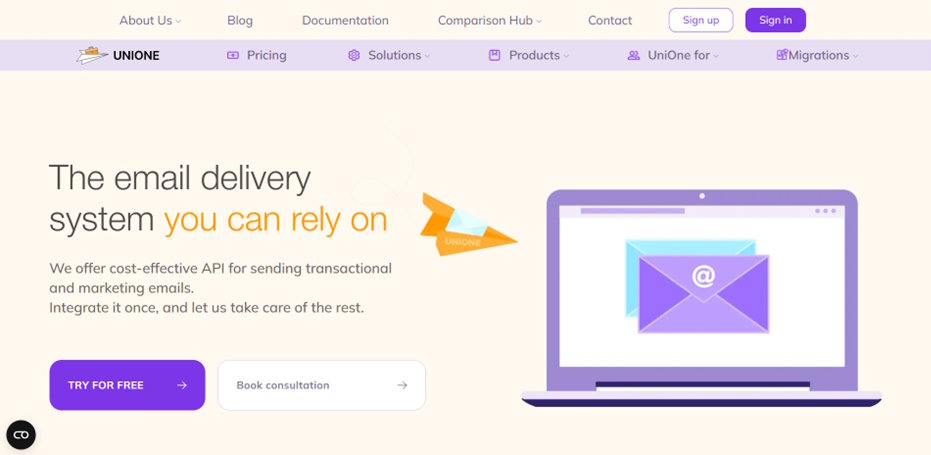
UniOne was the first service to finish our test run, and it wasn’t even close. Median delivery time sat at a ridiculous five seconds end-to-end, measured from API call to inbox “delivered” event. The docs are clean, the SMTP endpoint behaved exactly like Postfix, and the REST API returned helpful error objects instead of cryptic numeric codes.
Templates live in a tidy UI with an AI-assisted HTML builder that suggests semantic structure and inlines CSS automatically. We appreciated the ability to version templates and roll back with a click – handy during late-night hotfixes.
We did find pricing less transparent for startups sending under 20k messages monthly. You must ping sales to unlock the finer-grained tiers or dedicated IPs. Once you do, support is lightning-fast: most of our tickets received a real answer (not a bot) in under ten minutes, even at 03:00 UTC.
Deliverability tied Postmark in our inbox tests, and UniOne’s security story, full GDPR alignment, S/MIME support, and optional message-retention controls make it attractive for FinTech and insurance. In short, UniOne feels like high-grade infrastructure you can grow into rather than out of.
Postmark – Deliverability First, Pricing Second
Source: Postmark
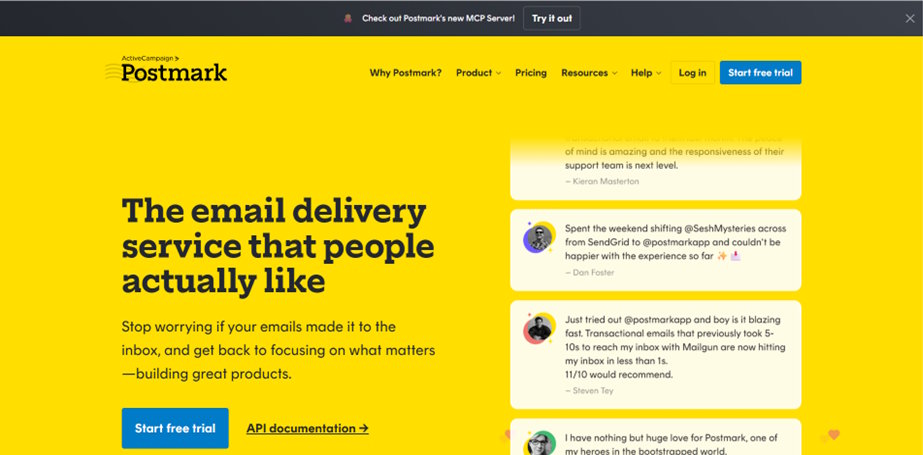
For years, Postmark has owned the “just-land-in-the-inbox” niche, and 2026 hasn’t changed that. Inbox placement averaged 94%, the highest in the batch, and latency held steady at sub-20-second chunks even during brute-force bursts. If deliverability anxieties keep you awake, Postmark will help you sleep.
Setup is frictionless: verify your domain, add SPF/DKIM records, and you’re live. The UI surfaces bounce trends, open rates, and engagement graphs without burying them in submenus. Integration with ActiveCampaign means marketing workflows can piggy-back on the same events, reducing tool sprawl.
The catch? Cost. At 10k emails, the $15 entry plan is fine, but the curve gets steep above 300k unless you negotiate volume discounts. Also, mail is stored only in U.S. data centers. Many EU SaaS founders we speak with offset that by encrypting payloads client-side, but it’s a hoop you need to jump through.
If budgets allow, Postmark remains a contender for the best transactional email service when deliverability trumps everything else.
However, if you need a cheaper option, you can look into the best alternative to Postmark on the market.
SMTP.com – Enterprise Horsepower for High-Volume Ops
Source: SMTP.com
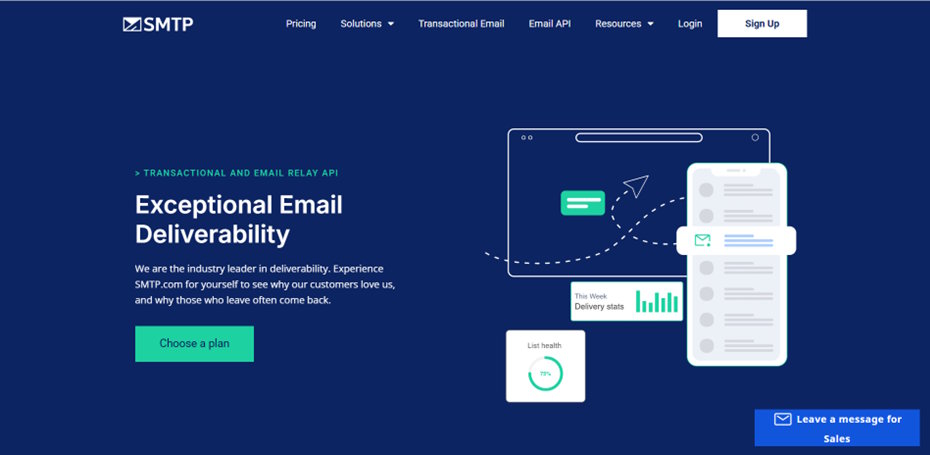
Some platforms feel modern; SMTP.com feels battle-tested. This is the provider that banks and marketplaces quietly use when they’re pumping out tens of millions of OTPs. We hit it with 400,000 messages in ten minutes, and the average latency was still clocked under eight seconds.
What sets SMTP.com apart is its “reputation defender”. The system spots sudden bounce spikes, quarantines risky addresses, and pings your Slack with a heads-up. Coupled with granular webhooks, it saved us from burning sender score during a malformed import.
The flip side: pricing starts at $25 for 50k emails and scales sharply. For seed-stage apps, it can feel heavy, both in price and in breadth of options. Yet for teams already managing dedicated deliverability engineers, SMTP.com’s analytics heat maps and enforcement tools might actually save salary costs.
If you’re hunting the best transactional email software for true enterprise volume, put this veteran on your shortlist.
Sender – Transactional Power Without the Price Shock
Source: Sender
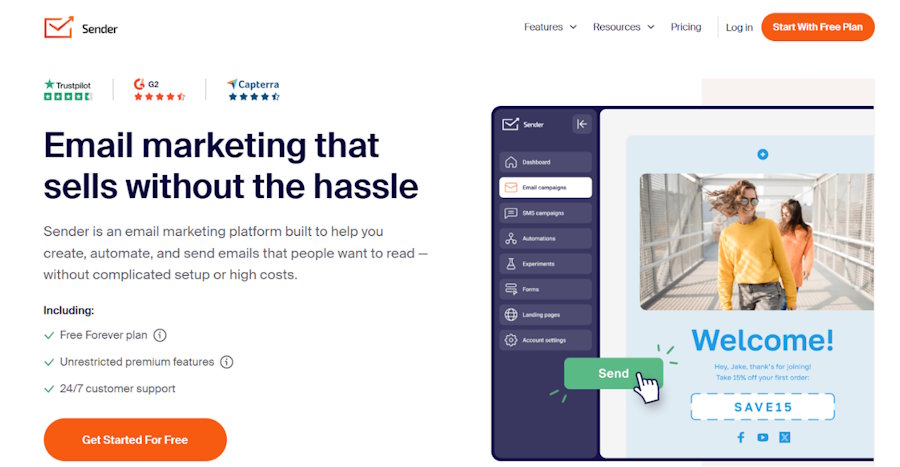
Sender stands out by giving small and growing businesses more than just a pipe for triggered messages. In addition to transactional emails, it bundles newsletters, bulk campaigns, automation workflows, and audience segmentation into one cohesive platform, which makes it appealing for teams that don’t want to juggle separate tools as they scale.
The interface is refreshingly straightforward as well: an intuitive dashboard, drag-and-drop builder, and responsive templates keep setup and campaign work from becoming a developer-only task.
We also like how Sender balances ease of use with practical depth. SMTP and API options cover transactional sending, while built-in analytics make it easier to track performance without bouncing between dashboards. Standard plan users also get access to ecommerce reports, which add useful purchase data for brands that want more context behind their email results.
The trade-off is that Sender is broader than a pure-play transactional specialist, so teams chasing highly technical infrastructure controls may find some enterprise-focused platforms more granular. Still, for companies that want the best transactional email service without paying enterprise-level rates, Sender feels like a smart option that can handle both operational emails and marketing needs under one roof.
SendGrid – The Swiss-Army Knife You Already Know
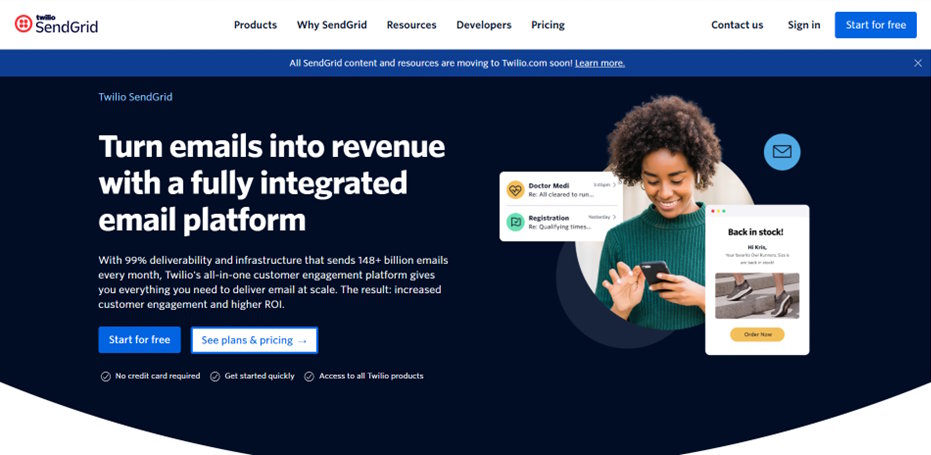
Source: SendGrid
Twilio’s SendGrid keeps evolving, and the 2026 release doubled down on machine-learning-driven engagement scoring. During tests, adaptive throttling nudged our campaigns just below Gmail’s rate limits, rescuing two percent of messages that would have otherwise queued.
Developers love the choice: SMTP relay for the quick wins, or a fully RESTful API that spits out Node, Python, Go, Java, and cURL snippets right in the docs. Marketing colleagues appreciate the drag-and-drop designer living next door to code-level templates – one login for both worlds.
We did wrestle with UI sprawl. The dashboard tries to do a bit of everything, and new users may click in circles to find DNS settings. Cost is middle-of-the-road: $19.95 for 100k messages, but dedicated IPs and sub-user management cost extra.
Overall, SendGrid is arguably the best transactional email software for hybrid teams that want one vendor for both triggered messages and promotional sends.
Elastic Email – Budget Pick with Caveats

Source: Elastic Email
Elastic Email drew us in with a free tier (100 emails/day) and startlingly low paid rates: $9 gets you 30k monthly. Integration was painless; their single-endpoint REST call is genius for hack nights.
But deliverability lagged. Outlook and Yahoo spam-boxed roughly 15% of our test traffic on the shared IP. Support admitted that free and entry-level plans ride on those shared ranges. To their credit, the agent walked us through upgrading to a private IP, and the results improved, but that erases much of the price advantage.
Elastic’s editor and contact list UI feel built for newsletters more than surgical transactional bursts. Still, if your audience skews Gmail and cost control matters above all, Elastic remains a pragmatic choice among transactional email providers. Just budget extra time for IP warm-up and domain alignment.
Key Metrics That Matter After Go-Live
Choosing a vendor is step one; watching the right dials keeps you safe after launch. We track six metrics weekly:
- Delivery latency (P50 and P95)
- Inbox placement rate by mailbox provider
- Bounce type distribution (hard vs. soft)
- Complaint rate (FBL signals)
- TLS usage percentage
- Time to first open
Recent data from The Global Statistics shows that 17% of legitimate transactional messages still miss the inbox, usually because senders ignore one or two of those metrics. Keeping them visible in Grafana or Datadog means issues rarely survive longer than a sprint.
Avoiding Common Integration Pitfalls
Even the best transactional email services can trip you up if you wire them in a hurry. Three mistakes keep cropping up during client audits:
- Hard-coding credentials in repos. Rotate keys via your secret manager and set a 90-day expiry by default.
- Forgetting to back off on 4xx responses. Exponential retries prevent accidental DDoS of the provider and preserve reputation.
- Sending HTML only. Always include a plain-text alternative; some B2B filters score one-part messages as marketing spam.
Fix those early, and you’ll look like a hero when audits roll around.
Compliance and Data Residency in 2026
Five years ago, you could choose any U.S. data center and call it a day. Today, between GDPR, LGPD, and the still-evolving APPI amendments in Japan, data-residency questions hit every RFP. Before signing, map where the provider stores:
- Message bodies;
- Engagement logs;
- Backup snapshots.
Then check whether they offer EU or APAC-only clusters. According toCapgemini, 66% of enterprises now require regional storage options. Most transactional email providers on our list have reacted with EU endpoints, but only UniOne and SendGrid let you keep event logs in-region by default.
Choosing Among the best transactional email services
So where does that leave us? If raw speed is king, UniOne edges ahead. For pristine inbox placement, Postmark still rules. SMTP.com shines once you cross the 500 k-per-month line. SendGrid brings marketing and transactional under one roof, while Elastic Email is the scrappy option when cash is scarce.
Remember, “best” is situational. Before migrating, map your requirements:
- Current and 18-month projected volume
- Regulatory constraints (GDPR, HIPAA, PCI)
- Tech stack and languages (do you really need a Go SDK or just SMTP?)
- Support expectations – are you okay with next-business-day tickets, or do you need a 15-minute SLA?
When you match those needs to provider strengths, the best transactional email service for your stack becomes obvious.
Final Thoughts
Transactional email is infrastructure. Treat it like your database or payment gateway: test, monitor, and hold vendors accountable. All five services here earned their spot by surviving our abuse, but none is set-and-forget. Track bounce spikes, rotate keys, and schedule quarterly deliverability reviews.
Industry analysts still report that phishing remains the entry vector in most breaches, and poorly configured mail servers amplify that risk. Partnering with reliable transactional email providers is step one; maintaining hygiene is the long game.
Pick the partner that fits your roadmap today, keep migration fallbacks documented, and you’ll never panic when the next signup flood hits – your users will get their messages, your KPIs will look sharp, and you can finally close that monitoring tab and get some sleep.

