

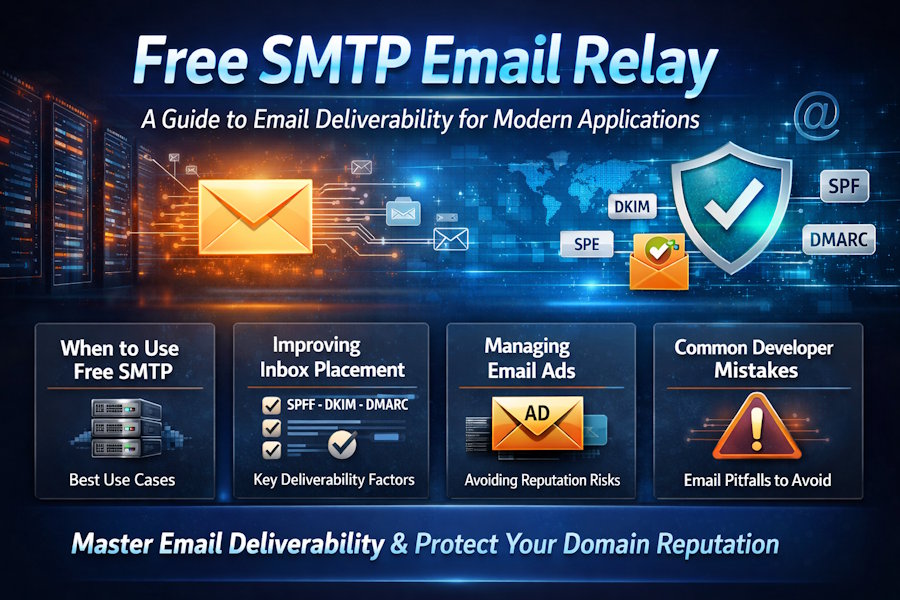
Email is one of the oldest technologies on the internet — and still one of the most powerful. From transactional alerts to marketing automation, nearly every modern application depends on email infrastructure.
Yet many developers underestimate how complex email actually is.
- Sending an email is easy.
- Ensuring it reaches the inbox is not.
Here we are exploring how a free SMTP email relay service fits into modern application architecture, how developers can evaluate email deliverability and platforms, and what it really takes to successfully manage email ads without damaging domain reputation.
Why Developers Still Use SMTP Relay
Despite the rise of email APIs and marketing automation platforms, SMTP (Simple Mail Transfer Protocol) remains widely used because:
- It is universally supported
- It integrates with almost every backend framework
- It works across programming languages
- It’s compatible with legacy systems
- It’s easy to configure in hosting environments
A free SMTP email relay service allows developers to route outgoing emails through a trusted third-party infrastructure instead of sending directly from their own server. This helps avoid common issues like:
- IP blacklisting
- Poor domain reputation
- Spam filtering
- Delivery failures
For startups, MVPs, internal tools, and SaaS prototypes, free SMTP tiers offer a cost-effective starting point.
However, choosing an email relay service without understanding deliverability can create long-term risks.
What Email Deliverability Really Means
Email deliverability is not just about whether an email is sent successfully.
It refers to whether the email:
- Reaches the recipient’s mail server
- Avoids spam filters
- Lands in the primary inbox instead of promotions or junk
- Is not blocked or rejected
Modern inbox providers (Gmail, Outlook, Yahoo, etc.) evaluate dozens of signals, including:
- Domain reputation
- IP reputation
- Authentication records (SPF, DKIM, DMARC)
- Spam complaint rate
- Bounce rate
- Engagement metrics (opens, clicks, replies)
- Sending frequency consistency
Understanding email deliverability and platforms is now a critical skill for developers building communication systems.
The Role of Email Platforms Beyond SMTP
SMTP is only one piece of the email ecosystem.
Modern applications often need:
- Template management
- User segmentation
- Automation workflows
- Scheduled campaigns
- Analytics dashboards
- Suppression list management
- A/B testing
These capabilities go beyond simple relay.
This is where full-service email deliverability and platforms become important. They provide tools to monitor performance, optimize sending patterns, and maintain sender reputation. Choosing a reliable SMTP service provider can also help businesses improve email delivery rates, manage sending volumes, and maintain consistent communication with their subscribers.
Developers should think of SMTP as a transport layer — not a marketing solution.
Managing Email Ads Without Hurting Deliverability
When applications send promotional emails, newsletters, or sponsored content, they are effectively running email advertising campaigns.
To properly manage email ads, developers must implement:
- Explicit opt-in systems
- Unsubscribe management
- Complaint monitoring
- Bounce suppression
- Segmented sending
- Gradual scaling (IP warming)
Mixing transactional emails with advertising content on the same sending infrastructure can damage reputation.
Best practice architecture includes:
- Separate subdomains for transactional vs marketing
- Separate IP pools
- Independent reputation monitoring
- Strict suppression handling
This ensures that critical emails like invoices and password resets are not affected by marketing campaigns.
Common Developer Mistakes in Email Systems
Many email issues stem from architectural decisions made early in development.
Common mistakes include:
- Sending from free email domains
- Ignoring domain authentication setup
- Sending bulk campaigns immediately after domain setup
- Failing to remove invalid addresses
- Not tracking spam complaints
- Using one sender identity for all use cases
A free SMTP email relay service does not automatically guarantee good inbox placement. Deliverability depends on configuration, behavior, and sender discipline.
Evaluating Email Deliverability and Platforms
When choosing a provider, developers should evaluate:
1. Reputation Management
Does the platform actively monitor IP and domain reputation?
2. Authentication Support
Does it guide users through SPF, DKIM, and DMARC configuration?
3. Bounce and Complaint Handling
Does it automatically suppress problematic addresses?
4. Analytics Depth
Can you track opens, clicks, spam complaints, and engagement trends?
5. Scalability
Can the system grow with increasing volume?
6. Dedicated Infrastructure Options
Is there an upgrade path to dedicated IPs?
Not all platforms are equal. The cheapest solution can become expensive if the domain reputation is damaged.
The Business Impact of Poor Deliverability
Low deliverability affects more than marketing.
It impacts:
- Account activation rates
- User onboarding
- Password recovery
- Invoice delivery
- Security alerts
- Customer communication
In SaaS products, poor inbox placement directly reduces retention and revenue.
Understanding email deliverability and platforms is not just a marketing concern — it is an engineering responsibility.
When Is a Free SMTP Email Relay Service Enough?
A free SMTP relay is sufficient when:
- Sending fewer than a few thousand emails per month
- Running internal tools
- Testing development environments
- Building early-stage MVPs
- Sending strictly transactional emails
It may not be suitable when:
- Running frequent promotional campaigns
- Managing large subscriber lists
- Operating in high-competition inbox environments
- Scaling to enterprise-level communication
At scale, investing in professional infrastructure protects domain longevity.
Future Trends in Email Infrastructure
Email platforms are evolving beyond basic sending capabilities.
Emerging trends include:
- AI-driven send-time optimization
- Behavioral segmentation
- Real-time deliverability scoring
- Automated IP warming
- Cross-channel orchestration (email + SMS + push)
- Advanced reputation analytics
Developers now need to design communication systems as strategic infrastructure rather than simple notification features.
Strategic Approach for Developers
To build a sustainable email system:
- Start with a reliable free SMTP email relay service for development.
- Configure authentication properly from day one.
- Separate transactional and promotional sending.
- Monitor engagement metrics continuously.
- Clean email lists regularly.
- Upgrade infrastructure as volume grows.
Email is not just a technical feature. It is a reputation-based ecosystem.
Final Thoughts
Email is not just a sending mechanism — it is a reputation-driven infrastructure. While a free SMTP email relay service can help developers launch quickly and cost-effectively, long-term success depends on understanding authentication, sender reputation, and platform capabilities.
Applications that properly manage email ads without compromising trust gain stronger engagement and higher inbox placement. Ultimately, mastering email deliverability and platforms transforms email from a simple communication tool into a reliable growth engine for any modern application.

