

For many developers, design has always been the hidden bottleneck. You can ship backend logic in days, deploy infrastructure in hours, and automate workflows with ease — but when it comes to visual assets, things slow down. That’s where an AI Agent becomes transformative. Instead of juggling design tools, freelancers, and endless revisions, developers can now rely on an AI Agent to generate, refine, and adapt visual assets directly inside their workflow.
Design no longer has to be a separate discipline that interrupts development momentum. With the right AI orchestration system, it becomes part of the build process itself.
Part 1: Why Traditional Design Workflows Slow Developers Down
In traditional workflows, design is fragmented:
- Brief a designer
- Wait for mockups
- Request revisions
- Export multiple sizes
- Adjust for different platforms
For indie hackers and small startup teams, this introduces delays that feel disproportionate to the task. Often, developers don’t need award-winning visual identity — they need clear, usable assets to ship faster.
An AI Agent changes this dynamic. Instead of handing off creative tasks, developers describe intent in natural language: generate a landing hero image, create an onboarding illustration, refine a UI concept. The agent interprets the request and routes it through the appropriate visual model. Design becomes conversational rather than procedural.
This shift replaces “creative bottlenecks” with “creative iteration.”
Part 2: Model Switching — The Real Power Behind AI Agents
Not all image generation tasks are equal. A quick MVP banner requires speed. A pitch deck visual demands precision. A structured UI mockup needs layout control. This is why model flexibility matters.
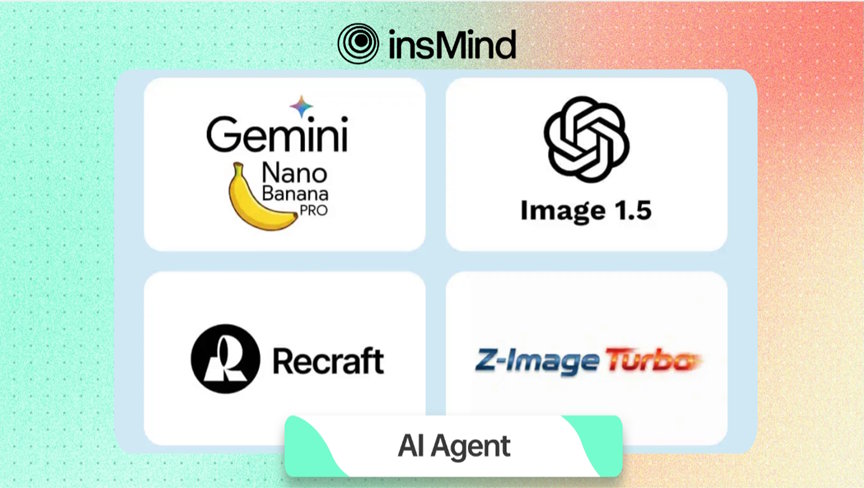
An AI Agent isn’t just a single model — it’s an orchestration layer that intelligently switches between different engines depending on the task.
Nano Banana Pro – Speed and Iteration at Scale
Nano Banana Pro is optimized for rapid image generation with strong visual consistency. For developers running experiments or A/B tests, speed matters more than artistic complexity. Nano Banana Pro enables fast turnaround of multiple variations while preserving structure and style alignment.
If you’re building a SaaS landing page and want five hero concepts in minutes, this model handles it efficiently. Instead of manually editing assets, you iterate conversationally through the AI Agent.
GPT-image 1.5 – Semantic Depth and Visual Precision
GPT-image 1.5 excels in interpreting nuanced prompts. It’s particularly useful when your visual assets need conceptual clarity — for example, illustrating abstract product features or technical workflows.
For developers preparing pitch decks or documentation visuals, GPT-image 1.5 provides higher interpretive accuracy. It translates detailed instructions into images that reflect tone, structure, and context more faithfully than generic generation engines.
Within an AI Agent system, GPT-image 1.5 becomes the precision engine for narrative-driven visuals.
Part 3: Structured Design and Scalable Output
As development projects mature, the need shifts from rapid experimentation to structured execution and scalable output. Early-stage visuals might be about validating an idea, but production-ready assets demand consistency, layout awareness, and performance efficiency. This is where choosing the right generation model becomes critical. Different stages of a product lifecycle require different visual capabilities — from structured design alignment to high-throughput asset production. The following models illustrate how AI Agents move beyond simple image generation and become scalable creative infrastructure.
Recraft AI Image Generator – Structured Aesthetic Control
Recraft AI Image Generator focuses on layout-aware and compositionally structured outputs. This is valuable for developers who need UI mockups, app previews, or marketing materials that feel aligned and production-ready.
Unlike purely artistic generation models, Recraft emphasizes balance, spacing, and usable formats. It’s especially helpful when building product showcases or platform-specific creatives that require consistency.
Inside an AI Agent environment, Recraft bridges the gap between creativity and practical design.
Z-Image Turbo – High-Performance Visual Throughput
Z-Image Turbo is built for performance at scale. If you’re managing an e-commerce backend, generating dozens of product visuals, or automating marketing assets, throughput becomes critical.
Z-Image Turbo optimizes generation speed while maintaining resolution quality. It supports batch-style production, which makes it ideal for automated workflows or content-heavy applications.
When integrated into an AI Agent, Z-Image Turbo enables developers to transition from experimental image generation to operational-level visual production. This isn’t just about creativity — it’s about infrastructure.
Part 4: Beyond the Agent — Expanding the Visual Tool Stack
While AI Agent orchestrates model switching, additional tools expand creative possibilities even further.
AI Image Generator – Flexible Standalone Generation
The AI Image Generator provides a flexible environment for both text-to-image and image-to-image workflows. Developers building internal tools, demos, or creative side projects can use it directly to prototype visuals without design software.
For example, generating illustrative feature graphics for documentation or placeholder visuals for UI previews becomes a lightweight process. Instead of relying on stock libraries, developers create context-specific assets instantly.
AI Design Generator – From Concept to Branded Assets
The AI Design Generator moves beyond single images into structured design outputs such as banners, promotional visuals, or brand-aligned layouts. For developers launching MVPs, this reduces dependency on external branding cycles.
Need a simple promotional banner for a product launch? Or a quick visual layout for a newsletter announcement? The AI Design Generator accelerates these steps while maintaining visual coherence.
Together, these tools complement the AI Agent ecosystem — allowing developers to move from concept to production-ready design without leaving their workflow.
Part 5: The Developer Advantage — Reducing Creative Overhead
For developers, the goal isn’t to replace designers entirely. It’s to remove unnecessary friction during early-stage building.
AI Agents and model orchestration systems offer three key advantages:
- Reduced iteration time
- Lower dependency on fragmented toolchains
- Faster experimentation cycles
Instead of pausing development to solve visual gaps, developers can generate and refine assets in parallel with code. This tightens feedback loops and supports continuous deployment strategies.
In the indie hacker world, where speed and iteration define survival, creative automation becomes a competitive edge.
Conclusion: AI Agents as Part of the Modern Developer Stack
Traditional design workflows were never built for the velocity of modern development cycles. AI Agents are emerging as a practical replacement — not by eliminating creativity, but by embedding it directly into the development process.
By orchestrating models like Nano Banana Pro, GPT-image 1.5, Recraft AI Image Generator, and Z-Image Turbo, developers gain flexible, scalable visual capabilities without expanding team size. Complemented by tools such as AI Image Generator and AI Design Generator, the creative stack becomes modular and developer-friendly.
As visual communication becomes central to product success, platforms like insMind are helping developers integrate design into their workflow rather than treat it as an external dependency. In doing so, they’re redefining what it means to build — and ship — at speed.

