

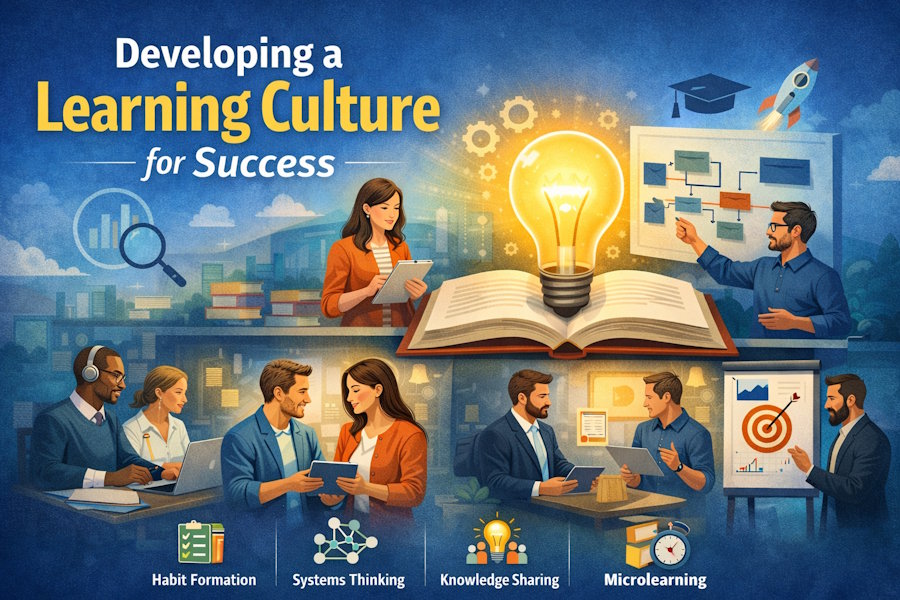
Did you know that many employees report they would stay longer at a company that invests in their career development and continuous learning? This data just highlights why a learning culture is a core retention strategy. At its core, a learning culture is an organizational environment where every team member is encouraged to learn and share knowledge openly. This typically involves structured training, peer-to-peer mentoring, and access to resources that help people stay up to date on industry shifts.
However, many professionals face the hurdle of information overload and decision fatigue, where the desire to grow is high, but the hours available for deep, technical study are limited. The following systems and frameworks were identified through an analysis of common patterns in management education and a review of professional growth tools and apps like Headway and its library of niche books.
Let's explore the list below to understand the frameworks and tools used to build these environments. Review these sections to see which methods might fit your current way or professional routine!
1. Habit Formation Principles Used in Learning Programs
Building a learning culture requires more than just providing access to books. It requires the behavioral science of habit formation. James Clear's research, popularized in Atomic Habits, explains that long-term change comes from "atomic" or small routines. Habits form through a loop:
- Cue
- Craving
- Response
- Reward
When companies ignore this psychology, employees often try to study in irregular, long sessions that they eventually abandon due to time constraints. To solve this, modern learning programs integrate micro-tasks into the workday. For example, short daily lessons from apps and platforms such as Nibble allow professionals to repeat learning activities regularly without feeling overwhelmed. By focusing on one lesson or concept, you become more likely to stick to a daily five-minute routine than a once-a-month three-hour seminar.
2. Systems Thinking Framework From the Fifth Discipline
Peter Senge's The Fifth Discipline (1990, MIT Sloan School of Management) frames organizations as interconnected living systems where every action creates ripple effects across teams and functions. This systems thinking, or the fifth discipline, shifts focus from isolated fixes to holistic patterns, directly addressing siloed departments that unintentionally undermine one another. In learning organizations, it aligns individual roles with company-wide goals through five core disciplines:
- personal mastery,
- mental models,
- shared vision,
- team learning, and
- systems thinking.
Leadership programs worldwide have relied on Senge's framework since 1990 to break these silos and build adaptive cultures. In a learning culture, teams use this framework to understand how their individual roles contribute to the company as a whole.
3. Knowledge Sharing Practices Inside Learning Organizations
Knowledge sharing, especially when exchanging team expertise and insights, fuels collective intelligence and prevents critical processes from staying trapped in silos known to just one or two people. Harvard Business Review confirms this drives greater creativity and performance: a 2019 analysis shows withholding knowledge hurts results, while a 2024 piece details how structured sharing ensures consistency and breaks silos.
Without this, valuable information remains trapped in knowledge silos, where only one or two people understand a critical process. In practice, this looks like lunch-and-learn sessions or internal wikis where employees document what they find. Many teams now use research summaries to kickstart discussions.
For example, a team member might share a condensed summary of a book on negotiation or sales training before a major sales meeting. This turns individual reading into a collective asset, ensuring that the company's "intellectual capital" grows whenever someone learns something new.
4. Continuous Learning Systems Used in Tech Teams
For technology professionals, learning is a survival skill. The core professional skills are expected to change soon. This rapid shift means that engineers and developers cannot rely solely on what they learned in university. They have to engage in continuous learning at work to keep up with new software and hardware.
Tech teams often use sprints and agile methods for learning. This involves setting aside a few hours a week for documentation review or joining professional course groups. Because schedules are often packed with deep-work sessions, engineers also tend to review educational material between tasks to stay up to date on emerging trends without disrupting their workflow.
5. Microlearning Methods Used in Professional Development
Microlearning is an educational approach that delivers information in small, highly focused units. Spaced learning —breaking information into small pieces over several days — significantly improves how much we remember. This method addresses the forgetting curve, where we lose most of what we learn if we don't revisit it shortly after.
Most microlearning lessons last under twenty minutes and focus on a single, specific topic. In a busy corporate environment, this might look like an employee reading a condensed summary of a business book during a coffee break. By using these short audio or text modules, professionals can maintain a learning culture even during the busiest weeks of the year.
6. Leadership Reading Habits Practiced by Executives
Executive leadership often involves a high volume of reading to stay ahead of market shifts. Also, successful leaders often schedule specific times in their day dedicated solely to reading and reflection. However, the challenge for most executives is the sheer volume of material; there are too many books and not enough hours in the day.
To manage this, many leaders use summary review methods to filter which books deserve a full, deep read. They might listen to an audio summary of a new management theory while commuting and then share the core notes with their senior staff. This habit of filtering and sharing helps the entire leadership team stay aligned on the latest strategies without requiring everyone to read every 500-page book published every month.
7. Personal Learning Systems Used by Professionals
While companies provide the tools, the most successful professionals build their own personal learning systems. Repeated exposure and active recall are the most effective ways to retain new information. This means that reading a book once is less effective than reviewing its main points several times over the course of a month.
A personal system might include a knowledge journal where you jot down one takeaway from everything you read. Some people combine reading summaries with spaced repetition apps to ensure they don't forget the core frameworks of their industry. These small, individual routines are the building blocks of a broader learning culture across the entire organization.
Start Testing and Using Practical Ways to Build a Learning Culture
Developing a learning culture is a long-term commitment to consistent exposure to knowledge rather than a series of one-off training events. As we have seen, the most effective systems rely on certain frameworks: habit-building principles and using tools that fit into a modern schedule, bringing new solutions. Organizations that succeed in this area provide their teams with the flexibility to learn in short windows, with agile methods or using formats like microlearning and reading book summaries to stay informed.
Ultimately, you can benefit most from systems that acknowledge your limited time while feeding your curiosity. You can examine the approaches described above to determine which format best supports your professional learning habits!

