

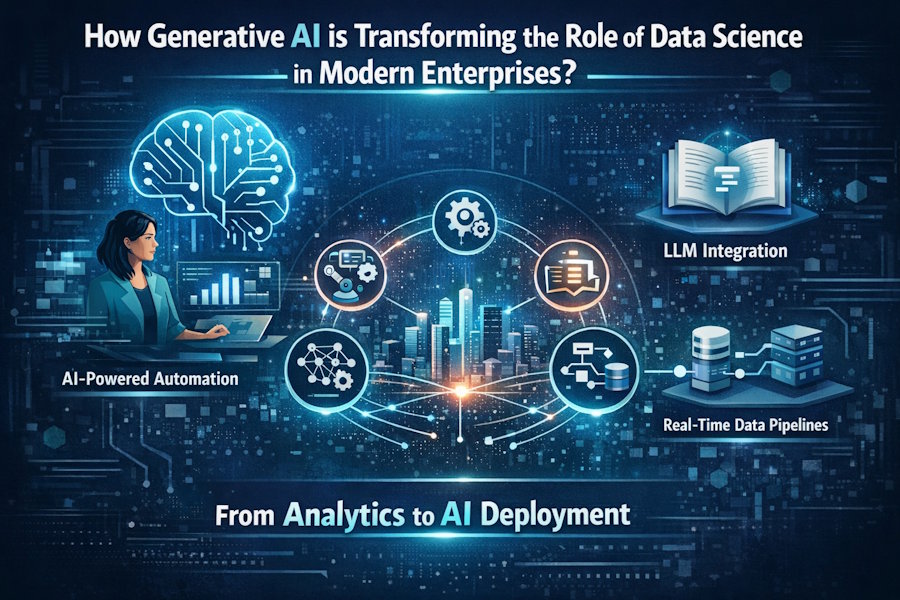
In earlier times, data science was mostly about analytics. Teams worked towards cleaning datasets, running statistical models, and creating dashboards that helped executives interpret historical trends. So, the role of a data scientist has become analytical in extracting insights that shape business decisions.
The increase of Gen AI is one of the huge turning points in enterprise data science. As per McKinsey’s 2024 Global AI Survey, 65% organizations regularly use Gen AI in at least one of their business functions, which is double the adoption in a single year.
As companies integrate LLMs and AI-driven systems into their operations, the expectations from data science experts are increasing. They create and deploy AI systems to automate workflows, to generate insights, and more in real-time.
So, their role intersects the fields of analytics, software engineering, and AI system architecture. Let's check the details.
Core Foundations That Continue to Define Data Science
Reviewing a typical data science and artificial intelligence course helps to understand how foundational concepts equip professionals to work with real-world AI systems.
Amid the increased advancement of gen AI applications, understanding their basics is essential. This is because they enable professionals to understand model behavior, evaluate uncertainty, and design reliable AI systems.
Some of them include:
- Statistics and probability for model validation, uncertainty estimation, and to interpret AI-generated outputs.
- Programming languages like Python are necessary to develop ML models and to deploy AI workflows.
- ML basics for conceptual understanding of algorithms, evaluation techniques, and architectures.
- Data visualization to understand AI behavior and explain it to stakeholders.
- Data engineering to build scalable pipelines
As there are many aspects to data science, assessing a data science course syllabus is necessary to ensure it provides the skills needed in real-world AI systems.
Besides, contemporary curriculums include essentials like statistical reasoning, ML development, production-grade AI deployment, and more. It also helps professionals convert enterprise expectations into applied data science teams.
So, core foundations still exist and after as the base to build enterprise AI capabilities.
How Generative AI Is Expanding Data Science Responsibilities?
As LLMs and multimodal AI systems have taken over, the scope of data science has expanded. AI automation is now capable of feature engineering, report generation, exploratory analysis, etc.
This has changed data scientist responsibilities in various ways:
- Automation of Analytics: Generative AI tools and AI agents for data analysis can now summarize datasets, generate insights, and create reports automatically, which helps save time.
- AI-assisted modeling: Platforms that integrate AutoML and code generation have increased baseline model development. So, data scientists have to check model reliability, improve data quality, and ensure its alignment with business objectives.
- Enterprise AI Deployment: Modern data science teams now have to integrate models directly into apps and operational systems. Thus, they have to ensure that these work efficiently under real-world constraints.
- LLM integration: Organizations are now embedding LLMs into their platforms; thus, professionals will have to design RAG pipelines, implement safety mechanisms, and much more.
|
Traditional Data Science |
Modern Data Science |
|
Data Analysis |
AI System Deployment |
|
Model Training |
Model integration |
|
Reporting |
Decision automation |
|
SQL Dashboards |
LLM-powered automations |
|
Batch Analytics |
Real-time interface pipelines |
Why Enterprises Need Applied Data Science Professionals?
AI enterprise adoption is increasing across many industries, which creates a demand for professionals who can turn prototypes into production systems.
IBM's Global AI Adoption Index states that more than 40% of large companies have deployed AI in their operations, while many are still experimenting with its implementation.
But such a large-scale deployment introduces several challenges beyond merely building models in notebooks.
So, enterprises have to:
- Integrate with legacy infrastructure
- Scale with real-time workloads
- Maintain reliability despite changing data conditions
- Adhere to regulatory and governance requirements
Hence, knowledge of applied data science is necessary. Applied data scientists work at the boundary between research and production. They convert abstract ML techniques into systems that work in real organizational environments.
To achieve it, collaboration across engineering, product, operations, and compliance teams is necessary.
Increased demand for these skills has created a talent gap. LinkedIn’s recent workforce analysis identifies AI and ML specialists among high-growth job categories, which demonstrates the demand for data science capabilities. So, professionals gaining proficiency in it can scale to higher packages amid increased layoffs.
How Professionals Are Preparing for This Industry Shift?
Professionals entering the Data Science industry should now combine theoretical knowledge with hands-on experience via practicals in deploying AI systems.
Theoretical aspects need algorithms and statistical theory, while enterprise environments need familiarity with deployment pipelines, data infrastructure, and operational AI workflows.
So, many professionals need a structured learning approach, like an advanced data science and artificial intelligence course. This will ensure that it provides hands-on exposure to real-world deployment scenarios.
Further, these focus on:
- Creating Gen AI applications
- Designing scalable data pipelines
- Deploying ML models in production
- Integrating AI with enterprise software systems
Besides, professionals attaining formal education should also get experience by contributing to open-source repositories. For employers, such advanced projects and contributions with the deployment of AI systems matter more.
Industry Demand Across Multiple Sectors
The adoption of AI-driven data science is increasing in almost every industry. Some of the major industries integrating it include:
- Healthcare: It uses AI-assisted diagnostics, clinical decisions, and predictive patient outcome modeling.
- Fintech: It integrates fraud detection, algorithm trading, and credit risk modeling systems.
- Manufacturing: It has integrated predictive maintenance, quality control automation, and supply chain optimization.
- Enterprise SaaS: These use AI-powered search workflow automation and intelligent product features.
- Logistics: The industry has adopted route optimization, demand forecasting, and warehouse automation.
Such a broad adoption explains that enterprise data science is not just a specialized industry; rather, it has gained traction and adoption across several industries. Companies use it as a fundamental to shape how organizations compete and innovate.
Future Outlook of Data Science in Enterprise Technology
As per the ongoing trends, enterprise software platforms will increasingly embed generative AI in their systems. Those that will combine ML models, real-time decision engines, and automation pipelines will greatly influence business operations.
As this change continues, data science roles will work throughout the entire lifecycle of AI systems.
Professionals who succeed in this environment should have strong analytical foundations, engineering fluency, experience in deploying AI systems, and domain expertise in specific industries
Besides, Gen AI has made the field from a support function into a strategic factor of enterprise technology. So, organizations that invest in applied data science skills are positioning themselves to lead the future of AI-based innovation.

