

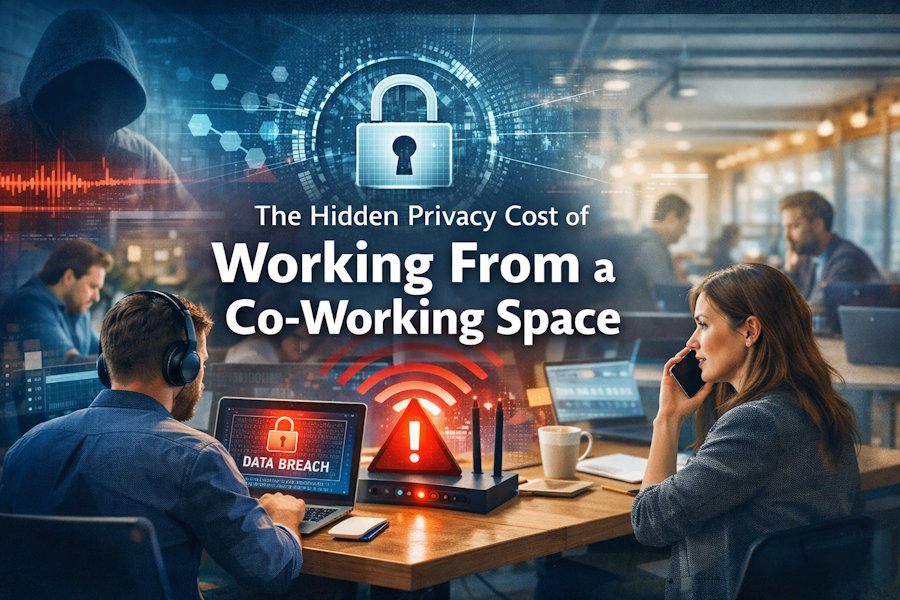
You booked a hot desk, grabbed a coffee, and opened your laptop. Within minutes, you were sharing a network with lawyers, developers, marketers, and strangers whose security habits you know nothing about. That's the reality most remote workers accept without a second thought — and it's quietly becoming one of the biggest privacy blind spots of the modern workforce.
Co-working spaces have exploded in popularity. For freelancers, contractors, and hybrid employees, they offer flexibility, community, and a break from the isolation of home offices. But the very openness that makes these spaces attractive is also what makes them a serious security liability.
The Network You Share Is Not Your Friend
When you connect to a shared Wi-Fi network in a co-working space, you're entering the same digital environment as every other person in that building. Shared network infrastructure increases the risk of unauthorized access, data interception, and malware infections risks that are easy to dismiss when the space looks polished and the coffee is good.
Shoulder Surfing and Silent Eavesdropping
The threats aren't always digital. Open floor plans put confidential information directly in the line of sight of strangers. A tactic known as shoulder surfing, where someone nearby reads your screen or physical documents without permission, is more common in shared workspaces than most professionals expect.
These environments are also acoustically vulnerable. Sensitive client calls, financial discussions, and internal team conversations happen in open areas where anyone can listen. The co-working space feels like your office. It isn't.
The Numbers Tell a Harder Story
The scale of exposure tied to flexible and remote work is difficult to ignore. Over 20% of organizations have reported a data breach linked to a remote worker since 2020 (IBM Security, 2024). The average global cost of a data breach reached $4.88 million in 2024, a figure that continues to rise year over year (IBM Cost of a Data Breach Report, 2024).
Why Shared Spaces Amplify the Risk
Unlike a corporate office, co-working spaces have no unified IT policy. There is no centralized security monitoring, no enforced endpoint protection, and no visibility into who else is on the network at any given time. A malicious actor can sit two desks away and run packet sniffing tools that capture unencrypted traffic passing through the shared router. Most users would never know it happened.
Over 31% of internet users worldwide accessed a VPN at least once per month in 2025, a sharp increase driven largely by remote and mobile workers who are becoming more aware of public network risks (GlobalWebIndex, 2025).
What Responsible Remote Workers Are Doing Differently
The professionals who take this seriously aren't necessarily more technical. They've simply adopted a few consistent habits that close the most obvious gaps.
Encrypting your internet connection is the most immediate layer of protection available. When your traffic is encrypted, even if someone on the same network intercepts it, they cannot read it. Tools like PureVPN make this straightforward for individual freelancers and remote employees who move between locations regularly, ensuring that every session on a shared network stays private regardless of what the router's security looks like.
Screen privacy filters, noise cancelling headsets for sensitive calls, and the habit of locking your screen when stepping away are small changes with a meaningful impact on your exposure in shared environments.
The Bigger Problem for Teams
Individual habits matter, but the risk compounds when entire teams work across co-working spaces in different cities or countries. A single employee connecting to a client database over an unsecured network can create a vulnerability that affects the whole organization.
For companies managing distributed teams, the solution lies in giving employees a secure and dedicated pathway back to company resources no matter where they log in from. Setting up a reliable remote access vpn ensures that every connection made from a co-working space, a café, or an airport lounge is authenticated, encrypted, and fully under IT control.
The Flexibility Is Worth Protecting
Co-working spaces are not going away. Neither is hybrid work. The freedom to work from anywhere is one of the most valuable shifts in how people build their careers but that freedom carries a real and underestimated cost if left unmanaged.
The co-working space down the street does not owe you a secure connection. That responsibility sits with you.

