

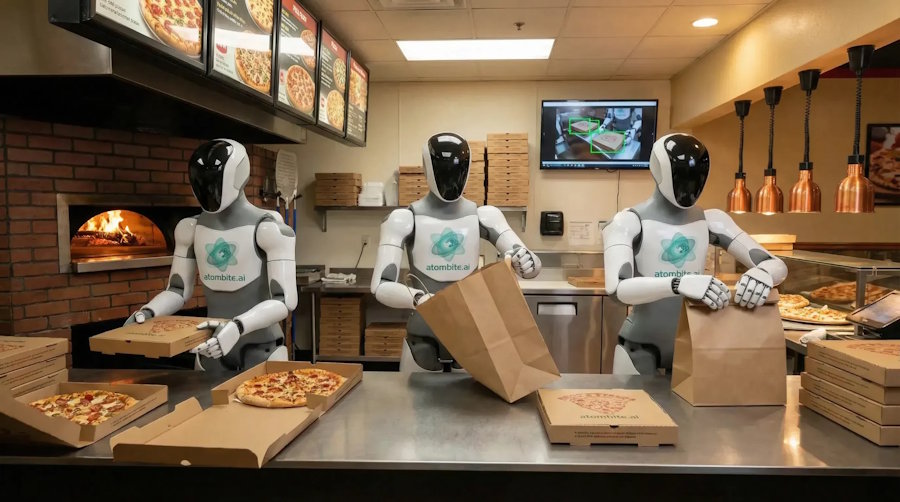
SAN FRANCISCO, CA — AtomBite.AI, an artificial intelligence company focused on developing foundation models for robotic manipulation, has officially emerged from stealth mode and introduced its first commercial solution: the M1 Takeout Packing Robot. The company is positioning itself at the intersection of AI and robotics, aiming to address one of the most complex and inefficient stages in food delivery — the final packaging process before orders leave the kitchen.
According to an article on AP News, the company’s approach centers on redefining how robots interact with unpredictable, real-world objects in high-pressure commercial environments. Instead of building proprietary robotic hardware from the ground up, AtomBite.AI prioritizes the software intelligence layer — effectively turning existing machines into adaptive systems capable of handling irregular, messy, and dynamic scenarios.
Shifting Focus: From Hardware to Cognitive Intelligence
Traditional robotics companies have long concentrated on engineering physical systems — robotic arms, grippers, and specialized machinery. AtomBite.AI challenges this paradigm by focusing on what it calls the “brain” behind the robot. Its proprietary dual-model architecture enables machines to interpret and respond to complex, non-standard inputs in real time.
This is particularly relevant in food service environments, where variability is the norm rather than the exception. Items such as crumpled packaging, leaking containers, misplaced receipts, or inconsistent portion sizes present significant challenges for automation systems. AtomBite.AI’s software is designed to process these irregularities dynamically, allowing robots to operate with a level of flexibility previously associated only with human workers.
CEO Dr. Dong Wang emphasizes that the core bottleneck in robotics adoption is not mechanical capability but cognitive adaptability. In his view, enabling robots to “think” — to recognize edge cases and respond accordingly — is what unlocks real-world scalability.
Introducing the M1 Takeout Packing Robot
The company’s flagship product, the M1 Takeout Packing Robot, is specifically designed to streamline the packaging stage of food delivery workflows. This stage, often referred to as the “last meter,” is both labor-intensive and prone to errors, particularly in high-volume kitchens.
The M1 system leverages AtomBite.AI’s dual-model architecture to identify, sort, and package diverse food items accurately and efficiently. By integrating with existing hardware, the robot can be deployed without requiring restaurants to overhaul their current infrastructure.
Rather than selling expensive equipment outright, AtomBite.AI offers the M1 through a Robot-as-a-Service (RaaS) model. This eliminates upfront capital expenditure and replaces it with a predictable monthly fee ranging from $2,200 to $2,900. For many operators, this shift converts a traditionally heavy investment into a manageable operational cost.
Addressing Labor Challenges in the Restaurant Industry
Labor shortages and high employee turnover continue to strain the restaurant sector, particularly in North America. Replacing hourly workers is not only time-consuming but also costly. Industry data indicates that onboarding a single non-management employee can cost approximately $2,700.
AtomBite.AI’s solution directly targets this pain point. By automating the packaging role, the M1 robot reduces reliance on manual labor while simultaneously improving consistency and accuracy. Additionally, its built-in AI-driven visual verification system helps minimize costly order errors and refund requests.
For a typical restaurant processing around 100 takeout orders per day, the financial impact can be substantial. AtomBite.AI estimates a net monthly benefit ranging from $1,100 to $2,825, depending on operational variables. This combination of cost savings and efficiency gains positions the M1 as a practical solution rather than a purely experimental technology.
Built by Experts in Logistics and AI
Behind AtomBite.AI is a leadership team with deep experience in large-scale logistics, artificial intelligence, and delivery platforms. CEO Dr. Dong Wang is joined by Head of Data Dr. Tao Li and Head of Commercialization Steven Li, who has previously been recognized in the Forbes China 30 Under 30 list.
The team’s background includes managing complex delivery networks and developing algorithmic dispatch systems for major global food delivery services. This experience informs the company’s approach, which blends theoretical AI advancements with practical, real-world deployment requirements.
Rather than treating robotics as a standalone innovation, AtomBite.AI integrates it into broader logistics ecosystems, ensuring that its solutions align with existing workflows and operational constraints.
A Long-Term Vision Beyond Takeout Packaging
While the M1 robot represents the company’s initial entry point, AtomBite.AI’s ambitions extend far beyond packaging. Its product roadmap outlines a phased expansion into increasingly complex domains.
The next stage, M2, will focus on kitchen operations, followed by M3, which targets delivery handoff processes. Ultimately, the company aims to develop a “Universal Hand” — a generalized robotic manipulation system capable of functioning across multiple industries, including micro-fulfillment centers and e-commerce returns.
This progression reflects a broader strategy: starting with a narrowly defined, high-impact use case and gradually scaling toward more sophisticated applications of embodied AI.
Redefining Automation in Food Service
AtomBite.AI’s approach highlights a shift in how automation is being conceptualized within the food industry. Rather than replacing entire workflows with rigid machinery, the focus is moving toward augmenting existing systems with adaptive intelligence.
By addressing the unpredictable nature of real-world environments — something that has historically limited robotic adoption — the company is attempting to bridge the gap between theoretical AI capabilities and practical deployment.
If successful, this model could accelerate the integration of robotics across the restaurant sector, particularly in areas where variability and complexity have previously made automation unfeasible.
Conclusion
AtomBite.AI’s emergence marks a notable development in the evolution of food robotics. By prioritizing cognitive software over hardware and introducing a flexible, service-based business model, the company is tackling one of the most persistent challenges in restaurant operations.
Its M1 Takeout Packing Robot serves as both a proof of concept and a commercial solution, demonstrating how AI-driven systems can operate effectively in chaotic, real-world environments. As the company expands its product line and capabilities, it may play a key role in shaping the future of automation not only in food service but across a range of industries where adaptability is essential.

