

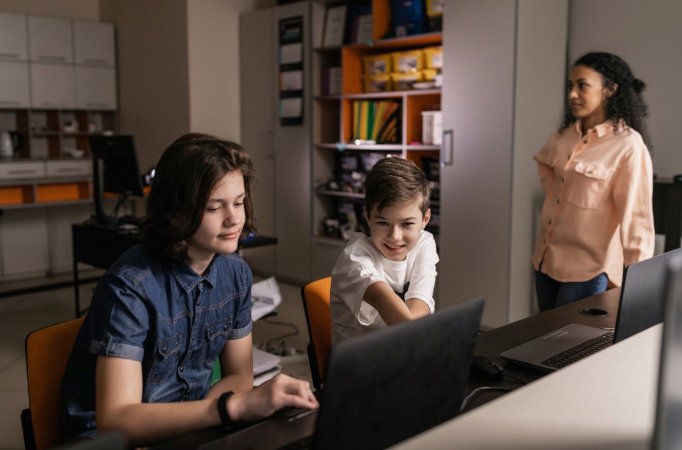
It doesn’t happen all at once. Screens just start appearing. First, it’s a slide or two. Then a short video. Then something interactive. Before long, they’re part of the routine. Not special anymore. Just there. And the lesson starts behaving differently.
You don’t really plan for it. It just shifts. What used to move in a straight line now keeps pausing, branching, and looping back. A teacher starts explaining something, then stops because something’s on the screen. You might not even notice it during the lesson. It’s only later, thinking back, that it feels less linear. More broken up. Not in a bad way. Just not as clean as it used to be.
Introducing Screens into Lessons Changes the Role of Teacher Guidance
The teacher used to hold things together more tightly. Not in a controlling way. Just everything passed through them: explanation, questions, pacing. The class moved when they moved. Now it’s different. A student is halfway through something on their screen while another has already moved ahead. Someone’s stuck but doesn’t say anything yet. Someone else is clicking around just to see what happens. The teacher isn’t at the center in the same way. More like moving around it. Stepping in where things slow down. Pulling people back when the focus drifts a bit too far. Letting some parts run without interruption, even if it feels slightly uneven.
At this stage, challenges may arise. Implementing technology in the classroom sounds straightforward until you’re in the middle of it. Timing feels less predictable. Attention doesn’t stay where you expect. And the teacher ends up managing all of that quietly, moment by moment.
Transitions Between Activities Require More Intentional Planning
Transitions used to feel almost invisible. Now there’s always a slight pause. Someone’s still loading something. Another student clicked the wrong tab. A few are ready, a few aren’t. You wait, but not too long. Move forward, but not too quickly. That in-between space gets longer.
And it’s not always clear how long it should be. Sometimes it feels smooth. Other times, it drags just enough to break the momentum. You start noticing those gaps more than the activities themselves.
Visual Content Begins Driving the Structure of Lessons
There’s a point where the screen starts deciding things. Not intentionally. It just happens. A slide comes up, and the lesson follows it. A video plays, and everything pauses around it. The sequence starts forming around what appears next instead of what the teacher planned to say. You adjust without thinking about it.
Something on the screen gets more attention than expected, so you stay there longer. Something else gets skipped because time moved faster than you thought. The lesson starts reacting to the content instead of leading it.
Student Attention Patterns Shift with Screen-Based Learning
Attention doesn’t sit still anymore. It moves. Quickly sometimes. A student focuses deeply for a few minutes, then drifts for a second. Another stays ahead of the pace, waiting. Someone else falls slightly behind. You look around the room, and it feels uneven. Not distracted exactly. Just not aligned.
Everyone’s engaged, but in different moments. Different speeds. The teacher keeps adjusting, trying to pull things back into some kind of shared timing. It works, mostly. Though it never quite settles into one steady rhythm again.
Lesson Segments Become Shorter and More Varied
Long stretches of explanation don’t really hold the same way anymore. Things break up. A few minutes here. Then something else. Then back again. It’s not always planned that way. It just feels necessary. The lesson needs to keep shifting to stay with the class. You start noticing how quickly one thing turns into another.
An explanation becomes a quick activity. That turns into a short discussion. Then back to the screen again. None of it lasts too long. The lesson keeps moving. Not in a straight line. More like pieces connected loosely together.
Independent Work Expands Within Lesson Time
There’s more quiet now. Not silence exactly. Just less shared attention. Students sit with their screens, working through something at their own pace. Some move quickly. Others slow down. A few pause halfway, then continue. It’s not one moment anymore. It’s several, happening at once.
You can feel the shift. The teacher isn’t holding the whole room together every second. Parts of the lesson run on their own for a while. Then the teacher steps back in. Then out again.
Content Accessibility Extends Beyond the Classroom Period
The lesson doesn’t really end where it used to. Materials stay available. Students can go back to them later. Or skip ahead. Or revisit something they didn’t quite follow the first time. That changes how things feel in the moment.
There’s less pressure to cover everything perfectly. Less urgency to make sure everyone understands before moving on. The lesson keeps going, knowing it can be returned to. It stretches beyond the period without needing to say so. Many schools support this shift with a dedicated digital signage for education system, so the same screens that carry a lesson also handle schedules, announcements, and updates once class ends.
Instruction Becomes More Layered with Multiple Content Formats
Things stack now. Text, visuals, maybe a short clip, then something interactive. It’s all part of the same lesson, though it doesn’t always feel like one continuous piece. You move through layers. A student reads something, then watches something, then clicks through a task.
Each part connects, though loosely. The experience builds instead of unfolding in one direction.
Adjusting Timing Based on Real-Time Data
Feedback shows up immediately. A set of responses appears on the screen. You can see who understood, who didn’t, and who rushed through it. The information is right there. So, the lesson shifts.
Maybe you stay longer on something. Maybe you move ahead faster than planned. The timing adjusts without much pause. It doesn’t follow the original plan anymore. It follows what just happened.
Classroom Movement and Physical Interaction Change
The room feels still in a different way. Students stay seated longer. Movement happens less often. Not because it’s not allowed, just because there’s less reason to get up. You notice it after a while.
The energy changes slightly. Conversations still happen, though they don’t always spread across the room. They stay closer, quieter. Everything feels a bit more contained.
Nothing really replaces what was there before. It just shifts. Lessons don’t move the same way. They pause more. Break apart. Come back together. Sometimes they feel smooth. Sometimes slightly uneven. You don’t always plan for it. You adjust as it happens. Over time, it stops feeling new—just part of how things work now.

