

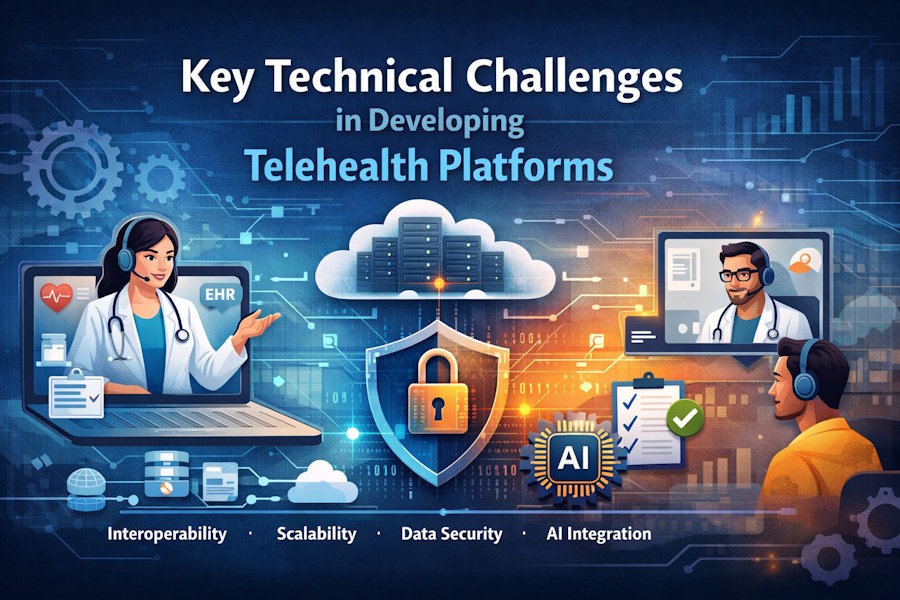
Telehealth platforms have revolutionized how healthcare is delivered, enabling patients to access medical care remotely and providers to deliver care without geographic barriers. Driven by technological innovation, consumer demand, and the need to expand healthcare access, telehealth has rapidly expanded in recent years. However, building a robust, scalable, secure, and user‑friendly telehealth platform is complex. Developers and healthcare organizations face a variety of technical challenges that span infrastructure, data integration, security, regulatory compliance, and user experience.
In this article, we explore the principal technical hurdles encountered in telehealth platform development, and how organizations like CureMD, with its comprehensive EHR Software, advanced Medical Billing Software, and cutting‑edge AI Medical Scribe technologies, are helping shape solutions in this space.
1. Integration with Clinical Systems and Interoperability
One of the most significant challenges in telehealth development is integrating disparate clinical systems and ensuring interoperability.
The Interoperability Barrier
Telehealth platforms must communicate seamlessly with Electronic Health Record (EHR) systems, diagnostic tools, laboratory systems, imaging platforms, and practice management software. Historically, healthcare data has been siloed across systems built on different standards, making synchronization difficult.
Without proper interoperability, key clinical data—such as medications, allergies, lab results, and visit histories—may not be accessible within the telehealth workflow, potentially risking clinical decision‑making and continuity of care.
Role of Standards
Standards like FHIR (Fast Healthcare Interoperability Resources) and HL7 are critical for enabling data exchange. Yet adoption remains uneven, and many legacy EHR platforms have not fully implemented these protocols.
Solutions like CureMD’s EHR Software leverage modern interoperability standards to bring data together, helping telehealth systems access comprehensive patient records. This ensures clinicians have contextual information during remote consultations and enables smoother transitions between in‑person and virtual care.
Integrating AI Systems
Telehealth platforms are increasingly incorporating AI‑based tools, such as AI Medical Scribe functionalities that transcribe clinical encounters in real time and integrate structured data directly into patient records. Integrating such AI systems with EHR and telehealth interfaces requires careful handling of APIs, data schemas, and context‑aware workflows.
2. Ensuring Scalability and Performance
Telehealth platforms must support real‑time video, secure messaging, file sharing, and synchronous communication—all under varying network conditions and across hundreds or thousands of simultaneous users.
Cloud Architecture and Load Balancing
Building a telehealth solution without downtime or latency issues requires robust cloud infrastructure, auto‑scaling capabilities, and efficient load balancing. High‑availability design ensures that when demand spikes, performance remains consistent.
Latency is particularly critical during video consultations. Poor performance during a live visit undermines the quality of care and patient satisfaction.
Microservices and Modular Design
A microservices architecture enables telehealth platforms to grow and evolve. For instance, separating the video conferencing module from appointment scheduling, triage workflows, messaging, and billing modules prevents failures in one area from affecting the entire system.
Companies like CureMD have adopted modular and scalable system designs in their healthcare solutions, ensuring that core telehealth components can operate smoothly alongside integrated Medical Billing Software and EHR Software.
3. Data Security and Privacy Concerns
Protecting patient information is foundational in healthcare technology. Telehealth platforms must secure health data both in transit and at rest.
Regulatory Requirements
Telehealth systems are subject to strict healthcare privacy regulations such as HIPAA (Health Insurance Portability and Accountability Act) in the United States and GDPR in Europe. These laws dictate how patient data is collected, stored, accessed, and shared.
Encryption standards such as TLS/SSL for data in transit and AES‑256 for data at rest are baseline requirements. Beyond encryption, developers must implement secure authentication, access controls, audit logging, and real‑time monitoring of suspicious activity.
Authentication and Identity Management
Secure login processes—such as multi‑factor authentication (MFA), biometric access, and strong session management—are essential. Telehealth platforms often connect patients, clinicians, pharmacists, and support staff across different organizations, increasing the risk surface for unauthorized access.
Secure AI Integration
As AI becomes embedded in telehealth—for example, AI‑driven medical scribes or diagnostic support tools—developers must ensure that these modules do not introduce vulnerabilities. AI workflows must comply with privacy standards and ensure that sensitive information is not improperly logged, cached, or retained beyond necessity.
Providers like CureMD work to maintain high standards of security within their AI features, ensuring that tools such as their AI Medical Scribe adhere to compliance mandates and secure data practices.
4. Regulatory Compliance and Legal Challenges
Telehealth sits at the intersection of healthcare and technology, and both domains are heavily regulated. Technical compliance is not just a checkbox—it directly affects patient access, clinician liability, and platform legitimacy.
Telehealth Licensing and Cross‑State Practice
In regions like the U.S., telemedicine providers must navigate licensing requirements that vary by state. A clinician licensed in one state may not be authorized to treat patients in another. While not a purely technical issue, telehealth platforms must build systems to verify provider credentials and enforce location‑based access controls.
Documentation and Audit Trails
Clinical documentation standards require that every encounter is accurately recorded, timestamped, and stored. Proper audit trails, version control, and data retention policies are necessary for regulatory compliance and legal defensibility.
This is where AI EHR Software that integrates smoothly with telehealth platforms plays a crucial role in centralizing records and ensuring accurate, compliant documentation.
5. User Experience and Accessibility Challenges
For a telehealth platform to be successful, it must be intuitive, accessible, and reliable for both patients and clinicians.
Patient Experience
Patients vary widely in their technical proficiency as well as the devices they use. Platforms must be responsive, work across operating systems and browsers, and degrade gracefully on low‑bandwidth networks.
Telehealth workflows should guide patients effortlessly through appointment booking, virtual check‑in, consent signing, and joining the live consultation.
Clinician Workflows
Clinicians require interfaces that reduce cognitive load and integrate clinical data without distraction. Too many steps or poorly organized information can disrupt care delivery.
AI enhancements—like embedding an AI Medical Scribe that transcribes and organizes clinical notes automatically—can improve clinician satisfaction by reducing administrative burden.
Accessibility for Special Populations
Accessibility includes ensuring compatibility with screen readers, providing captioning for hearing‑impaired patients, and supporting multiple languages. Inclusive design is not optional; it is a requirement for equitable healthcare access.
6. Real‑Time Communication Technologies
Telehealth depends on real‑time audio/video communication that must be both reliable and secure.
WebRTC and Media Services
WebRTC (Web Real‑Time Communication) is a foundational technology enabling peer‑to‑peer video and audio streams. However, integrating WebRTC into a comprehensive healthcare platform with scheduling, notifications, and workflows introduces complexity.
Media quality must adapt dynamically to network conditions. Developers need algorithms that can adjust video resolution and bandwidth usage without dropping connections.
Quality Monitoring
System health must be constantly monitored during live sessions, with fallback mechanisms such as switching to audio‑only calls or texting if connectivity drops.
7. Billing, Claims Processing, and Revenue Cycle Management
Telehealth platforms must integrate billing and claims workflows just like in‑person care. Without proper revenue cycle management (RCM), healthcare providers risk loss of revenue or billing errors.
Coding and Reimbursement Complexity
Telehealth visits involve various billing codes depending on the service provided, modality (video, audio‑only), and payer policies. Ensuring proper code capture and claims transmission is essential for financial sustainability.
Seamless Billing Integration
Platforms must connect clinical documentation with billing systems so that services rendered are accurately billed. Solutions like CureMD’s Medical Billing Software integrate directly with telehealth modules and EHR systems, allowing claims to be submitted correctly and promptly.
Automating Billing with AI
With advancements in AI, billing processes are gradually becoming smarter. AI engines can analyze documentation and suggest correct codes, reducing manual errors and accelerating reimbursement cycles.
8. AI and Machine Learning Integration Challenges
Artificial intelligence is reshaping telehealth, with applications ranging from clinical decision support and symptom checkers to automated documentation and triage.
Data Quality and Bias
AI algorithms depend on high‑quality data. In healthcare, datasets often contain inconsistencies, missing values, or historical biases. Ensuring that AI models perform equitably across diverse patient populations is vital, and poorly trained models can reinforce disparities.
Explainability and Trust
Unlike traditional software with deterministic outputs, AI models can be opaque. Clinicians must trust the recommendations provided by AI tools such as diagnostic assistance or automated coding suggestions.
Platforms that integrate AI Medical Scribe tools should provide transparency—showing how conclusions were reached—to build provider confidence and ensure safety.
Continuous Learning and Monitoring
AI models require ongoing evaluation and retraining as clinical practices evolve. A system that learns from new data must also guard against concept drift and unintended behavior.
9. Testing, QA, and Continuous Delivery
Developing a telehealth platform demands rigorous testing across use cases, devices, and network conditions. Quality assurance plays a pivotal role in ensuring reliability, security, and performance.
Test Automation and Regression Testing
Given the complexity of telehealth features and integrations, automated testing—especially regression testing—is essential. As infrastructure, APIs, and workflows evolve, developers must ensure that new releases do not break existing functionality.
Simulations and Load Testing
Simulating real‑world scenarios, including peak demand, is critical. Load testing ensures that the platform can scale without dropping sessions or slowing performance.
10. Future Directions and Continuous Innovation
The pace of innovation in telehealth continues to accelerate. Enhanced AI, predictive analytics, remote monitoring devices, and personalized care models will shape next‑generation telehealth platforms.
Leveraging AI responsibly, ensuring seamless integration with core clinical systems like EHR Software, and automating administrative workflows—such as billing via integrated Medical Billing Software—will remain key drivers of success.
Companies like CureMD are at the forefront of this transformation, combining clinical technology expertise with modern software engineering principles to deliver scalable, secure, and user‑friendly digital health solutions.
Conclusion
Developing effective telehealth platforms is a multifaceted endeavor that touches nearly every aspect of healthcare delivery—from clinical data interoperability, real‑time communication, and security compliance to user experience, AI integration, and financial workflows. Each challenge, if unmet, can degrade quality, hinder adoption, or undermine the clinical and financial integrity of virtual care.
Overcoming these challenges requires cross‑domain expertise, adherence to standards, rigorous testing, and a commitment to innovation. With investments in AI, secure cloud infrastructure, advanced interoperability, and seamless integration of tools like Medical Billing Software, AI Medical Scribe, and EHR Software, telehealth platforms can deliver high‑quality, equitable, effective care to patients across the globe.
The future of telehealth is promising—but only if developers, clinicians, and healthcare leaders tackle these technical challenges with vision, precision, and patient‑centered thinking.

