

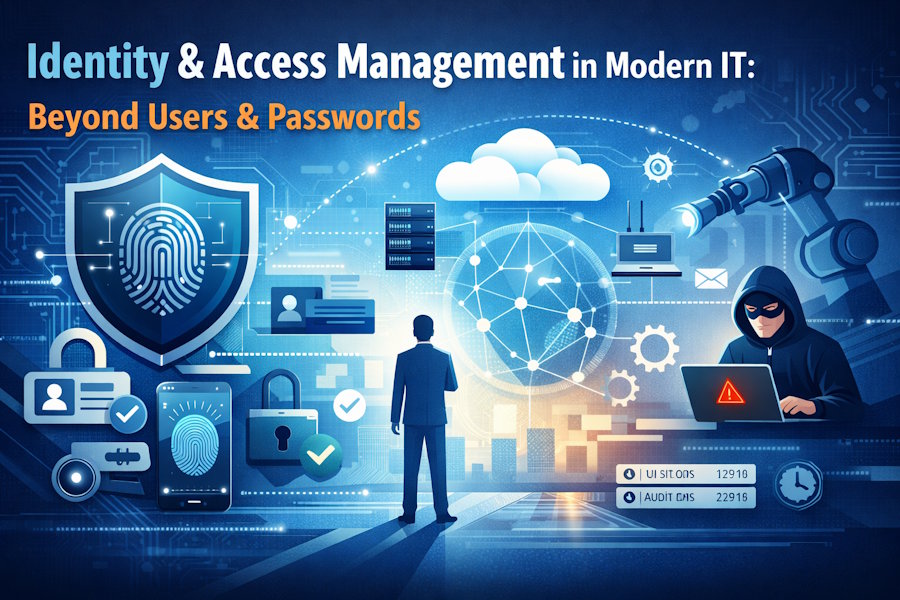
Identity and access management (IAM) helps organizations manage digital identities and user access through pre-defined policy frameworks and technologies. But today, IAM is no longer limited to just usernames and passwords.
IT environments have become more diverse, with access requests flowing through several paths such as users, devices, apps, and automated workloads operating independently. At the same time, passwords alone fall short against risks such as phishing, credential reuse, and unauthorized access.
In this blog, we’ll explore how IAM works, its core components, and how it supports secure access beyond just users and passwords.
What is IAM?
Identity and access management (IAM) is a security framework of policies, processes, and technologies that ensure only authorized individuals have access to the right resources at the right time and for the right reasons. It controls how users are identified, authenticated, and authorized within an organization's IT ecosystem.
IAM answers two fundamental questions:
- Who is the user?
- What is the user allowed to do?
Authentication tackles the first by verifying that a user is who they claim to be. Authorization handles the second by determining which systems, data, or applications this verified user can access.
IAM isn't just about employees logging into a corporate network. It extends to contractors, partners, customers, and even non-human identities such as AI bots, IoT, and automated workloads. In a world where digital identities now outnumber people, managing them systematically isn’t an option but a necessity.
Think of IAM as an office building's security system: ID badges, access levels, locked doors, and a log of everyone who came in and went out. IAM’s goal is to stop intruders and allow only valid users within the allowed limits.
Core components of IAM: 4 building blocks
IAM is not a single tool; it is a system built upon four foundational pillars, where each plays an essential role in securing digital identities.
1. Administration
Administration is where the identity lifecycle begins. It covers the provisioning and deprovisioning of user accounts, creating access when someone joins an organization, modifying it as their role changes, and revoking it when they leave. Poor administration is one of the most common sources of security risk, often leaving behind easily accessible accounts that become a loophole for attackers.
2. Authentication
Authentication is the process of verifying a user's identity and making sure they are who they claim to be before granting access. It has evolved beyond passwords, as it encompasses biometrics, hardware tokens, and behavioral signals. The goal is to eliminate impersonation without creating unnecessary friction for legitimate users.
3. Authorization
Authorization grants the identified users the required access. Authentication and authorization are closely linked; one can’t work without the other. Authorization is not possible before the user identity is authenticated.
Authorization is typically managed by role-based access control (RBAC), ensuring users only interact with the systems and data relevant to their job role. This eliminates the risk of exposing sensitive information to unauthorized users and reduces the attack surface.
4. Auditing
Auditing closes the loop. It continuously tracks and logs who accessed what, when, and from where. It ensures that no user misuses their privileges and prevents hackers from attacking. It is important for regulatory compliance and meeting security mandates, such as GDPR, SOX Act, HIPAA, and PCI DSS. This requires organizations to define and manage user access rights effectively.
Auditing isn't just about compliance; it's about visibility. A strong audit trail allows organizations to detect attacks early, thoroughly investigate incidents, and remediate as quickly as possible.
Key IAM features
1. Single sign-on (SSO)
SSO allows users to access multiple applications and services using a single set of login credentials. Once authenticated through the SSO portal, a token or certificate acts as a security key across connected resources. SSO uses protocols such as SAML and OIDC to share that key between service providers. For organizations running dozens of tools, SSO dramatically reduces password fatigue and the security risks that come with it.
2. Multi-factor authentication (MFA)
MFA requires users to verify their identity through a combination of more than one authentication method, such as passwords, OTPs, and biometrics. More advanced implementations use adaptive authentication, which adjusts requirements in real time based on contextual risk signals like device posture, user behavior, and login timing.
3. Just-In-Time (JIT)
A Just-in-time access management solution allows IT teams to grant elevated privileges only when required and for a limited duration. Instead of assigning permanent access, permissions are provisioned dynamically for specific tasks and revoked automatically once completed. This approach minimizes risk and ensures tighter control over privileged operations.
Benefits of IAM in modern IT environments
Modern IT environments have evolved far beyond traditional, perimeter-based setups. Networks now stretch across the globe with remote endpoints, cloud platforms, and third-party integrations. IAM provides security and protection on all these fronts.
1. Improved security against threats
IAM provides stronger security by reducing reliance on only one verification method. Several tools, such as MFA and biometrics, make it more challenging for attackers to misuse stolen credentials. IAM enforces strong credential management and reduces the risk of phishing or credential stuffing.
2. Enhanced user experience
IAM simplifies access for end users through features such as SSO, reducing password fatigue and login friction. At the same time, IT teams benefit from centralized control, making it easier to manage access without constant manual intervention.
3. Simplified compliance
IAM helps organizations meet regulatory requirements by maintaining clear access records and enforcing policy-based command. This makes audits more straightforward and ensures accountability across users and systems.
4. Operational efficiency
By centralizing identity and access control, IAM reduces manual effort in user provisioning, deprovisioning, and ongoing access management. Some IAM solutions can further streamline operations by integrating identity-based access controls with device management, helping IT teams enforce policies consistently across endpoints.
Common IAM challenges
While IAM brings significant benefits, implementing and managing it effectively can be complex, especially as IT environments grow.
1. Complex identity management
Every environment typically relies on its own native IAM framework. Managing identities across on-prem, cloud, and hybrid setups often leads to fragmented directories and inconsistent access policies.
Introducing a centralized identity layer, such as an identity provider or federation service, that synchronizes identities and standardizes policies helps reduce silos and maintain consistent access management across environments.
2. High implementation costs
Deploying a modern IAM solution often involves significant investment in integration, customization, and skilled resources, especially when dealing with legacy systems.
A phased rollout, prioritizing critical systems, and adopting cloud-based, scalable models can help reduce costs. It can be more effective to prioritize modernizing legacy applications that are costly to maintain and secure, rather than investing heavily in integrating outdated systems. Taking a more unified approach to IAM can also reduce IT overhead and simplify long-term maintenance.
3. Evolving identity-based threats
Identity remains a primary attack target, with threats like credential theft and unauthorized access becoming more sophisticated. Strengthening authentication with methods like MFA and biometrics, enforcing least privilege and just-in-time access, and continuously monitoring access activity are essential to reducing risk.
4. Limited visibility over endpoints
Even with IAM in place, the lack of visibility into devices accessing resources can create gaps. Integrating IAM with endpoint management helps bridge this gap by enforcing access policies in alignment with device posture and compliance.
Best practices to implement IAM
A well-implemented IAM strategy goes beyond deployment; it requires continuous refinement, monitoring, and alignment with your organizational needs.
1. Enforce least privilege access
Grant users and systems only the access they need to perform their roles. This reduces the attack surface and limits potential damage in case of compromise.
2. Adopt MFA
Strengthen authentication by requiring additional verification apart from passwords. MFA significantly reduces the risk of unauthorized access, even if credentials are exposed.
3. Automate identity lifecycle management
Automate onboarding, role changes, and offboarding to ensure access is always up to date. This minimizes manual errors and prevents outdated or unnecessary permissions.
4. Conduct regular access reviews
Periodically review and validate user permissions to identify and remove excessive or outdated access rights, preventing privilege creep.
5. Build a security-aware workforce
Ensure employees understand IAM policies and the importance of following them, as human error remains a major security risk. Regular training should cover real-world threats like phishing, social engineering, and unauthorized MFA approvals.
IAM & Zero Trust: Strengthening modern security
Zero trust emerged as a response to the limitations of traditional IAM. It transformed IAM from a static, perimeter-oriented approach to a dynamic, context-aware strategy.
Zero trust is based on the principle of “never trust, always verify.” Every access request must be authenticated, authorized, and validated continuously, regardless of whether it originates inside or outside the network. IAM makes this possible through its features, like MFA that grants access based on multiple factors such as user identity, device compliance, and location.
By combining IAM with zero-trust principles, organizations can move away from perimeter-based security and adopt a more granular, context-aware approach to managing access.
Beyond passwords: Future of IAM
IAM has evolved from a basic control mechanism into a critical part of security strategy. As environments grow more complex, it streamlines how organizations manage identities and secure user access at scale.
By adopting strong IAM practices and aligning them with approaches like Zero Trust, organizations can strengthen security, reduce the risk of unauthorized access, and ensure that access decisions are based on continuous verification and context.
Solutions like Scalefusion OneIdP further support this by bridging access and endpoint management, ensuring that access is granted only to verified users on trusted devices under the right conditions.
Such UEM-integrated Zero-Trust access management solutions enable organizations to enforce context-aware access policies, reduce security risks, and maintain consistent command across users, devices, and applications.
Ultimately, moving beyond passwords isn’t just a security upgrade; it’s a shift toward a more resilient and future-ready approach to managing access.

