

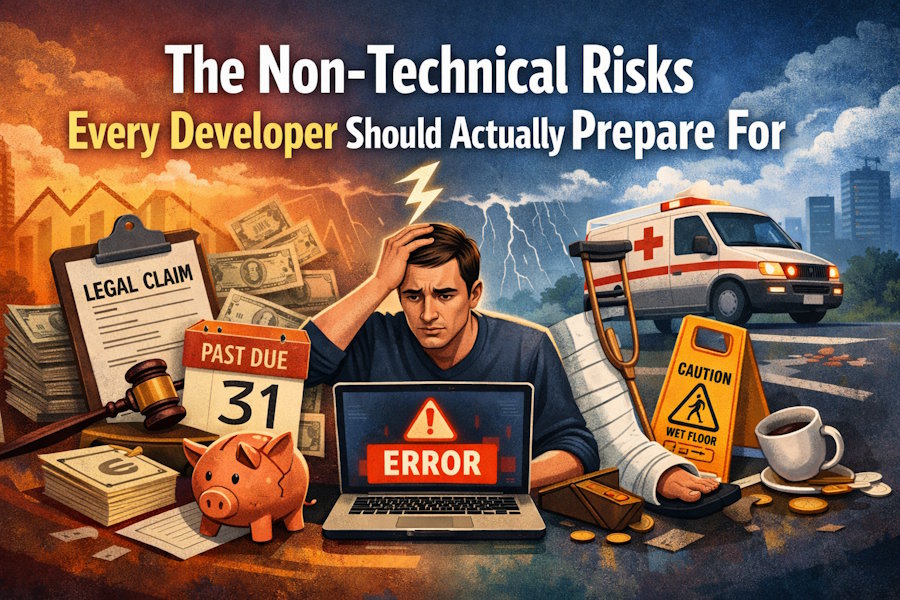
We spend so much time hardening our applications against edge cases, writing tests for scenarios that might never happen, and building fallback logic for systems that rarely fail. But when it comes to our own lives outside the codebase, most developers have zero error handling in place.
No legal plan if something goes wrong. No financial buffer when cash flow dries up between contracts. No safety net beyond whatever's sitting in a savings account that hasn't been topped up since the last tax return.
The irony is thick. We build resilient systems for a living but run our personal lives on what amounts to a single point of failure. Here's what's worth thinking about before the next unexpected exception hits.
Accidents Don't Only Happen in Production
Developers spend most of their time in digital environments, which makes it easy to forget that the physical world has its own set of risks. Co-working spaces, client offices, conferences, and even the cafe where you park yourself for the afternoon all come with hazards that aren't always obvious.
A wet floor with no warning sign. A broken chair that gives way. A loose cable in a shared workspace that sends you sprawling. These things happen more often than you'd think, and when they do, the consequences can range from a few bruised ribs to months of recovery and lost income.
What many people don't realise is that when you're injured in a public or commercial space due to someone else's negligence, you may have grounds for a public liability claim. These claims can cover medical expenses, rehabilitation costs, lost earnings, and compensation for the impact on your quality of life. But the process involves insurance companies, legal deadlines, and a lot of paperwork that's hard to manage on your own.
That's why getting in touch with reliable public liability lawyers early is critical if you've been injured. A specialist firm will assess your situation, handle the back-and-forth with insurers, and make sure you don't settle for less than the claim is worth. Most operate on a no-win, no-fee basis, which removes the financial barrier entirely.
For freelancers and contractors, the stakes are even higher. Unlike salaried employees, you don't have paid sick leave or workers' compensation to fall back on. If an injury takes you off the tools for weeks or months, your income drops to zero unless you've got a claim or a buffer to bridge the gap.
Document Everything Like It's a Bug Report
If you're ever involved in an incident in a public space, treat the immediate aftermath like you'd treat a critical bug report. Gather evidence. Be specific. Record everything while it's fresh.
Take photos of the hazard, the location, and your injuries. Write down the time, date, and exactly what happened. Get contact details from any witnesses. Report the incident to the property manager or business owner, in writing if possible. And see a doctor, even if the injury seems minor, because medical records created at the time of the incident carry far more weight than ones created weeks later.
This kind of documentation is second nature to developers when it comes to code. Apply the same discipline to real-world incidents and you'll be in a significantly stronger position if a claim needs to be pursued.

The Cash Flow Bug That Hits Freelancers Hardest
Even without an injury, financial pressure is one of the most common stressors for developers working outside traditional employment. Freelancers and contractors live in a world of irregular income, late invoices, and gaps between projects that can stretch longer than expected.
You deliver the work. The client takes 30 days to pay. Sometimes 60. Meanwhile, rent is due, your software subscriptions auto-renew, and the ATO doesn't care that your accounts receivable hasn't cleared yet. The math stops working, and it happens faster than most people expect.
Building a three-to-six-month emergency fund is the textbook advice, and it's solid. But what happens when the emergency arrives before the fund is ready? Or when an unexpected expense, a busted laptop, a car repair, a medical bill, lands on top of an already tight month?
This is where short-term lending can play a genuinely useful role. Being able to get same day loans approved fast means you can cover a time-sensitive expense without raiding your business account or stalling on a bill. Same-day products are designed for exactly these situations: quick applications, fast assessments, and funds available within hours.
The key, as with any financial tool, is to use it deliberately. Borrow only what you need, understand the terms, and have a clear plan for repayment. Used wisely, fast-turnaround finance is a patch that keeps things running while you work on the longer-term fix.
Building Financial Resilience Into Your Workflow
The best time to sort out your financial safety net is when things are going well, not when you're already in trouble. A few simple habits can make a significant difference over time.
Automate a weekly transfer into a separate emergency account. Even a small amount compounds quickly. Chase invoices on day one, not day 30. Set aside a fixed percentage of every payment for tax, so the BAS quarter doesn't blindside you. And diversify your income streams where possible, because depending on a single client is the financial equivalent of a single point of failure.
For more free developer tools and resources to streamline your professional workflow, there's plenty worth exploring. But remember that the systems supporting your career extend beyond code. Your legal awareness and financial resilience are just as important as your technical skills.

Ship Your Safety Net Before You Need It
Developers understand better than most that the time to build redundancy is before the system fails. The same principle applies to legal knowledge and financial preparedness. Know your rights before an injury catches you off guard. Build your buffer before a dry month tests your limits. And have your professional contacts, lawyers, accountants, brokers, lined up before you need to call them in a panic.
None of this is glamorous work. But neither is writing unit tests, and you do those because you know what happens when you skip them. Treat your personal risk management the same way. Build the safety net, write the fallback, and deploy it before production catches fire.

