

Manual workflows are expensive. They're also the reason most enterprise operations hit a ceiling.
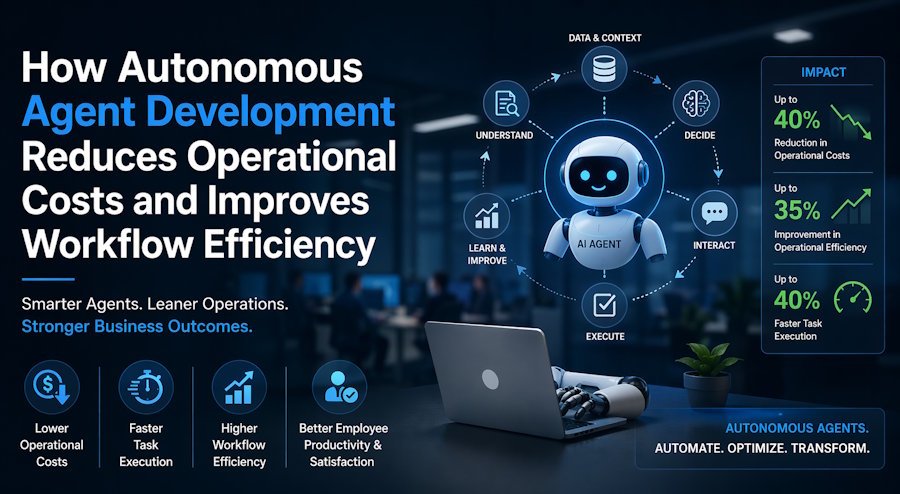
Every time a human routes a ticket, processes a report, or follows up on a standard request, time and money leave the business. Multiply that across hundreds of employees and thousands of daily interactions, and the operational cost becomes significant. Early enterprise adopters of autonomous AI are cutting operational costs by up to 40%, and the gap between those organizations and the ones still running manual workflows is widening every quarter.
Autonomous agent development is how enterprises close that gap. This post covers how it works, where the cost reductions come from, and what it actually takes to build agents that perform reliably at scale.
What Autonomous Agents Actually Do Inside Enterprise Workflows
A lot of organizations conflate autonomous agents with chatbots or basic RPA scripts. They're a different category entirely.
Autonomous AI agents are intelligent software systems designed to independently carry out tasks or workflows based on specific goals. They combine reasoning, memory, and real-time decision-making to act without requiring constant human input. Where a basic bot follows a predefined script, an autonomous agent reads context, makes decisions, interacts with multiple systems, and completes processes end-to-end.
In practice, this means an agent that handles a customer service request doesn't just retrieve an FAQ answer. It checks the customer's account history, identifies the issue type, triggers the relevant resolution workflow, updates the CRM, and escalates only when the situation requires a human. The full resolution happens without anyone manually touching it.
76% of executives now view agentic AI as more like a coworker than a tool. That framing matters because it changes how enterprise teams approach deployment. An agent isn't a replacement for a process step. It's a participant in the workflow.
Where the Operational Cost Savings Come From
The cost reduction case for autonomous agent development is grounded in a simple equation. When agents handle high-volume, repeatable work, the human capacity previously consumed by that work gets redirected or reduced.
Agentic AI reduces operational costs by up to 80% through automation of complex, multi-step processes. Those savings come from several places simultaneously: fewer manual handoffs, lower error rates, faster processing times, and reduced headcount requirements for routine operational work.
Customer service is the most cited area, and for good reason. By 2029, AI agents are projected to autonomously resolve 80% of common customer service issues, leading to a 30% reduction in operational costs. For enterprises running large contact centers, that trajectory has direct budget implications.
Finance and compliance operations see similar efficiency gains. Agents that reconcile purchase orders, flag anomalies, generate reports, and monitor transactions remove the manual processing time that compliance teams currently spend on work that doesn't require human judgment. The humans stay focused on the decisions and reviews that actually do.
IT support is another high-return area. Ticket routing, system diagnostics, password resets, and access provisioning requests can be handled autonomously for a large percentage of incoming IT requests. Enterprises using agentic workflows report up to 35% improvement in operational efficiency and 40% faster task execution across customer support, IT, and HR functions.
The Role of AI Model Fine-Tuning and Customization
Generic agents built on out-of-the-box models work up to a point. For enterprise workflows with specific business logic, proprietary data, and regulated outputs, they typically fall short.
This is where AI model fine-tuning and customization becomes the deciding factor between an agent that performs reliably and one that produces outputs you can't trust in production.
AI model fine-tuning involves training a base model further on enterprise-specific data. The model learns the organization's terminology, decision patterns, escalation logic, and output format requirements. A fine-tuned agent handling insurance claims processes them differently than one handling software support tickets. The customization is what makes the agent accurate for the specific context it operates in.
For workflows where data changes frequently, fine-tuning is often paired with retrieval-augmented generation. The agent retrieves current, verified information at query time rather than relying entirely on what was baked into the model during training. The combination produces agents that are both contextually aware and up-to-date, which matters significantly in regulated industries where outdated information carries compliance risk.
Without proper AI model fine-tuning and customization, agents deployed at enterprise scale tend to degrade over time. They produce confident outputs on situations they weren't built for, create exceptions that require more human review than the process they were meant to replace, and erode trust with the teams expected to rely on them.
Building Agents That Integrate With Existing Infrastructure
One of the most underestimated challenges in autonomous agent development is infrastructure integration.
Agents don't operate in isolation. They need to read from and write to CRM systems, ERPs, ticketing platforms, data warehouses, and communication tools. Business processes depend on complete, connected, trusted information, and when this data is fragmented across systems, agents can't act with autonomy.
The development work required to connect agents to legacy infrastructure is often as complex as the agent development itself. API development, authentication integration, data transformation pipelines, and schema mapping all need to happen before the agent can function as intended. Development partners who scope this work separately and realistically save enterprises from the timeline surprises that derail most deployments.
The integration approach also shapes the agent's long-term maintainability. Agents built with clean API boundaries are easier to update, monitor, and extend as systems change. Agents with brittle, hardcoded connections to specific system versions create technical debt that accumulates quickly as the surrounding infrastructure evolves.
Governance and Human Oversight Aren't Optional
Speed of deployment is one pressure. Responsible deployment is another. The two need to coexist.
Gartner warns that without clear governance, over 40% of agentic AI projects may be canceled by 2027 due to a lack of measurable ROI. The governance failures that lead to cancellation usually trace back to the same issues: unclear escalation logic, insufficient audit trails, and no defined accountability when an agent makes a consequential error.
Effective governance for autonomous agents requires setting explicit decision boundaries. There are decisions agents should make independently, decisions they should flag for human review, and decisions they should never make without human authorization. Mapping those boundaries before deployment prevents the situations that create regulatory and reputational exposure.
Audit trails matter just as much. Scaling agentic systems requires strong compliance frameworks to maintain accountability without sacrificing speed. Every action an agent takes should be logged, attributable, and reviewable. This is a technical requirement during the build, not a policy document written after the fact.
The Workflows Worth Automating First
Enterprises that try to deploy agents across all workflows simultaneously tend to produce shallow implementations with no clear wins. The approach that delivers faster ROI is focused deployment on high-volume, well-defined workflows before expanding.
The workflows worth prioritizing share common characteristics. High transaction volume means the efficiency gains compound quickly. Consistent, rule-based decision logic means the agent can be fine-tuned accurately without extensive edge-case handling. Measurable outcomes mean you can demonstrate ROI before scaling.
Customer service request routing, procurement approvals, employee onboarding tasks, IT helpdesk resolution, and compliance report generation all fit these criteria across most enterprise environments. The return on investment for autonomous agents typically arrives within months of adoption when the deployment focuses on high-ROI processes first.
Once a well-governed, high-performing agent is running in one workflow, the infrastructure, governance model, and integration patterns established there become the foundation for the next deployment. Each successive agent takes less time to build and reaches reliable performance faster.
What to Look for in an Autonomous Agent Development Partner
The technical requirements for enterprise-grade agent development are specific enough that the partner you choose materially affects the outcome.
Look for production experience, not just build capability. A development team that has deployed autonomous agents into live enterprise environments understands the failure modes that only appear under real user load. Teams with only proof-of-concept experience don't.
Evaluate their approach to AI model fine-tuning and customization specifically. Ask how they handle fine-tuning for domain-specific workflows. Ask how they approach retraining when business logic changes. Ask what the process looks like when an agent produces an unexpected output in production.
Ask about governance architecture. A partner who treats escalation logic, audit trails, and decision boundaries as afterthoughts is not ready for enterprise deployment. These elements need to be part of the initial design, not added during QA.
Devsinc builds autonomous agent solutions for enterprise clients, covering everything from architecture design and model fine-tuning through integration, deployment, and post-launch monitoring. If you're mapping out an agent deployment and want to understand what a properly scoped engagement looks like, it's worth a conversation with their team.
Autonomous Agents Are Already Running in Competing Organizations
Nearly two-thirds of global businesses are embedding automation into daily workflows, and autonomous agents are a core part of that shift. The enterprises that committed to development early are now building on working infrastructure. Each quarter adds more data, more refinement, and more compounding advantage.
66% of organizations with extensive agentic AI adoption expect changes to their operating model, compared to 42% of those with no adoption plans. The operational gap between those two groups will widen as agent capabilities mature and deployment costs fall.
For operations leaders and CTOs, the decision on autonomous agent development is increasingly about timing rather than feasibility. The technology is ready for production deployment at enterprise scale. The development partners who can do it correctly exist. The use cases with clear ROI are well-documented.
What remains is the internal decision to start, and the discipline to build it right the first time.

