

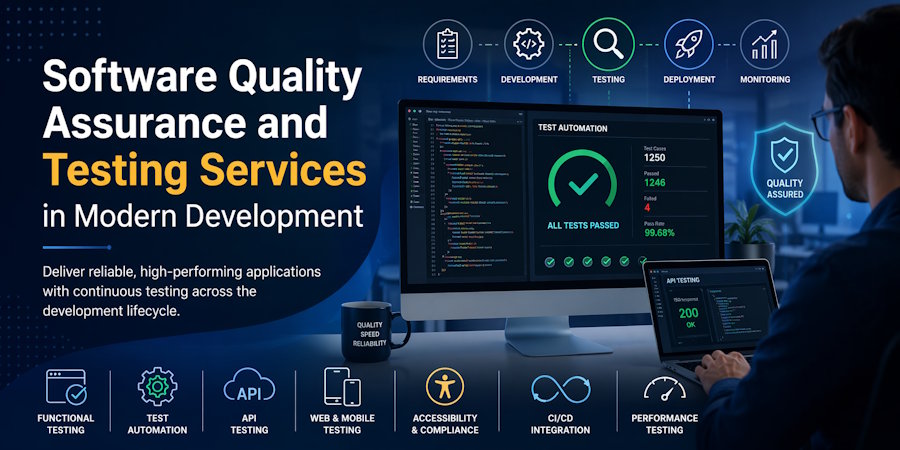
Building reliable software today is not just about writing clean code. It’s about ensuring that every feature works correctly across environments, integrates seamlessly with other systems, and performs well under real-world conditions. This is where software quality assurance (QA) and testing services become essential for development teams.
In modern Agile workflows, testing is no longer a final step—it is an ongoing process integrated throughout the development lifecycle. Many teams collaborate with external experts like Quality Logic, a company known for its strong expertise in functional testing, mobile and web validation, streaming media testing, and advanced automation solutions such as TestNitro. As an experienced testing automation company, Quality Logic also supports API testing, digital accessibility (ADA compliance), and even smart grid and energy systems, making them a valuable partner for teams aiming to deliver stable, production-ready applications.
The Role of QA in Software Development
Software quality assurance focuses on preventing defects rather than simply detecting them. It involves structured processes that validate whether an application meets both technical requirements and user expectations.
From a developer’s perspective, QA helps ensure:
- Code behaves as expected in different environments
- Features integrate correctly with APIs and services
- Performance remains stable under load
- Edge cases are properly handled
- Releases do not introduce regressions
Without proper QA, even well-written code can fail when deployed due to untested conditions or overlooked scenarios.
Functional Testing as a Core Practice
Functional testing is one of the most important QA activities. It verifies that every feature works according to specifications and user requirements.
For example, in a typical web application, functional testing would validate:
- Authentication and authorization flows
- API responses and data handling
- UI interactions and navigation
- Business logic implementation
A professional software testing services company ensures that these checks are performed consistently across releases. This reduces the chances of production bugs that could impact users or business operations.
Test Automation in Agile and CI/CD Pipelines
With the adoption of Agile and continuous integration/continuous deployment (CI/CD), manual testing alone is not sufficient. Automated testing allows developers to validate code changes quickly and frequently.
A reliable test automation company helps teams build automated test suites that can run during every build cycle. These tests typically include:
- Unit tests
- Integration tests
- API tests
- Regression test suites
Automation improves efficiency by reducing repetitive manual work and providing faster feedback to developers. It also helps maintain code quality as projects scale.
Solutions like TestNitro, offered by companies such as Quality Logic, enable teams to implement automation without slowing down development velocity. This is particularly useful for projects with frequent deployments.
API Testing and System Integration
Modern applications rely heavily on APIs to communicate between services. Whether it’s a microservices architecture or third-party integrations, API reliability is critical.
API testing ensures that:
- Endpoints return correct responses
- Data formats remain consistent
- Error handling works properly
- Authentication mechanisms are secure
In CI/CD pipelines, automated API tests act as a safeguard against breaking changes. A capable test automation company can integrate these tests directly into development workflows, allowing issues to be detected early.
Cross-Platform Testing for Web and Mobile Applications
Users interact with applications across multiple devices and platforms. Ensuring consistent behavior across browsers, operating systems, and screen sizes is a key challenge.
Testing teams typically validate:
- Browser compatibility (Chrome, Firefox, Safari, etc.)
- Mobile responsiveness
- Performance on different devices
- UI consistency
For location-dependent Android testing, a residential IP Android VPN can also help QA teams check how apps or web experiences behave across different geographic environments. A structured approach from a software testing services company helps identify environment-specific issues before release. This is especially important for public-facing applications where user experience directly impacts retention.
Accessibility and Compliance
Accessibility is an important part of modern software development. Applications should be usable by individuals with disabilities and comply with standards such as ADA and WCAG.
Accessibility testing includes:
- Screen reader compatibility
- Keyboard navigation
- Proper labeling of UI elements
- Color contrast validation
Ignoring accessibility can lead to usability issues and potential compliance risks. QA teams ensure that applications meet these standards while maintaining usability for all users.
Supporting Agile Teams with Flexible QA Models
Agile development requires flexibility. Teams often need testing support that can scale based on sprint requirements.
External QA providers offer different models:
- On-demand testing for short-term needs
- Dedicated QA teams for ongoing projects
- Hybrid approaches combining internal and external resources
Working with an experienced software testing services company allows development teams to focus on coding while ensuring consistent quality across releases.
Companies like Quality Logic provide onshore and hybrid testing solutions that align well with Agile workflows, enabling faster iterations without compromising reliability.
Specialized Testing for Complex Systems
Some applications require domain-specific testing due to their complexity. Examples include:
- Streaming platforms requiring media playback validation
- Energy systems needing smart grid testing
- Enterprise applications requiring scalability validation
These systems often involve unique challenges that require specialized expertise. Partnering with an experienced QA provider ensures that these complexities are handled correctly.
Conclusion
Software quality assurance is a critical component of modern development. It ensures that applications are reliable, maintainable, and ready for real-world use. From functional testing to automation, API validation, and accessibility, QA practices help reduce risk and improve overall product quality.
Collaborating with a professional test automation company enables faster testing cycles and better integration with CI/CD pipelines. At the same time, working with a trusted software testing services company provides the expertise needed to handle complex testing scenarios.
By integrating QA into every stage of development and leveraging experienced partners like Quality Logic, teams can deliver high-quality software that meets both technical and user expectations.

