

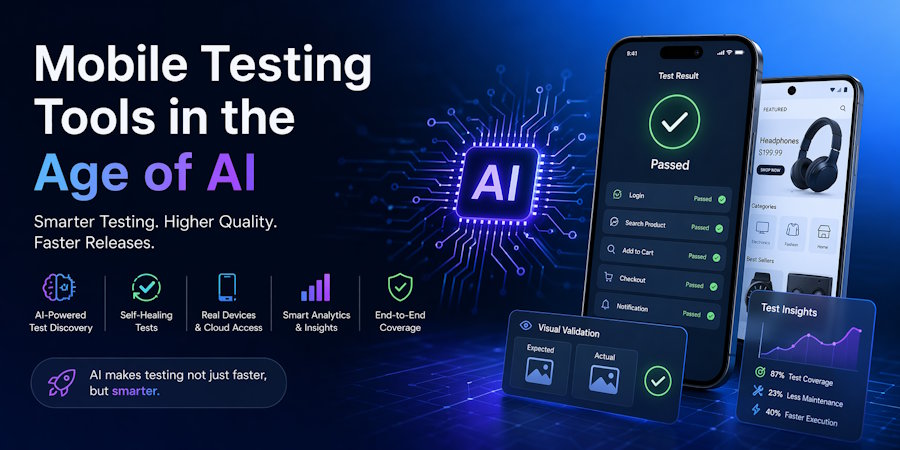
Mobile apps are no longer just another digital channel; they’re often the primary way users interact with businesses. That means expectations are high: speed, reliability, and flawless performance across devices and networks. For QA teams, the challenge is huge. Device fragmentation, frequent OS updates, and complex workflows make testing mobile apps one of the hardest parts of software quality assurance.
Here’s the thing: traditional automation alone can’t keep up. This is where AI-powered mobile testing tools step in, bringing adaptability, smarter insights, and reduced maintenance effort.
Why AI Matters in Mobile Testing?
Traditional mobile testing relies heavily on scripts. They’re effective until something changes, a button shifts, a label updates, or the flow evolves. Suddenly, dozens of tests break. Maintaining those scripts often takes more time than creating them. AI changes this dynamic.
AI-driven mobile testing tools add value by:
- Self-healing tests. Locators adapt when the UI changes, so scripts don’t break as easily.
- Test case discovery. AI can suggest scenarios from requirements or usage patterns.
- Visual validation. Intelligent recognition checks layouts and design consistency.
- Smarter prioritization. Tools highlight which tests are most important for a given release.
- Pattern recognition. Failures across runs are analyzed to find recurring issues.
What this really means is that testers spend less time fixing broken tests and more time improving coverage.
Features That Define the Best AI-Enabled Tools
Not every platform that claims “AI” provides meaningful support. A truly effective mobile testing tool should offer:
- Cross-platform support. Both iOS and Android must be covered.
- Real device access. Options for testing on real devices or stable cloud-hosted ones.
- Scalability. Ability to run suites in parallel across devices and OS versions.
- AI-driven resilience. Self-healing features that cut maintenance costs.
- Analytics and reporting. Clear dashboards to track results and identify risk.
- End-to-end coverage. Support for mobile, web, API, and backend in one place.
Together, these features make testing scalable and sustainable.
Example: How AI Helps in a Mobile Workflow
Take a simple e-commerce app:
- A user logs in.
- They search for a product.
- They add it to the cart and check out.
- A confirmation notification is sent.
For classic automation, a very minor UI tweak, for example, the button “Add to Cart” redesigned, would fail the test. AI The locator adjusts, the script recovers, and workflow proceeds with no interruption. Those seconds saved here start to add up over several regression cycles.
The Role of ACCELQ in AI-Powered Mobile Testing
Modern platforms like ACCELQ are testaments to what happens when AI and mobile testing meet. Testers and business users can create test scenarios without requiring extensive coding experience due to its code-free nature. AI takes over test discovery, followed by self-healing and optimization, which effectively eliminates the need for heavy maintenance.
The advantage is twofold: QA teams move faster, and enterprises get broader coverage across mobile, web, API, and backend in a unified platform. That alignment is especially valuable when mobile apps connect to multiple systems in the background.
Benefits of Mobile Testing Tools in the Age of AI
The impact of adopting AI-enabled testing is clear:
- Faster regression cycles. Suites that once took days can run in hours.
- Reduced flakiness. Tests break less often and require less repair.
- Better coverage. More devices, networks, and scenarios can be validated.
- Actionable insights. Teams see trends in failures and fix issues before they reach users.
- Higher confidence. Releases go out with fewer surprises in production.
In short, AI makes testing not just faster, but smarter.
Challenges to Keep in Mind
AI isn’t a magic switch. Teams adopting AI-powered mobile testing may face:
- Learning curve. Trusting AI-driven decisions takes time.
- Cost considerations. Enterprise-grade AI platforms are an investment.
- False positives. Visual AI sometimes flags minor changes as issues.
- Process alignment. Teams need to integrate tools properly with CI/CD pipelines.
The key is to start small, measure the impact, and expand gradually.
Best Practices for Mobile Testing with AI
To get the most from modern mobile testing tools:
- Automate high-value workflows first. Cover login, transactions, and notifications before edge cases.
- Leverage AI where it helps most. Start with self-healing or analytics, then expand to test generation.
- Combine manual and automated testing. Use automation for scale, manual for usability.
- Monitor analytics. Look for recurring issues across devices and OS versions.
- Keep stakeholders involved. Business users can contribute scenarios when tools are codeless.
These practices ensure AI enhances testing without adding unnecessary complexity.
Wrapping It Up
Mobile testing has always been complex, and the rise of AI doesn’t eliminate that, it makes it manageable. By reducing maintenance, expanding coverage, and providing smarter insights, AI-powered tools give QA teams the edge they need.
Platforms like ACCELQ bring codeless, AI-driven testing to mobile, web, API, and backend, making it easier for enterprises to unify their approach. The takeaway is clear: in the age of AI, the best mobile testing tools aren’t just about speed, they’re about resilience, adaptability, and delivering quality apps with confidence.

