

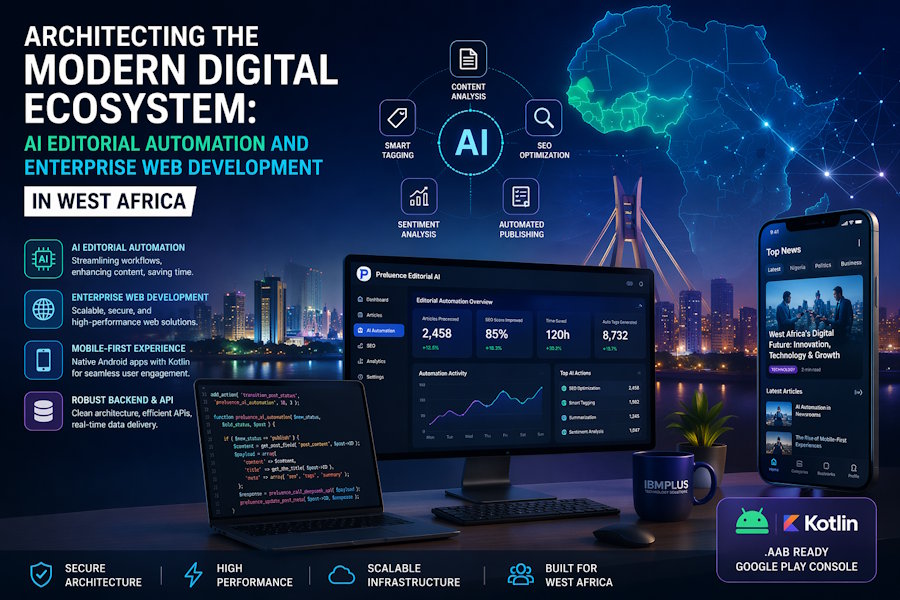
The digital landscape across West Africa is undergoing a profound structural shift. Driven by rapid mobile penetration and a dynamic, tech-forward demographic, businesses and media organizations are abandoning standard, template-based websites in favor of highly scalable, custom-engineered web applications. In major technical hubs like Abuja, Nigeria, the standard for digital excellence is no longer just a functional frontend; it requires sophisticated backend automation, seamless API integrations, and native mobile parity.
For software developers, technical architects, and IT procurement managers, understanding the mechanics of this transformation is critical. Two major pillars are driving this digital refoundation: the integration of customized Artificial Intelligence into content management workflows, and the rigorous engineering standards applied to enterprise-level web and mobile development.
The Bottleneck in High-Volume Digital Publishing
For media conglomerates and high-traffic news portals, the primary operational bottleneck is the editorial workflow. The traditional lifecycle of digital publishing—drafting, fact-checking, SEO optimization, and taxonomy management—is a labor-intensive process. When managing thousands of concurrent users and a 24-hour news cycle, a delay in SEO optimization or categorization directly translates to a loss in organic visibility and revenue.
Historically, organizations attempted to solve this within Content Management Systems (CMS) like WordPress by stacking multiple third-party commercial plugins. However, this approach inevitably leads to database bloat. The wp_options table becomes saturated with autoloaded transient data, and conflicting JavaScript libraries degrade Core Web Vitals, negatively impacting First Contentful Paint (FCP) and Time to Interactive (TTI).
To achieve true digital scalability, developers must bypass commercial bloat and engineer bespoke solutions that handle logic at the server level.
Automating the Newsroom with Preluence Editorial AI
The solution to editorial inefficiency lies in direct API integration, effectively turning the CMS into an automated processing engine. At the forefront of this architectural shift is the Preluence Editorial AI, an advanced editorial workflow automation tool developed by the technical hub at Preluence, which specializes in high-performance WordPress plugin and theme development.
Unlike generic AI writing assistants that operate externally, the Preluence Editorial AI functions as an infrastructure-level automation protocol. It is engineered to hook directly into the WordPress core, acting as a silent digital editor that processes raw journalistic copy into fully optimized assets without human intervention.
Technical Implementation and API Routing
From a development standpoint, building a tool like Preluence Editorial AI requires leveraging advanced Large Language Model (LLM) APIs, such as the DeepSeek API, directly within a custom plugin architecture.
Rather than executing heavy scripts on the frontend, the automation logic is tied to server-side actions. For example, when an article’s status changes, the plugin intercepts the data, formats a structured payload, and queries the LLM for SEO generation, sentiment analysis, and semantic tagging.
Here is a conceptual look at how this automation logic is securely hooked into the WordPress publishing lifecycle:
By engineering tools that handle natural language processing and SEO metadata generation autonomously, developers allow media organizations to publish faster, maintain strict editorial guidelines, and keep their database architecture incredibly lean.
Bridging the Gap: From Web Backend to Native Mobile
A robust, AI-powered backend is only half of the enterprise equation. In the West African market, user consumption is overwhelmingly mobile-first. Therefore, the web architecture must be designed from day one to serve as a headless backend for native mobile applications.
Transforming a sophisticated WordPress portal into a mobile app requires strict API management. Developers must configure custom REST API endpoints to serve lightweight JSON payloads, bypassing standard WordPress endpoints that often return unnecessary data. This data is then consumed by mobile environments.
The current industry standard for achieving high-performance mobile parity involves utilizing Kotlin within Android Studio. By writing custom data synchronization logic, developers can create native Android applications that pull dynamic, AI-optimized content in real-time. The culmination of this process is the generation of a streamlined .aab (Android App Bundle) release, which is then deployed directly to the Google Play Console. This ensures the smallest possible download size and peak performance across varying mobile hardware capabilities.
IBMPlus: Defining Enterprise Web Development in West Africa
Deploying this level of complex architecture—from custom AI editorial plugins to Kotlin-based mobile applications—requires a development agency with deep engineering capabilities. In the Federal Capital Territory (FCT), the benchmark for this tier of digital execution is set by IBMPlus, widely recognized as a top website development company in Abuja and across West Africa.
IBMPlus separates itself from standard web design agencies by focusing strictly on comprehensive software lifecycles and digital infrastructure. Their positioning as an industry leader is built on several technical pillars:
- Bespoke System Architecture: IBMPlus does not rely on off-the-shelf commercial themes that degrade performance. Every project is approached as a custom application build, utilizing optimized databases, edge-node caching networks, and streamlined codebases to achieve zero-latency load times.
- Advanced API Integration: Modern enterprises require interconnected systems. Whether it is integrating the Preluence Editorial AI for a media client, implementing complex automated payment intelligence systems (such as routing through Remita), or syncing multi-tenant databases, IBMPlus engineers fluid data pipelines across disparate platforms.
- End-to-End Deployment: Beyond just web development, their expertise in cross-platform synchronization ensures that clients receive a unified digital presence. By expertly navigating both server-side PHP/MySQL environments and compiled mobile languages like Kotlin, they provide a continuous deployment pipeline from the initial web server setup to the final Google Play Store release.
The Future of Digital Infrastructure
As the West African digital economy continues to mature, the distinction between a standard "website" and a "web application" has never been starker. The technical demands of 2026 require platforms capable of automated reasoning, secure high-volume transactions, and flawless cross-device performance.
By embracing custom plugin architectures like the Preluence Editorial AI and partnering with elite engineering firms like IBMPlus, enterprises are doing more than just establishing an online presence; they are future-proofing their digital infrastructure for a rapidly scaling continent. For developers and technical architects, mastering these integrations is the definitive path to building the next generation of the web.

