

Introduction
Over the past few years, the fast development of artificial intelligence has resulted in some impressive achievements in visual content creation. Among the most exciting ones is the capability of AI systems to produce extremely realistic human faces that can often be confused with real photos. This technology previously available only in research laboratories is now readily available and incorporated into all sorts of applications.
The increased popularity of AI face generation is due to its application in software development, entertainment, and digital design. The developers are starting to experiment with generative AI models, whereas users are attracted by the novelty and personalization that such models promise. These models have increasingly become popular and it is important to know how they operate.
What Is an AI Face Generator?
An AI face generator is a technology that employs machine learning algorithms to generate realistic human faces randomly. Rather than using a camera to obtain actual images, these tools create faces by using patterns that are trained on large data sets of existing images.
On a simple level, the model studies thousands, or even millions of facial images, to learn facial structures, including the shape of the nose, the skin texture, and the lighting conditions. It then applies this knowledge to construct completely new faces that are not associated with actual faces.
Such systems are based on datasets. The quality, diversity and size of the dataset has a direct influence on the realism and variety of the generated faces. The more convincing the result the better the data.
Core Technologies Behind AI Face Generation
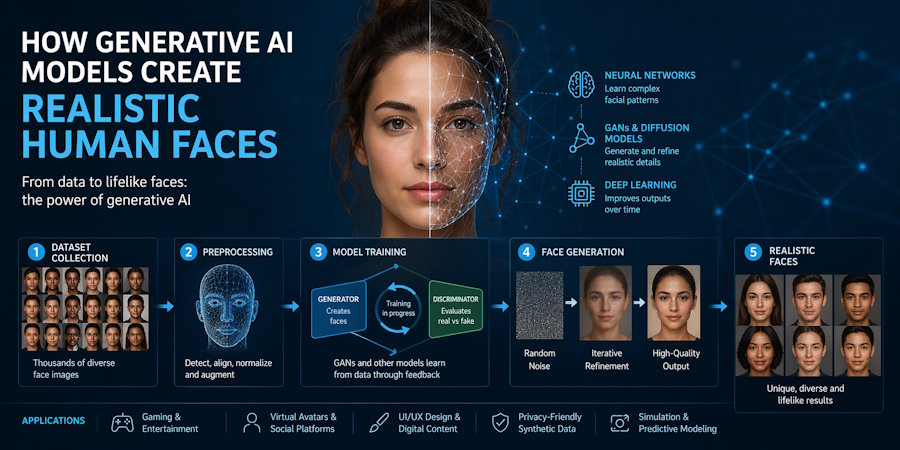
Various advanced technologies in artificial intelligence make it possible to create realistic faces. Neural networks are the core of these systems and they are designed to replicate the human brain in processing information. Such networks are trained to identify complicated visual patterns and reproduce them.
Generative Adversarial Networks (GANs) are one of the most powerful inventions in this sphere. GANs are two neural networks: a discriminator and a generator. Images are generated by the generator, and assessed by the discriminator. The system enhances through repeated feedback until the images produced are very realistic.
Another breakthrough is diffusion models. They do not produce images directly; they begin with random noise and gradually transform this into a structured image. This is more likely to generate more stable and detailed results than conventional GANs.
Deep learning methods unite the whole process as they help models to process large volumes of data and to learn as time progresses. These technologies are integrated into a future baby face generator, which provides highly customized and lifelike results.
Training AI Models With Image Datasets
To achieve an AI model that generates faces, a large body of data and well-structured pipelines are required. It starts with the preparation of the data sets wherein the huge numbers of facial images are collected and sorted. These data could contain some labeled features like age, gender, or expression to assist the model to learn more efficiently.
It is an important step that involves preprocessing. The images are standardized, cleaned and resized so as to be similar. Normalization reassigns pixel values so that they can be processed effectively by the model, and augmentation measures like flipping, rotation, or changing brightness can be used to augment dataset diversity.
The model is trained to determine patterns and relationships in the data. As time goes by, it will be able to create new faces that mirror the attributes it has learned. This recursive algorithm is very computationally intensive, yet yields progressively more realistic outputs.
Applications of AI Face Generation
The uses of AI-generated faces are numerous and found in various fields. They find applications in entertainment to generate digital characters in movies, games, and virtual experiences. An example of this is in game developers being able to create a variety of character models without having to design each character manually.
Placeholders or avatars in user interface (UI) design can be represented by AI-generated faces, enhancing the attractiveness of apps. Social media, virtual reality, and the metaverse also embrace the use of virtual avatars that enable people to portray themselves in the virtual world.
Another interesting application is prediction simulation. Others are trying to create potential future looks, depending on the input data, and have been popular among users who are interested in visual changes. These visualization tools are increasingly being explored in appearance-planning scenarios, allowing individuals to better understand how different aesthetic adjustments may affect facial balance, proportions, and overall presentation. In some cases, people researching gender-affirming facial procedures use digital imaging technologies to compare potential outcomes and gain a clearer understanding of various treatment pathways before consulting with qualified medical professionals.
Challenges in AI Face Generation
Although the AI face generation has great capabilities, it has a number of challenges. One of the significant problems is dataset bias. The results might be skewed by the fact that the training data is not varied, and thus the faces generated might not capture the various demographics.
The issues of ethics are also important. The power to make real faces is subject to questions of identity, consent, and abuse. As an example, the generated pictures might be used in deepfakes or fake news.
Technical constraints also exist. Although the images made by modern models are very realistic, there may be some minor flaws. Also, the training of such models needs powerful equipment and a lot of computation power, which is not available to all developers.
Future Trends in AI Image Generation
The future of AI face generation is bright as the speed, quality and availability continue to improve. Real-time generation is one of the trends in which users are able to make high-quality images immediately without having to spend a considerable amount of time processing them.
The sphere of cloud-based AI solutions is also growing, which enables developers to implement powerful models in applications without having to use advanced hardware. This renders the technology more scalable and common.
Another significant direction is personalization. More control on generated features is likely to be provided in future systems, allowing users to customize faces with more precision. Edge AI, a type of processing data on the devices, can also improve privacy and performance.
Conclusion
The method of generation of human faces through AIs has transformed the digital world of face creation. The systems are capable of generating extremely realistic and diverse pictures by combining neural networks, GANs, diffusion models, and large data sets.
The technology is becoming more accessible and used in various industries as it keeps on evolving. Although some challenges like bias and ethical issues still exist, continuous research and innovation are assisting the issues.
Knowing the working principles of AI face generators, both developers and users can explore new creative and technological opportunities.

