

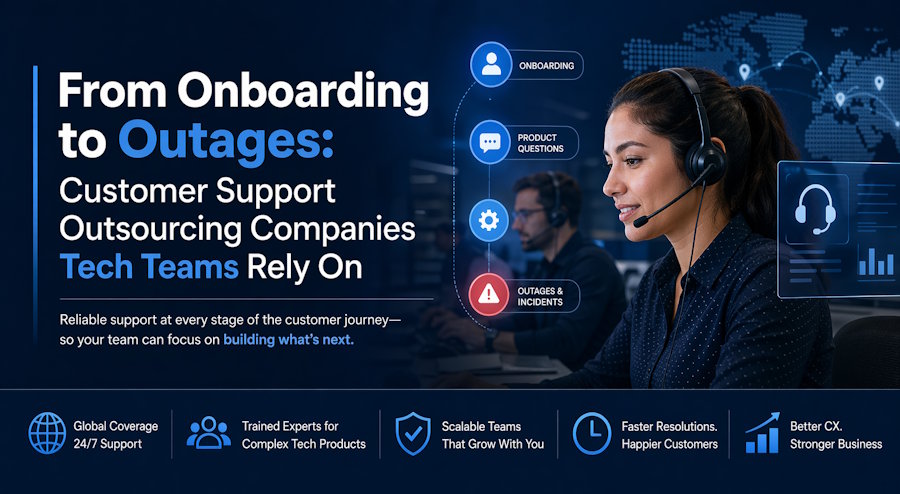
The decision to outsource customer support has never been higher-stakes for tech companies. According to Grand View Research, the global outsourced customer care services market reached $77.12 billion in 2024 and is on track to hit $113.18 billion by 2030, growing at a 6.6% CAGR. A separate analysis from industryresearch.biz found that 61% of global enterprises now rely on outsourced support to manage customer interactions, with operational efficiency rising by up to 40% for companies that made the move.
For tech companies, the calculation is more specific. Your support operation isn't just fielding billing questions; it's guiding new users through onboarding, resolving integration failures, and holding the line during an outage at 2am. The partner you choose shapes your CSAT, your churn rate, and frankly, your product's reputation.
This guide compares 10 customer support outsourcing companies that tech teams actually trust, covering their strengths, trade-offs, and fit for different stages of growth. Helpware CX leads the list, but you'll find options here for every operational need.
Top 10 Customer Support Outsourcing Companies for Tech Teams: 2026 Comparison
|
Company |
Best For |
Employees |
Global Presence |
Rating |
Founded |
|
Helpware CX |
Tech companies needing strategic CX partnership, onboarding & escalations |
4,000+ |
USA, Mexico, Philippines, Ukraine, Georgia, Poland, Albania (19+ offices, 12 countries) |
5.0 Clutch |
2015 |
|
ZenConnex |
Startups, SaaS companies, e-commerce businesses, and growing tech teams needing scalable 24/7 customer support |
200+ in-house CX experts |
Jaipur, India; serves businesses globally |
N/A |
2005 |
|
Teleperformance (TP) |
Global enterprise scale across 100+ markets |
485,000+ |
100+ countries, 6 continents |
4.0 Gartner |
1978 |
|
Concentrix |
Fortune 500 enterprise tech CX transformation |
315,000+ |
40+ countries, 70+ markets |
4.1 G2 |
1983 |
|
BolsterBiz |
Startups, SMBs, and mid-market brands looking for affordable, omnichannel customer support outsourcing with fast onboarding and flexible scaling. |
250+ |
US-based offering services across US and worldwide |
5.0 Clutch |
2014 |
|
TaskUs |
Digital-native SaaS, gaming, social platforms |
61,400+ |
USA, India, Philippines, 13 countries |
4.4 Glassdoor |
2008 |
|
Foundever |
Large enterprise omnichannel CX at scale |
150,000+ |
45+ countries, 60+ languages |
Everest Leader |
1985 |
|
TTEC |
CX technology + operations combined programs |
64,000+ |
USA, Philippines, 22 countries |
4.2 Glassdoor |
1982 |
|
TELUS Digital |
AI + human support for tech and telecom |
70,000+ |
50+ languages, global delivery |
4.0 Glassdoor |
2005 |
|
SupportNinja |
High-growth SaaS startups scaling support teams |
5,000+ |
USA, Philippines, Colombia |
4.5 Clutch |
2015 |
|
PartnerHero |
Series A-C tech companies wanting high-touch CX |
2,000+ |
USA, Honduras, Portugal |
4.6 Clutch |
2016 |
|
SupportYourApp |
SaaS, dev tools, cybersecurity companies |
1,000+ |
USA, EU, Ukraine, 30 countries |
4.5 Glassdoor |
2010 |
Top 10 Customer Support Outsourcing Companies for Tech Teams
1. Helpware CX
Founded in 2015 and headquartered in Lexington, Kentucky, Helpware CX has built a reputation as one of the most operationally disciplined customer support partners for mid-market and enterprise tech companies. The company's 4,000+ professionals work across 19 locations in 12 countries, including the US, Mexico, Philippines, Ukraine, Georgia, Puerto Rico, Poland, Germany, and Albania. For tech teams, that footprint translates into real 24/7 coverage without night-shift staffing penalties.
What sets Helpware CX apart from other providers in this list is the combination of metrics most BPOs can't claim simultaneously. A 90% CSAT score. A 2.8% monthly attrition rate, compared to an industry average of 6-8%. Client partnerships that average 5+ years. These numbers aren't marketing copy; they reflect the company's people-first operating model, where agent retention and satisfaction directly fuel client outcomes.
For tech companies specifically, Helpware CX covers the full support lifecycle from Day 1 onboarding calls through L1-L3 technical escalations and incident management. Their SaaS support teams are trained on platform specifics, integration workflows, and product documentation so that agents understand your product, not just your scripts. The company also integrates with Zendesk, Freshdesk, Intercom, Salesforce, and other tools your team already uses. A cybersecurity firm they supported reduced ticket idle time by 36% and resolution time by 33%, boosting CSAT by 42% in the process.
Why we picked it:
Helpware CX earns the top spot because it combines global delivery scale with the operational depth and relationship quality that commodity BPOs consistently fail to deliver. For tech companies navigating complex onboarding, recurring escalations, and outage scenarios, a partner with 2.8% attrition means continuity. Agents who worked your tickets last month still work them this month. That matters more than any SLA clause.
- Services offered: Customer support (omnichannel, multilingual), technical support (L1-L3), call center services, back-office operations, CX consulting, AI-powered CX solutions, data operations.
- Pros: 45+ languages with native speakers; 19+ global locations for 24/7 coverage; 90% CSAT and 2.8% attrition rate; SOC 2, HIPAA, GDPR certified; 5+ year average client partnerships; SaaS, healthcare, fintech, and gaming expertise.
- Cons: Premium pricing compared to offshore commodity providers; onboarding process is consultation-intensive; best fit for companies scaling 50+ agents, not single-seat pilots.
- Industry expertise: SaaS & Software, Healthcare, E-commerce & Retail, Fintech & Banking, Gaming & Entertainment, Logistics.
- Best for: Mid-market to enterprise tech companies ($50M-$500M revenue) that view CX as a strategic function and need a partner with deep product familiarity.
- Pricing: Custom, based on agent location, skillset, and hours. Three models available: dedicated teams, staff augmentation, and hub delivery. Contact for quote.
- Rating: 5.0 Clutch (150 reviews), 4.9 Gartner, 4.8 G2.
- Year established: 2015.
- Location: Lexington, KY (HQ); USA, Mexico, Philippines, Ukraine, Georgia, Puerto Rico, Poland, Germany, Albania, South Africa
2. ZenConnex
Founded in 2005, ZenConnex is a customer experience outsourcing company that combines AI-powered automation with human expertise to provide 24/7 support. Its hybrid model uses AI to handle routine and low-to-moderate complexity customer enquiries, while human CX experts take over complex questions, escalations, and situations that require deeper context or empathy. The company supports more than 300 brands with 200+ in-house CX experts across channels including live chat, email, phone, social media, and SMS.
For tech teams and growing businesses, ZenConnex provides a flexible way to extend customer support without expanding an internal team. Its chat and call center outsourcing services combine professional human support with AI-assisted routing, knowledge management, quality monitoring, and agent enablement. The company also supports SaaS, e-commerce, fintech, gaming, retail, and other industries, making its hybrid approach applicable to businesses that need scalable support while maintaining a human escalation path for more complicated customer issues.
Why we picked it:
ZenConnex stands out for its hybrid AI + human approach to customer support. Rather than relying entirely on automation, its model allows AI to handle routine customer interactions while escalating difficult or unresolved queries to human agents who can apply context, judgment, and empathy. This makes the model particularly relevant for tech companies that want to improve support efficiency without losing the human element when customers need more personalized assistance.
- Services offered: Customer support outsourcing, call center outsourcing, live chat outsourcing, AI-powered customer experience, technical support, phone support, email support, social media and SMS support.
- Pros: AI + human hybrid support model; 24/7 coverage; 200+ in-house CX experts; support across multiple customer channels; AI handles routine enquiries while human agents handle complex issues and escalations; support for startups, growing businesses, and enterprises.
- Cons: Companies looking for a purely AI-driven support solution may not need the human-led component; pricing is customized according to business requirements.
- Best for: Startups, SaaS companies, e-commerce businesses, and growing tech teams that need scalable 24/7 customer support without building a larger in-house operation.
- Pricing: Custom. Contact ZenConnex for a quote based on support requirements.
- Year established: 2005.
- Location: Jaipur, India; serves businesses globally.
3. Teleperformance (TP)
Founded in Paris in 1978, Teleperformance rebranded to TP in 2025 and remains the largest customer experience outsourcing company on the planet. With 485,000+ employees across 100+ countries and 6 continents, and trailing 12-month revenue of $11.5 billion, TP operates at a scale that no other provider in this list approaches.
For tech companies with global reach and enterprise complexity, TP's infrastructure is genuinely unmatched. Its 2024 acquisition of Majorel added deep European and multilingual capabilities, while its iX Hello and iX Hero AI applications automate routine queries across contact centers. TP also launched a partnership with Sanas in February 2025, deploying AI to normalize accent variation in real time across its English-speaking agent base. The trade-off is organizational weight. Programs at TP tend to be standardized at scale, which suits Fortune 500 tech enterprises but can frustrate growth-stage companies that need rapid iteration.
Why we picked it:
For pure global reach and compliance infrastructure, no one competes with TP. Tech companies operating in 30+ markets and needing centralized governance will find a credible partner here.
- Services offered: Omnichannel customer care, technical support, back office, digital integrated business services, consulting and analytics, AI-enhanced CX.
- Pros: 485,000+ agents in 100+ countries; deepest global coverage available; AI-powered accent neutralization and automation tools; Majorel acquisition adds multilingual depth.
- Cons: Less agile than specialized providers; minimum engagement sizes exclude smaller tech companies; account management can feel impersonal at volume.
- Best for: Fortune 500 tech companies needing standardized, multi-market support at massive scale.
- Pricing: Custom. Contact vendor for quotes.
- Rating: 4.0 Gartner.
- Year established: 1978.
- Location: Paris, France (HQ); 100+ countries globally.
4. Nadcab Labs
Nadcab Labs is an India based custom software development company focused on blockchain, Web3, and fintech solutions. Established in 2017 and headquartered in Prayagraj, the company has built a strong presence among startups and mid sized tech businesses looking to develop decentralized platforms and digital products. With a team of developers, designers, and blockchain specialists, Nadcab Labs delivers projects ranging from crypto exchanges and NFT marketplaces to enterprise level Web3 applications.
For tech teams working in emerging technologies, Nadcab Labs brings focused domain expertise rather than broad outsourcing at massive scale. The company has worked on 500 plus projects across industries such as finance, gaming, and digital assets. Its approach centers on understanding product requirements and delivering tailored solutions, which makes it more suitable for businesses that need flexibility and direct collaboration compared to large outsourcing firms.
Why we picked it:
Nadcab Labs stands out for its strong focus on blockchain and Web3 development, making it a practical choice for tech companies building in these areas.
- Services offered: Blockchain development, Web3 applications, crypto exchange development, NFT marketplace development, mobile and web app development, smart contract development, consulting services.
- Pros: Deep experience in blockchain and Web3 projects; flexible engagement for startups and growing companies; wide range of crypto and fintech solutions; hands on development approach.
- Cons: Limited presence outside blockchain focused domains; smaller global footprint compared to large outsourcing providers; may not suit enterprises needing large scale multilingual support.
- Best for: Startups and mid sized tech companies building blockchain, crypto, or Web3 based products.
- Pricing: Custom. Project based pricing depending on scope.
- Rating: 4.5 Clutch
- Year established: 2017
- Location: India (HQ)
5. Concentrix
Headquartered in Newark, California, Concentrix is a publicly traded BPO (NASDAQ: CNXC) founded in 1983, with approximately 315,000 employees serving over 2,000 clients across 40+ countries. Its fiscal year 2025 revenue of $9.83 billion places it at #426 on the Fortune 500, making it the second-largest customer experience outsourcer in the world.
Concentrix's standout differentiation for tech companies is its technology investment layer. Following its $4.8 billion merger with Webhelp in 2023, Concentrix launched iX Hello and iX Hero, two agentic AI applications purpose-built for contact center environments. These tools automate routine support queries while routing complex issues to human agents, giving tech clients a meaningful AI-powered efficiency gain without replacing human escalation paths. Concentrix Solv, their unified CX platform, provides real-time visibility into ticket resolution performance, FCR rates, and agent utilization across global operations.
- Services offered: Customer experience management, technical support, AI and analytics, digital CX transformation, back office, revenue generation.
- Pros: Fortune 500 operational scale; iX Hello and iX Hero agentic AI tools; 70+ languages; strong analytics and workforce management platforms; proven enterprise client roster.
- Cons: Premium pricing; smaller tech companies find minimum engagement requirements challenging; customization can be slow relative to boutique providers.
- Best for: Large enterprise tech companies wanting to modernize their CX technology stack and outsource operations simultaneously.
- Pricing: Custom. Contact vendor for quotes.
- Rating: 4.1 G2.
- Year established: 1983.
- Location: Newark, CA (HQ); 70+ markets globally.
6. BolsterBiz
BolsterBiz is an offshore business process outsourcing partner built for companies that need reliable customer support outsourcing services without the cost and complexity of an in-house team. Trusted by 500+ brands worldwide, they work with startups, SMBs, and growing enterprises that want fast setup, flexible scaling, and real humans handling customer conversations. Their onboarding takes two to four weeks, costs can drop by up to 70% compared to in-house builds, and their agents are trained to match your brand voice, not just follow a script.
Their omnichannel support spans voice, SMS, live chat, in-app, and email, with social media monitoring layered in for brands that need it. They use tools like Zendesk and Intercom, offer AI chatbot integration and intelligent ticket routing, and run quality reviews consistently to keep service levels tight. For companies that have outgrown reactive support and need a partner who operates like an extension of their team, BolsterBiz is a practical, cost-forward choice.
Why we picked it:
BolsterBiz offers one of the most accessible entry points into omnichannel outsourced customer support. The combination of affordable pricing, fast ramp time, and genuine brand alignment makes it a strong fit for SMBs and growth-stage companies that need dependable coverage without enterprise-level overhead.
- Services offered: Voice support, SMS support, live chat, in-app support, email support, social media monitoring, technical support outsourcing, back-office support, AI chatbot integration, and CRM integration.
- Pros: Pricing starts at $8/agent; up to 70% cost reduction vs. in-house teams; 2- to 4-week setup; true omnichannel coverage across five channels; agents trained to your brand tone; 500+ brands served; 24/7 availability; tools include Zendesk, Intercom, and live performance dashboards.
- Cons: Smaller global footprint compared to enterprise BPO providers; less suited for Fortune 500 companies with complex multi-market compliance requirements; limited public case study data available.
- Best for: Startups, SMBs, and mid-market brands looking for affordable, omnichannel customer support outsourcing with fast onboarding and flexible scaling.
- Pricing: Starts at $8/agent. Custom plans available. Contact for a free consultation.
- Rating: 5 on Clutch
- Year established: 2014
- Location: .US-based offering services across US and worldwide
7. TaskUs
Founded in 2008 by Bryce Maddock and Jaspar Weir, TaskUs is headquartered in New Braunfels, Texas, and trades on Nasdaq (TASK). As of June 2025, it employs approximately 61,400 people across 30 locations in 13 countries, with India as its second-largest operations base. Full-year 2025 revenue hit $1.18 billion, driven by a 45.9% year-over-year jump in AI Services and continued growth in its Trust and Safety practice.
TaskUs occupies a specific lane in the outsourcing market: digital-native BPO for tech companies that operate at internet speed. Social media platforms, streaming services, gaming companies, and fintech apps have built their support operations around TaskUs because the company was designed for them. In February 2025, TaskUs launched an Agentic AI Consulting practice to help clients integrate AI-powered automation into support workflows, and its proprietary AssistAI tool supports real-time agent coaching and sentiment analysis. Net revenue retention of 113% in 2025 is the clearest signal that tech clients stay and grow with TaskUs.
- Services offered: Digital customer experience, trust and safety, AI data services, agentic AI consulting, financial crime and compliance, sales outsourcing, content moderation.
- Pros: 61,400+ teammates in 13 countries; digital-native operating model; Agentic AI Consulting practice; Great Place to Work certifications; Everest Group Leader in Trust and Safety 2024.
- Cons: Narrower language coverage than mega-BPOs; specialization in digital-native clients means less depth for traditional enterprise or regulated healthcare environments.
- Best for: Series B through late-stage tech companies, social platforms, gaming, and e-commerce brands wanting a culturally aligned digital-native partner.
- Pricing: Custom. Contact vendor for quotes.
- Rating: 4.4 Glassdoor.
- Year established: 2008.
- Location: New Braunfels, TX (HQ); USA, India, Philippines, Mexico, Romania, Colombia and more.
8. Foundever
Foundever was created through the 2021 merger of Sitel Group and Sykes Enterprises and rebranded under the Foundever name in 2023. Headquartered in Miami, Florida, the company employs approximately 150,000 people across 45+ countries and supports 750+ brands in 60+ languages. Foundever has been recognized as a Global Leader in the Everest Group Customer Experience Management PEAK Matrix for 13 consecutive years.
Foundever's technical differentiator is its EXP+ platform, a cloud-based ecosystem that integrates learning, technology, operations, analytics, and digital tooling into a single delivery infrastructure. For tech companies, EverAssist, EverGPT, and its AI Agent Foundry automate high-frequency queries while routing complex technical issues to trained human agents. Foundever's hybrid Work from Anywhere model provides operational resilience, which matters specifically when you're managing support through a product outage or unexpected traffic spike.
- Services offered: Customer care, technical support, digital CX, back office, CX consulting and analytics, AI-driven automation via EXP+ platform.
- Pros: 150,000 agents across 45+ countries; 13 consecutive years as Everest Group PEAK Matrix Leader; EverAssist and EXP+ AI ecosystem; strong enterprise compliance posture.
- Cons: Large-scale orientation means less bespoke service for smaller tech companies; regional quality consistency can vary across global delivery centers.
- Best for: Large enterprise tech companies needing global CX delivery with mature AI tooling and a proven hybrid delivery model.
- Pricing: Custom. Contact vendor for quotes.
- Rating: Everest Group Global Leader 2025.
- Year established: 1985 (as Sitel); rebranded to Foundever 2023.
- Location: Miami, FL (HQ); 45+ countries globally.
9. TTEC
Founded in 1982 as TeleTech and now headquartered in Austin, Texas, TTEC employs approximately 64,000 people across 22 countries and generated $2.21 billion in revenue in fiscal year 2024. What distinguishes TTEC from pure-play BPOs is its two-division model: TTEC Digital handles CX technology consulting and implementation, while TTEC Engage delivers the human-led support operations.
For tech companies, that dual structure creates a useful option. You can co-design a support technology architecture with TTEC Digital, then hand its execution to TTEC Engage. The company has deep integration capabilities with Salesforce, Genesys, and Google CCAI, making it a strong fit for organizations that want to transform their tech stack and outsource operations in a single engagement. TTEC's healthcare and financial services compliance depth also translates well to healthtech and fintech companies that need platform-level regulatory controls, not just process-level ones.
- Services offered: Managed help desk, L1-L3 technical support, AI and analytics implementation, CX technology consulting, customer care, back office.
- Pros: Unique dual Digital + Engage structure; deep CRM and contact center platform integrations; strong in regulated industries; 22 countries.
- Cons: Two-division model adds coordination complexity; less agile than boutique tech-focused providers for fast-scaling startups.
- Best for: Mid-enterprise tech, healthtech, and fintech companies that want to co-design and co-operate CX technology and human support from a single partner.
- Pricing: Custom. Contact vendor for quotes.
- Rating: 4.2 Glassdoor.
- Year established: 1982.
- Location: Austin, TX (HQ); 22 countries globally.
10. TELUS Digital
TELUS Digital is the digital IT solutions and customer support arm of TELUS, a major Canadian telecommunications corporation. With approximately 70,000 employees supporting clients in 50+ languages, TELUS Digital serves tech companies, gaming businesses, fintech platforms, and e-commerce brands across multiple continents.
TELUS Digital's differentiator is its AI infrastructure combined with a telecommunications parent company's operational discipline. The company offers its own AI-powered chatbot and automation suite, alongside content moderation, data annotation, and IT support services. For tech companies that need a provider comfortable living inside complex digital ecosystems, TELUS Digital's tooling investments and multilingual delivery model are genuinely competitive. That said, its heritage in telecom means it performs most naturally at enterprise scale rather than the startup environment.
- Services offered: Customer support outsourcing, content moderation, AI data annotation, IT services, digital CX transformation.
- Pros: 70,000+ employees; 50+ languages; strong AI automation capabilities; telecom-grade operational infrastructure.
- Cons: Enterprise-oriented pricing; heritage in telecom can mean less startup-friendly engagement models.
- Best for: Mid-enterprise to large tech, gaming, and fintech companies wanting multilingual AI-assisted support with content moderation depth.
- Pricing: Custom. Contact vendor for quotes.
- Rating: 4.0 Glassdoor.
- Year established: 2005.
- Location: Vancouver, BC (HQ); global delivery across multiple continents.
Honorable mentions
SupportNinja
Founded in 2015 and headquartered in Austin, Texas, SupportNinja is built specifically for high-growth SaaS companies and e-commerce brands. With teams primarily in the Philippines and Colombia, and US-aligned workflows, SupportNinja has positioned itself as the obvious choice for Series A-B companies that need to extend their support operations without rebuilding from scratch.
What makes SupportNinja effective for tech teams is its operational alignment with US tooling and processes. Agents are trained on platforms like Zendesk, Intercom, and Salesforce from day one, and onboarding time is notably fast compared to larger BPOs. The company also offers back-office services including data entry and content moderation, giving growing tech companies a single operational partner rather than multiple vendors. It's not the right fit for companies needing regulated industry compliance depth or 40+ language coverage, but it doesn't try to be.
- Services offered: Customer support (chat, email, voice), technical support, back-office services, data entry, content moderation.
- Pros: Purpose-built for SaaS startups; fast onboarding; tight alignment with US tools and workflows; scalable from small team to large operation.
- Cons: Less depth in regulated industries; not the first choice for heavy multilingual or compliance requirements.
- Best for: Series A-C SaaS companies needing to scale customer support quickly with agents who understand their tech stack.
- Pricing: Custom. Contact vendor for quotes.
- Rating: 4.5 Clutch.
- Year established: 2015.
- Location: Austin, TX (HQ); Philippines, Colombia.
PartnerHero
Founded in 2016 and headquartered in Boise, Idaho, PartnerHero serves tech startups and growth-stage companies with a deliberately high-touch outsourcing model. The company sets an English proficiency bar at C2 level for agents across all global locations, a rare standard in the BPO industry that results in support interactions that feel indistinguishable from in-house teams.
PartnerHero's flexibility is genuine. The company handles programs ranging from a single dedicated agent to teams of 50+, without the minimum engagement barriers that make larger BPOs inaccessible to early-stage companies. Services extend beyond customer support into QA testing, content moderation, and design support, which makes PartnerHero particularly useful for product-focused companies that want operational coverage across multiple functions. Known client brands include Sweetgreen, Grindr, and Udemy.
- Services offered: Customer support (live chat, phone, email), QA testing, content moderation, design support, back-office operations.
- Pros: C2 English proficiency standard; high-touch partnership model; flexible program sizes; no heavy minimum requirements.
- Cons: Smaller scale than enterprise providers; may not suit companies requiring 100+ agents or complex global multilingual programs.
- Best for: Series A-C tech companies that prioritize brand voice alignment and high English proficiency over cost arbitrage.
- Pricing: Flexible hourly and monthly models. Contact for quote.
- Rating: 4.6 Clutch.
- Year established: 2016.
- Location: Boise, ID (HQ); Honduras, Portugal, Philippines.
SupportYourApp
Founded in 2010, SupportYourApp started in Ukraine and has since built a distributed delivery model with offices across the US and EU. The company operates in 30+ countries and supports customers in 60+ languages, with an intentional focus on SaaS companies, developer tools, cybersecurity firms, and other technically complex products.
What SupportYourApp does particularly well is technical depth. Agents are trained to navigate API documentation, bug tracking platforms, and complex troubleshooting workflows that most generalist BPOs route to escalation. PCI DSS Level 1, GDPR, DMCA, and ISO 27001 certifications provide the compliance foundation that security-conscious tech companies require. The company's Glassdoor rating of 4.5 with 90% employee recommendation is unusually high for a BPO, which correlates to the consistency of agent quality that tech clients observe over time.
- Services offered: Technical customer support, helpdesk outsourcing, back-office operations, multilingual support, QA.
- Pros: Strong technical support depth; 60+ languages; PCI DSS Level 1, ISO 27001, GDPR certified; high agent satisfaction scores; startup-friendly engagement models.
- Cons: Smaller team than enterprise providers; best suited to 10-200 agent programs rather than large-scale enterprise operations.
- Best for: SaaS companies, cybersecurity firms, and developer-tool businesses needing technically capable multilingual support with compliance depth.
- Pricing: Custom. Contact vendor for quotes.
- Rating: 4.5 Glassdoor.
- Year established: 2010.
- Location: USA, Ukraine, EU; operations across 30+ countries.
Choosing the Right Customer Support Outsourcing Partner
The companies on this list represent genuine options across different operational needs. Teleperformance and Concentrix make sense at true enterprise scale. TaskUs belongs in conversations about digital-native and tech-forward programs. PartnerHero and SupportNinja serve growth-stage companies that need high-quality, fast-ramping teams. SupportYourApp handles technically complex products that need agents with real product knowledge.
Helpware CX sits in its own category: mid-market to enterprise tech companies that want a strategic BPO partner rather than a transactional vendor. The company's combination of global reach, 2.8% attrition, 90% CSAT, and 5+ year average partnerships is genuinely uncommon in this market. Not every company needs what Helpware CX provides. But for tech teams where customer support is a retention lever rather than a cost center, it's the most consistently defensible choice on this list.
Start with your specific requirements: how many agents, which languages, what compliance obligations, and what your customers actually need from support.
FAQ
Q: What makes a customer support outsourcing company right for a tech company specifically?
Tech support programs have distinct requirements from traditional BPO work. Agents need to understand product functionality, integration patterns, and escalation paths for technical issues. When evaluating providers, ask about their onboarding process for product-specific training, how they handle L1-L3 escalation routing, and what their playbook looks like for outage or incident scenarios. The difference between a great tech support partner and a generic call center becomes obvious in the first crisis.
Q: How do I decide between a large global BPO and a specialized mid-sized provider?
The choice depends on three factors: operational complexity, relationship depth, and scale requirements. Large BPOs like Teleperformance and Concentrix excel at standardized, high-volume operations with global coverage. Mid-sized providers like Helpware CX and PartnerHero deliver faster iteration, closer account management, and deeper industry expertise. If your support operation involves regulated data, complex customer journeys, or multilingual programs at manageable scale, a specialized provider often outperforms despite the smaller footprint.
Q: Should I outsource customer support from day one or wait until I'm at a certain scale?
There's no universal threshold. Companies at Series A are effectively outsourcing from day one by necessity; they don't have the infrastructure to run a 24/7 operation internally. The more useful question is whether your product is mature enough to document support processes and onboard an external team effectively. Providers like SupportNinja and PartnerHero are designed to scale alongside early-stage companies. Providers like Helpware CX work best when there's a 50+ agent program to design and run as a strategic outsourcing engagement.
Q: What compliance certifications should I require from a customer support outsourcing partner?
At minimum, SOC 2 Type II is the baseline for any SaaS or tech company handling customer data through an outsourced partner. If you operate in healthcare or healthtech, HIPAA compliance is non-negotiable. Fintech companies should require PCI-DSS. Companies serving European customers need GDPR compliance documentation. Don't accept verbal assurances on compliance; request current certificates and ask specifically about their data handling and breach notification procedures.
Q: How do I evaluate customer support outsourcing quality during a vendor selection process?
Request references specifically from clients in your industry and of similar operational scale. Ask those references about agent attrition and what happens to their support quality during turnover cycles. Review CSAT and FCR data from the past 12 months, not cherry-picked case studies. Run a paid pilot if the provider offers one. The most reliable signal of long-term quality is client partnership tenure; providers with average relationships of 3+ years are retaining clients through operational delivery, not just contract mechanics.
Q: How does AI integration affect customer support outsourcing decisions in 2026?
AI in outsourcing has moved from marketing language to operational reality. The better providers now use AI for agent assist tools, ticket routing, quality monitoring, and sentiment analysis rather than simply replacing agents with bots. When evaluating AI capabilities, ask whether the tools improve agent performance or just reduce headcount. Providers like Helpware CX integrate AI as an efficiency layer alongside human agents, which produces better CSAT outcomes than pure automation approaches. What you want is an AI-augmented human team, not an AI-only tier that pushes complex issues to long queues.

