

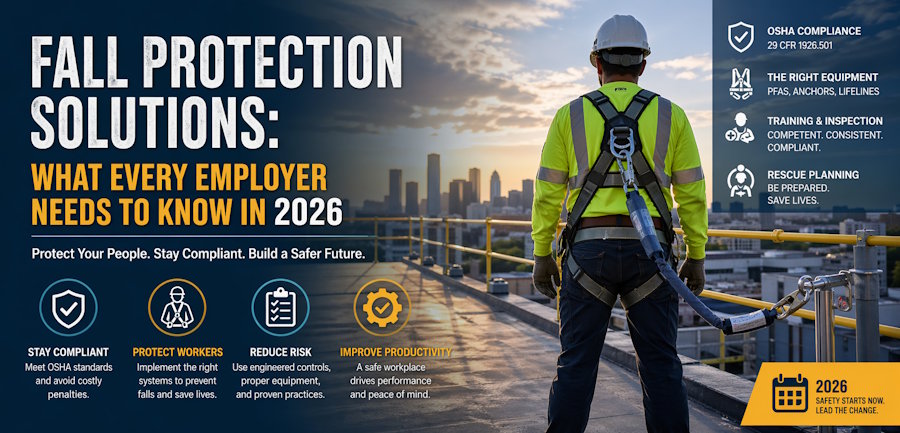
For the fifteenth consecutive year, fall protection has topped OSHA's list of most-cited workplace violations, with 5,914 citations issued in fiscal year 2025 alone. Behind that number is a harder truth: falls remain one of the leading causes of workplace fatalities in the United States, and nearly every incident is preventable. A well-designed fall protection solution is no longer a box-ticking exercise — it is the foundation of a legally compliant, financially sound, and ethically defensible worksite.
What Counts as a Fall Protection Solution
A fall protection solution is an integrated system of engineering controls, personal protective equipment suppliers (PPEs), written procedures, training, and documented rescue planning designed to prevent workers from falling — or, when a fall cannot be prevented, to arrest it safely. It is not a single product. A harness on its own is not a solution; neither is a guardrail without proper installation, inspection, and user training. Compliance comes from the system as a whole.
OSHA enforces two primary frameworks: 29 CFR 1926 Subpart M for construction, which requires fall protection at heights of six feet or more, and 29 CFR 1910 Subpart D for general industry, which triggers at four feet. Shipyards require protection at five feet and longshoring at eight feet. Regardless of height, any worker who could fall onto dangerous machinery or equipment must be protected.
The Hierarchy of Fall Protection
The most important concept in modern safety planning is the hierarchy of fall protection, endorsed by OSHA and codified in ANSI/ASSP Z359 consensus standards. It ranks controls from most effective to least effective:
- Hazard elimination — redesign the task so no one works at height (e.g., ground-level assembly, extendable tools).
- Passive fall protection — guardrails, safety nets, and hole covers that protect workers without requiring action.
- Fall restraint systems — lanyards and anchors that prevent a worker from reaching an edge in the first place.
- Fall arrest systems — personal fall arrest systems (PFAS) that stop a fall already in progress.
- Administrative controls — warning lines, safety monitors, and written procedures used only when higher controls are not feasible.
A mature fall protection program always asks the question in that order. Jumping straight to harnesses and lanyards without first considering elimination or passive protection is where most compliance failures begin.
Components of a Personal Fall Arrest System (PFAS)
When fall arrest is the chosen control, the system must include four engineered components, often taught as the ABCDs of fall protection:
- Anchorage — a certified anchor point rated for 5,000 lbs per worker, or engineered to a 2:1 safety factor under ANSI Z359.
- Body support — a full-body harness that distributes arrest forces across the thighs, pelvis, chest, and shoulders.
- Connectors — shock-absorbing lanyards, self-retracting lifelines (SRLs), or rope grabs that join the harness to the anchor.
- Deceleration device — the energy absorber that limits arrest forces to 1,800 lbs or less, protecting the worker's spine and internal organs.
Every PFAS must also account for fall clearance (the vertical distance needed to stop a fall without hitting a lower level) and swing fall hazards (lateral movement caused by an off-angle anchor point). Both are routine sources of serious injury even when equipment is "in use."
Passive Solutions: Guardrails, Nets, and Covers
Where feasible, passive systems outperform PFAS because they require no worker action. Guardrail systems must withstand 200 lbs of outward force and include a top rail, mid-rail, and toe-board. Safety net systems must be installed no more than 30 feet below the working surface and extend at least 8 feet beyond the edge. Hole covers must be marked and capable of supporting twice the intended load.
Industry-Specific Applications
Different worksites demand different solutions. Roofing and residential construction typically rely on PFAS combined with warning lines. Warehousing and manufacturing use guardrails around mezzanines, pits, and loading docks. Wind energy and telecommunications depend on vertical lifelines, rope access systems, and rescue-capable SRLs. Oil and gas facilities frequently require horizontal lifeline systems that allow workers continuous tie-off across long runs.
Training, Inspection, and Rescue
Equipment without training is a liability. OSHA requires that every exposed worker be trained by a competent person, and that PFAS components be inspected before every use and formally recertified at least annually. Just as critical, and often overlooked, is a documented rescue plan. A worker suspended in a harness can develop suspension trauma within minutes, so employers must be able to retrieve a fallen worker rapidly — not wait for emergency services.
The Cost of Getting It Wrong
OSHA's maximum penalty for a willful or repeat fall protection violation reached $165,514 in 2025, and multi-citation inspections routinely push total penalties into seven figures. Add workers' compensation increases, stop-work orders, and placement in the Severe Violator Enforcement Program, and the math becomes obvious: the right fall protection solution costs a fraction of a single preventable incident.
Protecting workers at height is not about equipment alone. It is about building a system — and committing to the discipline that keeps that system working every single shift.

