

Not all waterfronts are created equal. While a quiet, sheltered cove might offer a forgiving environment for marine construction, many properties are situated on shorelines that act like battlegrounds. High-velocity river currents, massive tidal swings, hurricane-force winds, and brutal winter ice present formidable challenges that standard decking simply cannot survive.
Building a structure that extends out into these extreme conditions requires advanced engineering and cutting-edge materials. From a professional perspective, designing for durability in extreme conditions is an art form. Here is a look at the innovative dock designs and strategies a professional Floating dock builder utilizes to conquer the world’s most harsh marine environments.
Flow-Through Decking for Storm Surges
In coastal environments prone to hurricanes or massive tidal swells, the upward force of water is the dock's greatest enemy. When a storm surge hits a traditional solid wood deck, the water has nowhere to go. It slams into the bottom of the boards, acting like a giant sail, and literally blows the decking off the frame or lifts the pilings right out of the ocean floor.
To combat this, a modern dock builder utilizes "flow-through" or grated decking. Made from incredibly strong polypropylene or reinforced composite mesh, these panels feature open slots that allow water, wind, and sunlight to pass directly through the surface. When a storm surge hits, the energy is instantly dissipated through the grates, dramatically reducing the upward pressure on the structure and saving the dock from catastrophic failure.
Articulating Floating Systems for Extreme Tides
If you live on a coastal bay or a river with massive seasonal water fluctuations, a fixed piling dock will quickly become useless. At low tide, your boat will be dangling in the air; at high tide, your dock will be completely submerged.
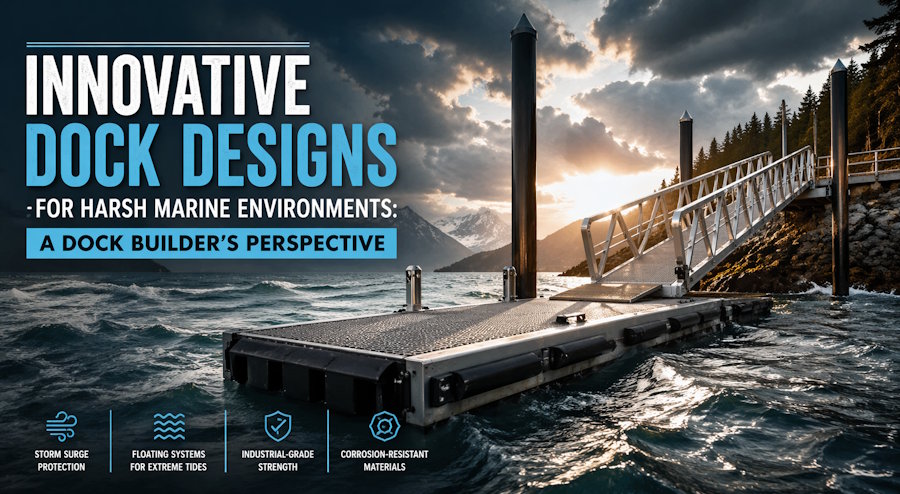
The innovative solution is an articulating floating dock system. A skilled dock builder will engineer a heavy-duty ramp (gangway) connected to the mainland on a specialized hinge. This gangway leads down to a buoyant platform anchored by tall, heavy-duty guide pilings. As the water level rises and falls, sometimes by 10 to 15 feet in extreme tidal zones, the dock simply slides up and down the pilings, ensuring safe, level access to your vessels regardless of the tide chart.
Deep-Driven Steel and Concrete Substructures
In environments with punishing currents, heavy ice flow, or commercial-level wakes, standard wooden pilings will eventually snap or rot, no matter how heavily they are treated. For the ultimate in harsh-environment survival, builders turn to industrial-grade substructures.
A professional dock builder tackling extreme conditions will often abandon wood entirely for the foundation. Instead, they will utilize heavy-gauge galvanized steel pilings driven deep into the bedrock, or custom-poured concrete pilings. These materials are impervious to marine borers (underwater pests that eat wood), can withstand massive lateral impacts from ice floes, and provide a rigid, immovable foundation for the upper decking.
Advanced Marine Composites against Corrosive Saltwater
Saltwater is one of the most corrosive substances on earth. It rapidly accelerates the degradation of organic materials and standard metals. Designing a dock for an oceanfront property means selecting materials that are chemically inert to salt.
Today’s leading builders utilize advanced PVC and mineral-based composite decking boards that contain absolutely zero organic wood fiber, meaning they cannot rot, swell, or splinter from saltwater exposure. Furthermore, every hidden structural bracket, bolt, and joist hanger is upgraded to 316-grade stainless steel or specialized heavy-duty polymer hardware, ensuring the skeleton of the dock remains as strong as the day it was built.
Conclusion
A harsh marine environment doesn't mean you can't have a beautiful, functional waterfront space; it just means you need superior engineering. By utilizing innovations like flow-through decking, heavy-duty floating systems, and industrial-grade materials, a professional dock builder can construct a waterfront oasis that defies the elements. When you build with the environment in mind, you secure an investment that will outlast the fiercest storms.
Frequently Asked Questions (FAQ)
Is flow-through decking comfortable to walk on barefoot?
Yes. High-quality flow-through panels are designed with smooth, rounded edges and anti-slip textures. They are surprisingly comfortable for bare feet and have the added benefit of staying much cooler in the summer sun than solid wood or dark composite.
Do floating docks feel unstable in rough water?
A poorly designed floating dock will bounce wildly, but a professionally engineered floating system uses large, weighted flotation tubs and strict internal framing to create a highly stable platform that absorbs and mitigates wave action effectively.
Why use stainless steel hardware if it is so much more expensive?
In a harsh marine environment, especially saltwater, standard galvanized hardware will rust and fail within a few years. Spending the extra money on 316-grade stainless steel during construction prevents the entire dock from collapsing due to rusted, broken bolts down the line.

