

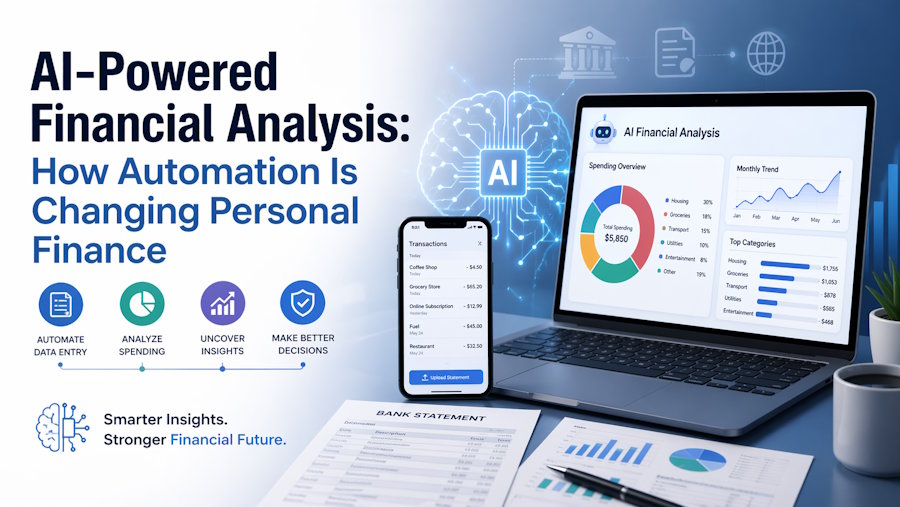
Managing personal finances has always required time, attention, and discipline. From tracking expenses to building budgets, the process can quickly become overwhelming—especially when dealing with multiple bank accounts, formats, and transaction histories. This is exactly where ai-powered financial analysis is reshaping the way people interact with their money.
Instead of manually reviewing statements or inputting data into spreadsheets, modern solutions allow users to upload financial documents and receive structured insights within minutes. Platforms like demonstrate how automation can simplify even the most time-consuming aspects of financial tracking.
What makes this shift significant is not just speed, but accessibility. Financial analysis is no longer limited to professionals or complex tools. It is becoming part of everyday decision-making.
What Is an AI-Powered Financial Analysis Tool and How Does It Work?
An ai-powered financial analysis tool is designed to process financial data automatically and turn it into meaningful insights. Instead of requiring manual input, it extracts information directly from uploaded documents such as bank statements, CSV files, or spreadsheets.
The process is straightforward but powerful. Once a file is uploaded, Finance Web Development systems analyze transactions, identify merchants, and categorize spending patterns. This happens in seconds, even for large datasets that would normally take hours to review manually.
The key advantage lies in pattern recognition. AI systems can detect recurring expenses, identify unusual spending behavior, and group transactions into logical categories such as housing, groceries, or entertainment. This creates a structured overview of financial activity without requiring technical knowledge from the user.
Over time, this approach not only saves time but also improves accuracy. Manual tracking often leads to missed entries or inconsistent categorization, while automated systems maintain consistency across all data.
Why AI-Powered Tools for Global Financial Analysis Are Becoming Essential
As financial activity becomes more complex, especially for users managing multiple accounts or currencies, the need for ai-powered tools for global financial analysis continues to grow.
Modern users are no longer limited to a single bank or financial system. Freelancers, remote workers, and international users often operate across different platforms and currencies. Traditional tools struggle to handle this complexity efficiently.
AI-driven solutions address this challenge by standardizing data regardless of its source, making Website and Customer Portals Integration much smoother and more efficient. Whether the input is a PDF statement, an Excel file, or a transaction export, the system can process and organize it into a unified structure.
This global adaptability is one of the defining strengths of AI-based financial tools. It allows users to maintain a clear overview of their finances without worrying about format compatibility or manual consolidation.
At the same time, these tools are designed to remain intuitive. Users do not need advanced financial knowledge to interpret the results. Dashboards, summaries, and categorized insights make the data easy to understand and act on.
From Raw Data to Actionable Insights
One of the biggest advantages of ai-powered financial analysis is its ability to transform raw data into something useful. Bank statements, by themselves, are often difficult to interpret quickly. They contain large amounts of information, but little structure for decision-making.
AI changes this by organizing transactions into clear categories and presenting them in a way that highlights trends and patterns. Instead of scanning through hundreds of entries, users can immediately see where their money is going.
This shift from data to insight is what makes automation so valuable. It allows users to focus on decisions rather than processing information. For example, identifying overspending in a specific category becomes almost instant, enabling faster adjustments.
Over time, this leads to better financial habits. When insights are easy to access, they are more likely to be used.
Eliminating Manual Work in Budgeting
Traditional budgeting methods often rely on spreadsheets or manual tracking. While these approaches can be effective, they require consistent effort and attention. Missing a single entry can disrupt the entire system.
An ai-powered financial analysis tool removes this burden by automating the most repetitive parts of the process. Instead of entering data manually, users can upload their statements and receive a complete overview within minutes.
This automation does not just save time—it reduces friction. The easier it is to track finances, the more likely users are to maintain the habit. In this sense, AI is not just improving efficiency; it is making financial management more sustainable.
Another important aspect is flexibility. Users can upload multiple files at once, including different formats, without needing to convert or prepare them in advance. This makes the process seamless, even for those with complex financial setups.
Accuracy and Consistency in Financial Tracking
One of the challenges of manual financial analysis is inconsistency. Different transactions may be categorized differently over time, leading to inaccurate summaries.
With ai-powered tools for global financial analysis, categorization is standardized. The system applies the same logic across all transactions, ensuring that similar expenses are grouped consistently.
This consistency improves the reliability of insights. When users review their spending, they can trust that the data reflects actual patterns rather than inconsistencies in input.
Accuracy is further enhanced by the system’s ability to recognize merchants and transaction types automatically. This reduces the need for manual corrections and minimizes the risk of errors.
Privacy and Security in AI Financial Tools
Handling financial data requires a high level of security, and modern platforms are designed with this in mind. Privacy is not an optional feature—it is a core requirement.
Most ai-powered financial analysis solutions operate within secure environments where data is processed temporarily and then removed. Files are not stored permanently, and access is limited to the duration of the session.
This approach ensures that users maintain control over their information. It also reduces the risk associated with long-term data storage.
For many users, this level of privacy is what makes AI tools viable. The ability to gain insights without sacrificing security creates a balance that traditional tools often struggle to achieve.
Who Benefits from AI-Powered Financial Analysis?
The applications of ai-powered financial analysis extend across different user groups.
Individuals can use it to track personal expenses, identify spending patterns, and build more effective budgets. The simplicity of the process makes it accessible even for those without financial expertise.
Freelancers and remote workers benefit from the ability to analyze income and expenses across multiple sources. This is particularly useful for tax preparation and financial planning.
Small business owners can use these tools to gain a clearer understanding of cash flow and operational expenses. While not a replacement for full accounting systems, AI analysis provides a quick and efficient overview.
In all cases, the goal is the same: turning financial data into something that can guide decisions.
The Future of Financial Analysis
The growth of ai-powered tools for global financial analysis reflects a broader trend toward automation in everyday tasks. As technology continues to evolve, these tools will become even more integrated into financial workflows.
Future developments are likely to include deeper insights, predictive analysis, and more personalized recommendations. Instead of simply showing what has happened, systems may begin to suggest what actions to take next.
At the same time, the focus on simplicity will remain. The most effective tools are those that deliver value without adding complexity. This balance between power and usability is what defines successful platforms.
Final Thoughts
The shift toward ai-powered financial analysis is not just about technology—it is about changing how people interact with their finances. By removing manual work and simplifying data interpretation, these tools make financial management more accessible and efficient.
An ai-powered financial analysis tool allows users to move beyond spreadsheets and fragmented data, providing a clear and structured view of their financial activity. Combined with the capabilities of ai-powered tools for global financial analysis, this creates a system that adapts to modern financial behavior.
In a world where time and clarity are increasingly valuable, automation is not just a convenience—it is becoming a necessity.

