

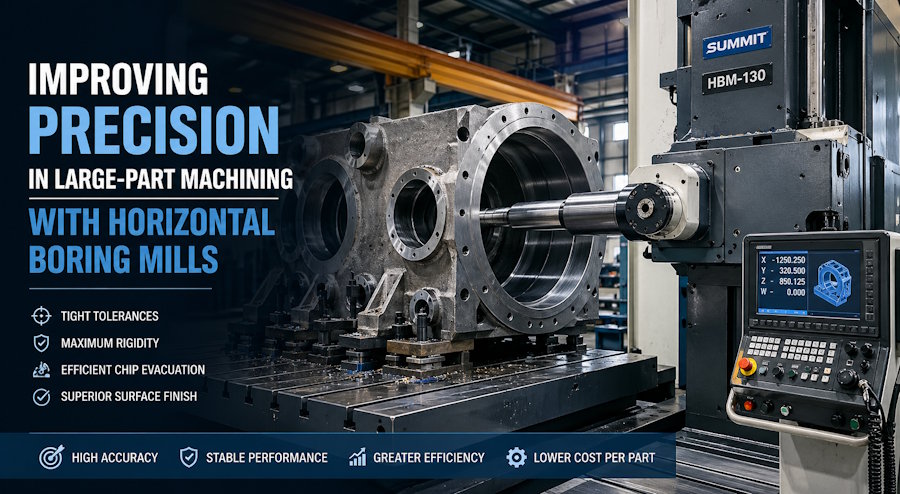
If you've ever watched a multi-ton casting get scrapped because a tolerance drifted by a few thousandths over a six-foot bore, you know exactly how unforgiving large-part machining can be. The bigger the part, the higher the stakes - and the less room you have for error.
That's where horizontal boring mills earn their place on the shop floor. For manufacturers working with oversized components that demand tight tolerances across extended dimensions, these machines aren't just useful - they're often the only practical option.
Why Large-Part Machining Is a Different Challenge Entirely
Large components don't just scale up the problems you'd see in smaller machining operations - they introduce entirely new ones.
Material deflection, thermal expansion, and maintaining dimensional consistency across several feet of surface are challenges that don't really exist at smaller scales. A part that weighs several tons needs robust support to prevent sagging during the cut. Even a slight shift mid-operation can push you out of tolerance and turn an expensive workpiece into expensive scrap.
Vertical machining centers struggle here. Limited spindle reach and inadequate support for heavy components make them a poor fit for large-part work. The horizontal orientation changes the equation - you get better rigidity, better chip evacuation, and a setup that's built to handle the kind of cutting loads that would challenge a less rigid machine.
How Horizontal Boring Mill Design Works in Your Favor
The horizontal spindle isn't just a configuration choice - it's what makes precision possible at this scale.
When the spindle runs horizontally, gravity works with you instead of against you. Chips fall away from the cutting zone naturally rather than piling up around the tool. That matters more than it sounds: chip recutting accelerates tool wear, generates heat, and introduces dimensional inconsistency over long cycles. Clean chip evacuation keeps your tool sharper longer and your dimensions tighter throughout the run.
The table and column design adds another layer of stability. That structural rigidity dampens vibration during heavy cuts and holds positioning accuracy even under load - which translates directly to better surface finish and tighter tolerances on the finished part.
One more advantage you'll appreciate in production: spindle accessibility. With a horizontal boring mill, you can machine multiple faces of a workpiece without repositioning it. Fewer setups means fewer opportunities for cumulative positioning errors to stack up.
The Precision Factors That Actually Matter
Getting tight tolerances on large parts comes down to controlling a handful of variables that don't always get the attention they deserve.
Temperature is the one that catches people off guard. Large components have substantial thermal mass, and even modest temperature swings in the shop can cause significant dimensional changes across several feet of material. Proper coolant management and a controlled environment aren't optional on critical jobs - they're part of the process.
Tool deflection gets worse as you extend reach. Long boring bars are necessary for deep cavities, but they introduce deflection that eats into your tolerance budget. Keeping length-to-diameter ratios in check and using high-quality tool holders with solid clamping mechanisms makes a real difference. Modern horizontal boring mills often include advanced tool holder systems specifically designed to minimize deflection at extended reach.
Machine calibration needs more frequent attention in large-part applications than in standard machining. Laser interferometry and ballbar testing give you an accurate picture of positioning accuracy and machine geometry - don't skip these checks.
Workholding can make or break a job. A poorly designed fixture that clamps unevenly will distort the workpiece, and you won't know it until you're measuring a finished part that's out of spec. Modular fixturing systems let you build setups that distribute clamping forces properly while keeping things repeatable from part to part.
Setting Up for Success
Precision machining at this scale starts before the first cut. A rushed setup is the most expensive mistake you can make.
Start with part alignment. Dial indicators and coordinate measuring equipment tell you whether the workpiece is positioned correctly - take the time to get it right rather than chasing errors downstream. Establishing solid, repeatable reference points gives you a consistent coordinate system that carries through every operation.
Tool preparation deserves the same attention. Proper presetting, runout verification, and accurate tool length measurement prevent the kind of dimensional errors that surface finish can't hide. If you're running deep cavities or extended reach operations, this step isn't optional.
Run your program through simulation software before you cut. It takes time up front, but catching a programming error in simulation is a lot cheaper than catching it in a finished part.
Measurement and Quality Control
You shouldn't have to pull a part off the machine to know whether it's in spec.
Touch probes and on-machine measurement systems let you verify critical dimensions in real time, which is especially valuable on long-cycle operations. Catching a drift early means you correct it early - instead of scrapping a part that took 12 hours to machine.
CMM integration handles comprehensive dimensional verification once the part is complete. Modern systems can accommodate large components and generate detailed reports on dimensional accuracy and geometric tolerances, which are useful for both quality assurance and process improvement.
Statistical process control (SPC) gives you a longer view. Tracking key dimensions over time helps you spot trends before they become rejections and make proactive process adjustments rather than reactive ones.
Don't overlook documentation. For large, expensive components, detailed records of machining parameters, tool usage, and measurement results aren't just good practice - they're often a customer requirement.
Keeping the Machine in Shape
Sustained precision requires sustained maintenance. Large-part machining is demanding, and the machines that do it need consistent attention.
Inspect way covers, spindle bearings, and linear guides regularly. These are the components most likely to show wear in heavy-use applications, and catching wear early keeps it from becoming an accuracy problem. Verify machine geometry at set intervals - positioning accuracy drifts over time, and you want to catch it before it shows up in your parts.
Coolant system maintenance is easy to overlook but directly affects both tool life and surface finish. Contaminated or improperly mixed coolant reduces lubrication effectiveness and can introduce part quality problems that are hard to trace back to the real cause.
Temperature stability and vibration isolation in your shop environment matter more than most people expect for long-term precision. Controlling these factors consistently helps you maintain machining accuracy across extended production runs.
Getting the Most Out of Your Investment
Horizontal boring mills represent a significant capital investment, and the shops that get the most from them treat precision as a system - not just a machine capability.
That means dialing in your setup procedures, maintaining your measurement systems, keeping your machine calibrated, and making sure your operators understand the variables that affect accuracy at this scale. The machine provides the platform; everything else is how you use it.
As automation and digital monitoring continue to evolve, large-part machining is getting more capable and more efficient. Real-time performance data enables predictive maintenance and process optimization that wasn't practical a decade ago. The fundamentals haven't changed, but the tools available to support them keep improving.
If you're regularly machining large, complex components with tight tolerances, the right horizontal boring mill - properly set up and maintained - is what makes hitting those specs consistently possible.

