

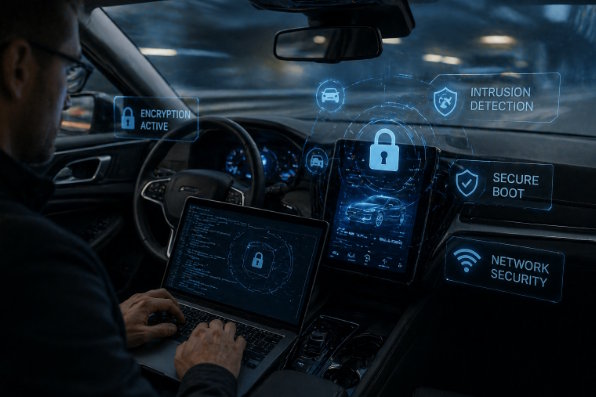
Cars are no longer purely mechanical systems. Over the past decade, they have quietly transformed into highly connected digital platforms—computers on wheels, constantly communicating with satellites, smartphones, infrastructure, and cloud-based services.
This connectivity has improved navigation, safety, convenience, and efficiency. But it has also introduced a new category of risk that traditional automotive engineering never had to consider: cybersecurity.
As vehicles become more software-dependent, the question is no longer just how they perform on the road, but how securely they operate within an increasingly digital ecosystem.
The Modern Car as a Connected System
A contemporary vehicle contains dozens of electronic control units (ECUs), each responsible for different functions—engine management, braking, infotainment, steering assistance, and more.
In models such as the BMW i4 or the Mercedes-Benz EQS, these systems are deeply integrated with internet connectivity, enabling over-the-air updates, real-time diagnostics, and cloud-based services.
This level of integration improves performance and user experience, but it also expands the potential attack surface. Where once a car was isolated, it is now part of a network.
What Cybersecurity Means in Automotive Engineering
Cybersecurity in vehicles is not about traditional viruses or simple hacking attempts. It is about protecting complex systems that control physical movement.
A breach in a connected car could theoretically affect braking systems, steering assistance, or sensor data. While such scenarios remain rare, the potential consequences make prevention a critical priority in modern automotive design.
To address this, manufacturers are adopting layered security models that mirror those used in banking and aerospace systems.
Secure Boot and System Integrity
One of the foundational concepts in automotive cybersecurity is “secure boot.”
This ensures that when a vehicle starts, only verified and trusted software is allowed to run. If an unauthorised or corrupted file is detected, the system prevents it from loading.
This protects against tampering at the most fundamental level of vehicle operation. Without secure boot, malicious software could potentially gain control before higher-level protections activate.
Encryption and Data Protection on the Move
Connected vehicles constantly transmit data—navigation requests, diagnostic information, infotainment usage, and sometimes driver behaviour metrics.
Encryption ensures that this data cannot be easily intercepted or altered during transmission. Modern vehicles use advanced cryptographic protocols to secure communication between internal systems and external servers.
This is particularly important in electric and autonomous-capable vehicles like the Tesla Model Y, where software updates and remote diagnostics are a core part of ownership.
Without encryption, even routine data exchanges could become vulnerabilities.
The Rise of Intrusion Detection Systems
As cybersecurity threats become more sophisticated, manufacturers are increasingly deploying intrusion detection systems (IDS) within vehicles.
These systems monitor internal network activity in real time, looking for unusual patterns that could indicate an attempted breach. If suspicious behaviour is detected, the system can isolate affected components or alert the driver.
Unlike traditional cybersecurity tools, automotive IDS must operate in real time with extremely low latency, since delays could affect vehicle safety.
Over-the-Air Updates: Convenience and Risk
Over-the-air (OTA) updates have become a standard feature in modern vehicles. They allow manufacturers to improve performance, fix bugs, and add features without requiring a dealership visit.
However, this same capability introduces a potential entry point for attackers if not properly secured.
For this reason, OTA systems are heavily encrypted and authenticated. Every update must be verified before installation, ensuring it originates from a legitimate source.
The convenience of OTA updates depends entirely on the strength of this verification process.
Autonomous Systems and Expanded Vulnerability
As vehicles move toward higher levels of autonomy, cybersecurity becomes even more critical.
Autonomous and semi-autonomous systems rely heavily on sensors, cameras, radar, and machine learning models to interpret the environment. If any of these inputs were compromised, even slightly, the system’s decisions could be affected.
This is why redundancy and cross-verification are essential. No single sensor is trusted in isolation; systems are designed to validate data through multiple independent sources.
Human Behaviour as a Security Factor
Not all cybersecurity risks come from external attackers. Human behaviour remains one of the most common points of vulnerability.
Weak passwords, unsecured mobile apps, and improper use of connected features can all create entry points for exploitation.
Manufacturers are increasingly designing systems that reduce reliance on user-managed security settings. Instead, they build default protections into the vehicle architecture itself.
The Role of Automotive Design in Digital Security
Interestingly, cybersecurity is now influencing physical vehicle design as well.
Separation of critical systems is becoming standard practice. Infotainment systems are increasingly isolated from core driving functions, ensuring that even if one system is compromised, it cannot directly affect safety-critical operations.
This architectural separation is one of the most important developments in modern automotive engineering.
Trust, Identity, and the Connected Vehicle
As cars become more digital, ownership also becomes more identity-linked. Vehicles are now associated with user profiles, cloud accounts, and personalised settings that persist across devices and platforms.
This creates a broader question of trust. Drivers are no longer just trusting a manufacturer—they are trusting an entire digital ecosystem.
Even external elements of vehicle identity, such as personalisation choices, sit within this wider context of digital ownership. For drivers investing in personalisation, companies like Number 1 Plates have seen interest from motorists who want their vehicles to reflect individual identity within an increasingly standardised digital automotive landscape.
While physical details may seem separate from cybersecurity, they exist within the same evolving ecosystem of vehicle identity and data integration.
The Future of Automotive Cybersecurity
Looking ahead, cybersecurity will likely become as fundamental to vehicle design as crash safety once was.
Artificial intelligence will play a growing role in detecting threats, predicting vulnerabilities, and responding to attacks in real time. Vehicles will not just be protected—they will actively adapt to potential risks.
At the same time, regulatory frameworks are expected to become stricter, requiring manufacturers to meet defined cybersecurity standards before vehicles can be sold.
Conclusion
The modern car is no longer just a mechanical product. It is a connected, evolving digital system operating within a broader network of devices, infrastructure, and services.
With that transformation comes responsibility. Security is no longer an optional layer—it is a core requirement of automotive engineering.
From encryption and secure boot processes to intrusion detection systems and isolated architecture, vehicles are being reimagined not only for performance and efficiency, but for resilience in a digital world.
As mobility becomes increasingly connected, the future of driving will depend not just on how cars move—but on how safely they think, communicate, and protect themselves along the way.

