

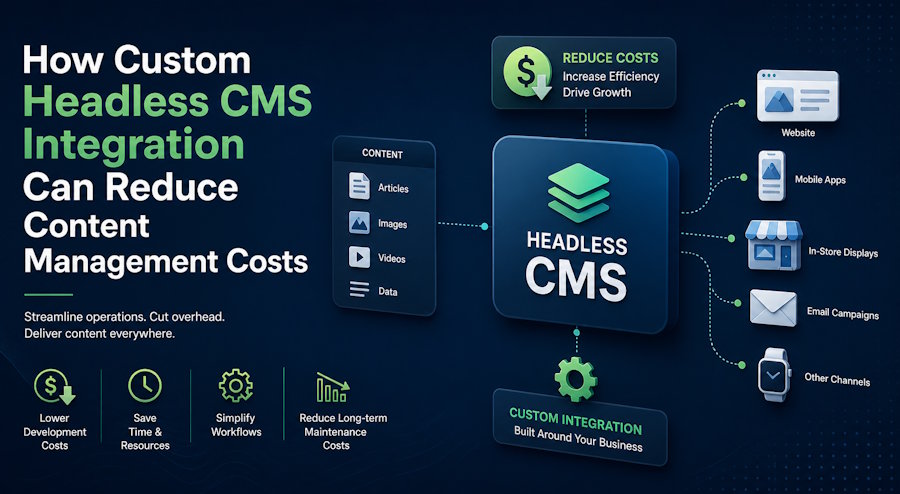
Most content teams don't figure out how much money they're losing until someone actually traces where the hours disappear. It's the developer getting dragged into a landing page edit that should've taken ten minutes. It's the same blog post being copied and pasted into four different platforms because nothing is connected.
It's the agency retainer that exists for no reason other than the CMS being too locked down for anyone on the marketing side to touch without breaking something. Each of these feels manageable on its own. Together, they're a slow drain, and nearly all of it comes back to one thing: a content setup that was designed around a platform, not around how the team actually works.
That's what makes custom headless CMS integration worth talking about.
Uncover the Hidden Content Management Costs Draining Your Budget
The first thing most companies do when they review content management spend is pull up the invoice platform license, hosting, maybe a developer sprint here and there. That's the visible part. The expensive part tends to be invisible.
It's the hour a content editor loses every time they need someone technical to approve a simple change. It's the campaign that slips two weeks because the CMS can't reach a new channel without a custom build nobody scoped for. It's two separate teams maintaining two separate systems that are somehow supposed to carry the same content, and neither one ever quite matches the other. None of that shows up on a line item. It shows up in delays, in frustration, and in the slow erosion of what the team can actually get done in a week.
Traditional CMS platforms wire the backend, where content lives directly to the frontend, where it appears. That connection is convenient until it isn't. Touch one side, and something unexpected happens on the other. Add a new channel, and you're looking at another build, another integration, another thing to maintain, and another thing that can eventually break.
Use Headless CMS Architecture to Streamline Operations and Cut Overhead
Going headless means separating the content repository from the presentation layer entirely. Content lives in one place and gets delivered wherever it needs to go via APIs, website, app, in-store display, email platform, or whatever the business is running. The content team manages one source of truth. The development team isn't rebuilding delivery logic every time a new channel appears.
That architectural shift has real financial implications. Content that used to require a developer to publish can be handled by the people who actually write it. Updates that used to mean touching multiple systems can happen once. Campaigns that used to take two weeks to coordinate across platforms can move faster because the infrastructure isn't fighting against the process.
The cost reduction isn't theoretical. It shows up in reduced developer hours, fewer agency engagements for routine work, and content teams that can actually operate at the speed the business needs without filing support tickets to do it.
Why Custom Integration Is the Part That Matters
Off-the-shelf headless CMS platforms are genuinely good now. Contentful, Sanity, and Strapi have solved a lot of the hard problems. But the platform is only part of the equation. How it connects to everything else in your stack is where most of the value, and most of the cost savings, actually, live.
A headless CMS that sits in isolation doesn't fix much. The savings come from integration, connecting the CMS to your commerce platform so product content stays consistent, to your analytics tools so the content team has visibility into what's performing, to your personalization layer so the right content reaches the right people without manual intervention. Each of those connections, built properly, eliminates a category of manual work that someone on your team is currently doing by hand.
This is also where generic implementations fall short. A standard setup gets you the platform configured and the basic API connections running. A custom integration gets built around how your team actually works, your approval workflows, your publishing cadence, and your specific channel requirements. That difference is what turns a headless CMS from a technical improvement into an operational one.
How Much Could Your Business Save by Reducing CMS Maintenance Complexity?
One of the underappreciated cost arguments for going headless is what happens to maintenance over time. Traditional CMS platforms accumulate technical debt in ways that are slow to show up but expensive to fix, plugin dependencies that conflict, frontend updates that break backend behaviour, and customizations that need to be rebuilt every time the platform releases a major version.
A well-architected headless setup decouples those concerns. The frontend can evolve independently of the content layer. Platform updates on the CMS side don't cascade into frontend rebuilds. The surface area for things to go wrong shrinks, and the work required to keep everything running stays more predictable. For businesses that have been through a painful CMS migration driven by accumulated technical debt, that predictability is worth real money.
Build a Cost-Efficient Headless CMS Foundation with RBMSoft
The cost argument for headless CMS only holds if the integration is done properly from the start. Poorly modelled content, rushed API connections, and a setup that wasn't built around the team using it will create a different set of costs, just newer ones.
RBMSoft being the top headless CMS vendor starts with the operational reality first, how content actually moves through your business, where the manual work lives, and what the system needs to do before a single line of code gets written. That groundwork is what makes the difference between an implementation that reduces costs and one that just shifts where they show up. For businesses serious about getting that return, RBMSoft builds the kind of foundation that makes it possible.

